
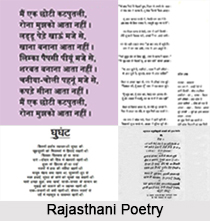
 Rajasthani poetry mostly comprises poetry right from its nascent stage. Rajasthani poetry has been often divided into five major types: (1) Jain (2) Charan (3) Akhyan (4) Sant (5) Laukik, including secular love.
Rajasthani Poetry
Rajasthani Poetry has flourished both in ancient and medieval literature and now in modern age also. Rajasthani poetry has played an important role in shaping the literary history of Rajasthan.
Introduction
Rajasthani poetry mostly comprises poetry right from its nascent stage. Rajasthani poetry has been often divided into five major types: (1) Jain (2) Charan (3) Akhyan (4) Sant (5) Laukik, including secular love.Early History of Rajasthani Poetry
Rajasthan Poetry is the land of the chivalrous. Its poetry too reflected the same sentiments. Initially it was the heroic poetry that shaped the Rajasthani poetry. The language used to narrate the tales of the fearless heroes was Dingal. Besides this other languages, like, the Prakrit-Apabhramsa, Pingal, Maru-Gurjar, Dingal and other colloquial Rajasthani languages. In ancient Rajasthan, the Charan poets or court poets, chroniclers and others were responsible for composing several eulogies that described the heroic deeds of the Rajput kings. Though mostly oral in tradition, the Rajasthani poetry was penned down primarily in the medieval era.
Medieval History of Rajasthani Poetry
Amongst the several forms of Rajasthani poetry, Charan and Akhyan Kavya deserve special mention. Due to traditional ties with the Rajputs, feelings of hero-worship, place and function in the medieval social set up, certain castes, particularly the Charans, were more connected with Charan style of poetry. The other castes include Motisar, Bhat, Rav, Dhadhi etc. Brahmins, Rajputs, Mahajans and others have also made notable contributions to it. Echoes of rivalry, mostly professional, between Charans and Bhats resound in ancient Rajasthani literature. Most Charans used Maru Bhasa or Dingal languages and the Bhats used Pingal for their poetic compositions. But from the 17th century this tendency changed. Many Charans composed poems in Pingal language.
 On the other hand, Akhyan Kavya is another important type of the medieval Rajasthani poetry. Such Kavyas have rendered remarkable cultural service to Hindu society in the medieval times. The themes are taken from the epics or the Indian Puranas and the stories or episodes are popular. An effort is made to render the story in a highly artistic poem, so as to attract the people. It is sung in popular musical modes and its appeal is mainly musical. The dramatic elements are skilfully incorporated. The dialogues are brief, meaningful and effective. The descriptions are pointed, vivid and charming. The language used is necessarily easy and fluent. The Akhyan may, thus, be easily committed to memory and reproduced for wider popularity. Traditionally Akhyan has been connected with religious rites. This was an additional advantage for the propagation of Akhyan Kavyas. Popular entertainment is the objective, but;` indirectly, lofty religious and cultural traditions, ideals, ideas, and values are imparted. Akhyans are generally sung and recited in Jagaran. Many of them may be easily staged in open-air theatres. Akhyans are mostly short, such as Ramayana by Mehoji, Rukmani Mangal by Padam Bhagat but longer Akhyans such as, Katha Ahmani by Delhji have also been written.
On the other hand, Akhyan Kavya is another important type of the medieval Rajasthani poetry. Such Kavyas have rendered remarkable cultural service to Hindu society in the medieval times. The themes are taken from the epics or the Indian Puranas and the stories or episodes are popular. An effort is made to render the story in a highly artistic poem, so as to attract the people. It is sung in popular musical modes and its appeal is mainly musical. The dramatic elements are skilfully incorporated. The dialogues are brief, meaningful and effective. The descriptions are pointed, vivid and charming. The language used is necessarily easy and fluent. The Akhyan may, thus, be easily committed to memory and reproduced for wider popularity. Traditionally Akhyan has been connected with religious rites. This was an additional advantage for the propagation of Akhyan Kavyas. Popular entertainment is the objective, but;` indirectly, lofty religious and cultural traditions, ideals, ideas, and values are imparted. Akhyans are generally sung and recited in Jagaran. Many of them may be easily staged in open-air theatres. Akhyans are mostly short, such as Ramayana by Mehoji, Rukmani Mangal by Padam Bhagat but longer Akhyans such as, Katha Ahmani by Delhji have also been written.Jain Poetry in Rajasthan
The Jain poetry that formed the bulk of ancient Rajasthani poetry was mainly composed by the Jain saints. Religious in nature, these verses were quite popular and are a part of Rajasthani tradition. Emotions of love and separation, remorse, heroism, pride, prudence, and accounts of heroic deeds of both men and women form the subject matter of the love poems from Rajasthan. Secular poems were also a part of these verses. Some verses have been quoted in more than one work mentioned above due to the popularity of their appeal. Some of them, developed in Rajasthani form, are still popular amongst the common folk. Many of them have also been adopted in substance and given new forms by later Rajasthani poets. This shows the long tradition and mass popularity of such verses.
Sant Poetry of Rajasthan
Besides these the Sant poetry is the product of those adhering to some sects, and those who were unattached and self-willed like Miran, Din Darves and others. The deeds of Divine incarnations also formed the subject matter of such poetry. Thus, such different forms of Rajasthani poetry went further enriched Rajasthani literature.
Charan Poetry in Ancient Rajasthani Literature
Charan poetry is available in the form of stray verses quoted in the Apabhramsa `Grammar` of Hemcandra and the Jain `Prabhandhas`. They are mostly in the Western Apabhramsa but some are akin to the then developing Rajasthani with a touch of Apabhramsa. Such verses deal with laudatory, historical and heroic deeds, amorous feelings, and objective descriptions, moral and religious topics. This kind of poetry is preceded by verses of the following type. They are the utterances of known or unknown Charans or Bhats. Names of some Charans are Phuman, Ramcandra, Gagil, and Hatti Pravist.
The characters of the Charan poems include a blending of the erotic and the pathetic with the heroic emotions. Subtle touches of sringar have often been given in some poems. In these poems heroic emotions were expressed and statements of tradition made in abundance by poets of this style. Lions, boars, elephants, bullocks, aquilas and cobras were used respectively as symbols of firmness, gigantism, hardiness, vigour, swift movement and assault and wrath.
Sridhar Vyas is the earliest Charan poet of significance of this period who has contributed to both the major types of Charan poetry namely, the historical and heroic and the mythological and religious. His poems are Ranmall Chand, Saptsati ra Chand and Kavitt Bhagwat. Ranmali Chand is a historical poem. It depicts heroic characters and describes the battle which Rav Ranmali Rathore of Idar fought against Zafarkhan, the Governor of Gujarat, when the latter invaded Idar in 1398. The poem was composed in 1400.
Its alliterative and tinnitus diction, and vivid description of battle makes it a poem of distinction. Some Persian and Arabic words have also been used. In fact, the use of such words in describing battles and in dialogues with the Mohammedans is a common tendency of Charan poetry.
The Saptsati is a heroic poem based on the Durga-Sapt-sati which is part of the Markandey Puran and, as such, there is no originality in the subject matter. But from the point of view of antiquity, language, style and tradition, it is an important work. The poet is more interested in descriptions of all sorts than in the story which is feebly linked. This characteristic and the penchant for Sanskrit diction are also noticeable in a later poem Veli Krisan-Rukmaniri by Prthviraj Rathore. Sapt-sati`s language and metre-scheme are similar to that of Ranmall Chand.
Kavitt Bhagwat is based on the 10th skandh of the Bhagwat Puran. These poems are the earliest specimens of mythological poems of the Charan style. In the characterisation of Charan poems, depth and loftiness of sentiments prevail. Literary embellishment is not so significant. Actions of the Rajputs are motivated by their love for freedom, honour and dignity. Some of the Charan poems bear a mythological style and have discussed several mythological events in its vivid description.
The Vacanika is a milestone in the Charan poetry. The creation of the work and the occurrence it depicts were almost contemporary. As far as the mythological and religious poetry in the Charan style is concerned, Sridhar Vyas`s two creations are the only ones available in the Early Period.
The characters of the Charan poems include a blending of the erotic and the pathetic with the heroic emotions. Subtle touches of sringar have often been given in some poems. In these poems heroic emotions were expressed and statements of tradition made in abundance by poets of this style. Lions, boars, elephants, bullocks, aquilas and cobras were used respectively as symbols of firmness, gigantism, hardiness, vigour, swift movement and assault and wrath.
Sridhar Vyas is the earliest Charan poet of significance of this period who has contributed to both the major types of Charan poetry namely, the historical and heroic and the mythological and religious. His poems are Ranmall Chand, Saptsati ra Chand and Kavitt Bhagwat. Ranmali Chand is a historical poem. It depicts heroic characters and describes the battle which Rav Ranmali Rathore of Idar fought against Zafarkhan, the Governor of Gujarat, when the latter invaded Idar in 1398. The poem was composed in 1400.
Its alliterative and tinnitus diction, and vivid description of battle makes it a poem of distinction. Some Persian and Arabic words have also been used. In fact, the use of such words in describing battles and in dialogues with the Mohammedans is a common tendency of Charan poetry.
The Saptsati is a heroic poem based on the Durga-Sapt-sati which is part of the Markandey Puran and, as such, there is no originality in the subject matter. But from the point of view of antiquity, language, style and tradition, it is an important work. The poet is more interested in descriptions of all sorts than in the story which is feebly linked. This characteristic and the penchant for Sanskrit diction are also noticeable in a later poem Veli Krisan-Rukmaniri by Prthviraj Rathore. Sapt-sati`s language and metre-scheme are similar to that of Ranmall Chand.
Kavitt Bhagwat is based on the 10th skandh of the Bhagwat Puran. These poems are the earliest specimens of mythological poems of the Charan style. In the characterisation of Charan poems, depth and loftiness of sentiments prevail. Literary embellishment is not so significant. Actions of the Rajputs are motivated by their love for freedom, honour and dignity. Some of the Charan poems bear a mythological style and have discussed several mythological events in its vivid description.
The Vacanika is a milestone in the Charan poetry. The creation of the work and the occurrence it depicts were almost contemporary. As far as the mythological and religious poetry in the Charan style is concerned, Sridhar Vyas`s two creations are the only ones available in the Early Period.
Recently updated articles in Indian Literature
Gadyakarnamrita
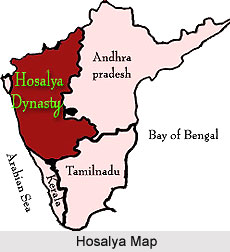
Gadyakarnamrita is a 13th-century Sanskrit literary work written mainly in prose. It describes the ninety-day battle at Srirangam between the Hoysala...
Women Writers in Malayalam Literature
Women writers in Malayalam literature have worked incessantly to make a place for their literary works. In the earlier periods, they were completely o...
Comrade Kirillov, Novel by Raja Rao
Comrade Kirillov, a distinctive creation of Raja Rao, is presented as a brief yet incisive novelette that offers an ironic portrayal of the self-contr...
The Foreigner, Novel by Arun Joshi
“The Foreigner” is a book authored by Arun Joshi and published by Vision. It is an illustrious creation in the entire career of Arun Joshi, the famous...
Short Story in Telugu Literature
Short Story in twentieth century Telugu Literature was extremely popular and growing in and developing in a major way. Their popularity was greatly fa...
Related articles in Indian Literature
Mythological Themes in Indian Literature
Mythological themes in Indian literature have been integral to every ancient and contemporary writer and their path to f
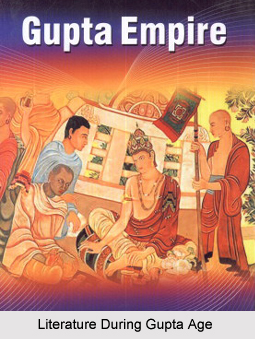
Literature During Gupta Age
It is during the Gupta Age literature in the form of poetry, epos and drama gained a colossal importance.
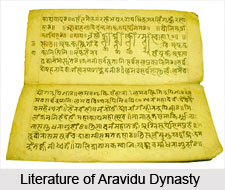
Literature of Aravidu Dynasty
Sanskrit and Telugu were the popular literary medium of communication during Aravidu dynasty.
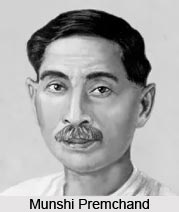
Munshi Premchand
Munshi Premchand was a legendary Indian writer notable for his modern Hindustani literature. A writer of a very high caliber, Premchand`s writings hav...
Sanskrit Poets
The names of some of the Sanskrit Poets are Bharavi, Devarshi Ramanath Shastri, Jayadeva and Srinivas Rath.