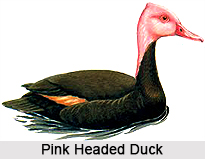
 Pink-Headed Duck is an Indian bird with an scientific name "Rhodonessa caryophyllacea" is a large diving duck that was once found in parts of the Gangetic plains of India (Plains of Ganga River), Bangladesh and in the riverine swamps of Myanmar but feared extinct since the 1950s.
Etymology of Pink-Headed Duck
Pink-Headed Duck was described by John Latham in 1790 under the genus Anas. In describing the species, it is possible that he made of use of a painting in the collection of Lady Impey, wife of Sir Elijah Impey who was Chief Justice of court in Kolkata from 1774 to 1783. Mary Impey maintained a menagerie in Calcutta and commissioned Indian artists such as Bhawani Das from Patna to illustrate animals in the collection. The Impeys moved to England, and after the death of her husband, she sold these paintings at auction in 1810. Some of them were acquired by the 13th Earl of Derby.
 Gender of Pink-Headed Duck
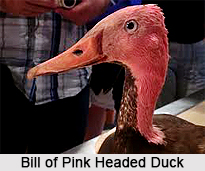
Pink-Headed Duck has the male genre which is unmistakable when a good view is hard. But both sexes are 41-43 cm and long-billed with long necks and peaked heads. The male has a pink bill, head and neck while the female has a pale pinkish head and neck with a paler bill. The black part of the body extends as a narrow strip on the front of the neck. Wings have a leading white edge. In flight it would not contrast as much as the syntopic white-winged duck. Wing does not have the dark trailing edge of the red-crested pochard.
Wings of Pink-Headed Duck
The upper side of the wing of Pink-headed duck is distinguishing, with dark green secondaries (speculum) and prominent white tertiaries in the spot-billed duck and a pinkish-beige speculum, much lighter than its surroundings, in the pink-headed duck. If the upper part of the wings cannot be reliably seen, they are all but indistinguishable except to expert observers in good visibility conditions. Young birds had a nearly whitish head without a trace of pink and a mellow two note call wugh-ah has been attributed to the species.
 Breeding Habitats of Pink-Headed Duck
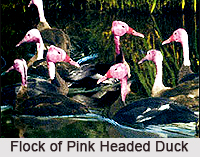
The breeding habitat of Pink-headed duck is lowland marshes and pools in tall-grass jungle. The nest is built amongst grass. The eggs, six or seven in a clutch, are very spherical and creamy white. The eggs measure 1.71 to 1.82 inches long and 1.61 to 1.7 inches wide. They were believed to have been non-migratory and found singly or in pairs and very rarely in small groups. Pink-headed ducks are believed to have eaten water plants and molluscs. Like Netta species, they typically up-ended or dabbled for food and did not dive like a pochard.
Concentration of Pink-Headed Duck
Pink-headed duck is concentrated in the Ganges and west of the Brahmaputra, mainly in Maldah, Purnea, Madhubani and Purulia districts of present day Bihar. It was said to be commoner in Singhbum. Hume collected a specimen in Manipur which he noted was very rare, hiding among dense reeds in Loktak Lake, Manipur. Edward Blyth claimed that it was found in the Arakan state of Burma. Brian Houghton Hodgson obtained specimens from Nepal. A few records were also noted from Delhi, Sindh and Punjab. Birds were also reported from the Awadh region some from very close to Lucknow, Northern India. The specimens were shot at Najafgarh Lake in the Delhi district. Jerdon obtained specimens of the bird from further south although he did not personally observe any in the wild until he visited West Bengal.