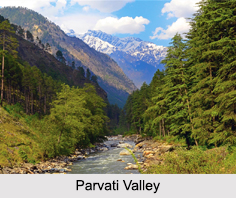
 Parvati Valley is a beautiful valley situated in the northern Indian state of Himachal Pradesh. It is one of the beautiful and lush green valleys of Himachal Pradesh. It covers a large area surrounding the Parvati River. From the confluence of the Parvati River with the River Beas, the Parvati Valley runs eastwards, through a steep-sided valley from the town of Bhuntar, in the Kullu district of Himachal Pradesh. Parvati Valley is known as the "Amsterdam of India".
Legend of Parvati Valley
It is said that Lord Shiva meditated in this valley for about 3,000 odd years. He is believed to have taken the form of a Naga Sadhu or a naked ash-smeared sanyasi. He continued his meditation while seasons came and went. One day he opened his eyes and looked at this untouched, beautiful landscape and named it Parvati after his consort.
Trek Route of Parvati Valley
There are some excellent treks in the area, including the Chandrakani Pass route to/ from Naggar, or the Pin-Parvati Pass to/ from Spiti. The scenic trekking routes through Parvati Valley are a popular destination for trekkers and tourists.
The precipitous valley road climbs past a side valley leading to the village of Malana near the famous tourist spot Kasaul. From here, the road passes through the Sikh and Hindu pilgrimage town of Manikaran and terminates at Pulga, where the construction of the Parvati Hydel Project, a hydroelectric dam was carried out. From Pulga, the footpath climbs to a temple at Rudra-Nag waterfall. Beyond Rudra-Nag waterfall, the trail ascends further through thick pine forests to the spiritual site of Kheerganga where Shiva is said to have meditated for 3000 years. There is a hot spring at Kheerganga which believed to have sacred healing properties.
At Thakur Kuan village (3560m), the Parvati Valley meets the valley of Dibibokri Nal River which is a tributary of Parvati River, which climbs towards the Northeast to the Dibibokri Glacier and Dibibokri Pyramid mountain peak (6400m). Beyond Thakur Kuan village, the Parvati Valley ascends gradually to Pandupul village (Pandu Pul) where two natural, rock bridges cross the Parvati River and a southern tributary. According to legend, these bridges were created by the massive strength of the Pandava brothers. From Pandupul, the wide valley of the upper Parvati valley climbs gradually through the wide, high-altitude meadowland of Odi Thatch to the sacred site of Mantalai Lake (4100m), the source of the Parvati River.