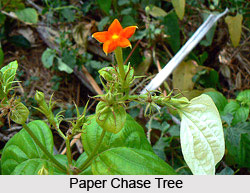
 As the tree belongs to the `Mussanda` group, it is very easily recognisable by its interesting enlargement of one or two of the flower sepals in every spray. At first sight, it looks as if it is pale underside of a leaf. One might also get the impression that someone had been scattering paper among the leaves as the name suggests. It is a straight shrub or small tree and it has a tendency to climb. The bark of the `Paper Chase Tree` is grey in colour and smooth. The branches are covered with a harsh brown coloured down. The oval shaped pointed leaves are usually soft above but downy underneath. They are of a fairly deep green in colour. The stems and veins are red coloured and the leaves are so indented by these veins that they have a combined appearance.
The tree blooms from the months of July to October and bears fleshy and hairy stalks and clusters of tiny, orange flowers. The long, green corolla tube protrudes from the calyx of narrow sepals. This tube enlarges at the end and opens into five triangular petals, like orange velvet. These are pale green underneath, and the centre of the flower is yellow in colour. On a few of the flowers, one sepal of the calyx is extended into an oval shaped bract. This is dead white in colour and very distinguishing. The people in Bombay eat these white leaves as a vegetable and as can be expected with a shrub as common as this, various parts of it have medicinal uses also.
The root of the tree is bitter in taste and has a healing and softening action. People use this in the treatment of white leprosy and eye trouble. They also give a weak decoction of dried shoots to children as a cure for coughs. The wood of the `Paper Chase Tree` is used for spinning, and the villagers also make ladles, spoons and other domestic articles from it. It is said that they are able to prevent the evil eye. For the same reason milky cattle are tied to pegs made from this wood. The tree propagates by shaping or cuttings and it is advisable to prune after the leaves have fallen to ensure a good shape.