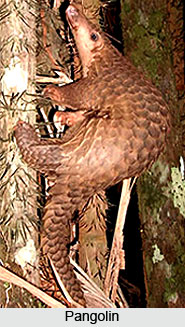
 Pangolin is previously classed in the order Edentata, meaning without teeth, along with the sloths and armadillos of America pangolins or Scaly Anteaters are now grouped under Pholidota (`scaled animals`). The dorsal and lateral sides of a pangolin, and the outside of its limbs, are covered with large overlapping scales composed of modified agglutinated hairs. Coarse bristle-like hairs occur on the under-surface of the body and a few between the scales. Two species are found in the Indian subcontinent: the Indian Pangolin, Manis crassicaudata is widespread from the base of the Himalayas to south India, and in Sri Lanka; the Chinese Pangolin, M.pentadactyla, ranges through Nepal and the eastern Himalayas to Burma and southern China.
Pangolins are nocturnal in habit, spending the day in their burrows, which are long tunnels ending into a large chamber. Burrows may be fairly deep (about six metres) in loose soil. The entrance of the burrow is closed with earth when the animal is inside. It walks slowly with the back well arched and sometimes stands up on its hind feet with the body inclined forward.
The food of Pangolins consists of various kinds of ants and termites. The termite mould is torn open by the powerful claws and the pangolin thrusts its long tongue, lubricated with saliva, into the passages and withdraws it with white ants adhering to it. Pangolins roll into a ball for defence and exhibit enormous muscular power that defies any ordinary attempt to unroll them. Probably, stronger carnivorous can prey upon them.
In south India, young are born in January, March and July. In the Shekhawati region of Rajasthan, the young ones are born in November, while another female from some other region delivered in January. Usually a single young one is produced, rarely two. The mother carries the young on her tail.
This article is a stub. You can enrich by adding more information to it. Send your Write Up to content@indianetzone.com