
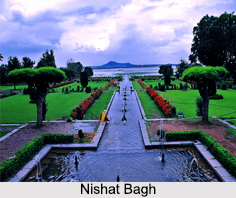
 Nishat Bagh is the second largest terraced Mughal garden which was built on the banks of the Dal Lake, close to Srinagar in the state of Jammu and Kashmir, India. With splendid architecture and planning, the Nishat Bagh is considered to be one of the most attractive sights of Kashmir. Nishat garden is one of the historic and popular destinations of Srinagar valley.
Nishat Bagh
Nishat Bagh is one of the most picturesque Mughal Gardens that was built on the eastern part of Dal Lake close to Srinagar City of Kashmir valley.
Introduction
Nishat Bagh is the second largest terraced Mughal garden which was built on the banks of the Dal Lake, close to Srinagar in the state of Jammu and Kashmir, India. With splendid architecture and planning, the Nishat Bagh is considered to be one of the most attractive sights of Kashmir. Nishat garden is one of the historic and popular destinations of Srinagar valley.History of Nishat Bagh
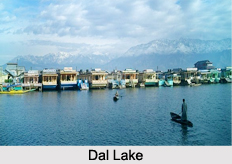 History of Nishat Bagh witnessed the life of Shah Jahan and his notion of art and architecture.
Formation of Nishat Bagh : Nishat Bagh is a garden of bliss that commands a magnificent view of the lake beneath the snow-capped Pir Panjal Range that stands far away to the west of the Kashmir valley of Jammu and Kashmir. Nishat Bagh was designed and built in 1633 by Asif Khan, elder brother of Nur Jahan.
Making of Nishat Bagh and the Gift : It was an interesting anecdote of jealousy of the Emperor Shah Jahan on beholding such a delightful garden, which almost shutdown the garden for some time. When Shah Jahan saw Nishat Bagh, after its completion in 1633, he expressed great appreciation of its grandeur and beauty. He is believed to have articulated his appreciation three times to Asif Khan, his father-in- law, with the hope that he would gift it to him. As no such offer was made by Asif Khan, Shah Jahan was piqued and ordered closure of the water supply to the garden. Then, for some time, the garden was deserted. Asif Khan was desolate and heartbroken; he was uninterested in the sequence of events. When he was resting under the shade of a tree, in one of the terraces, his servant was bold enough to turn on the water supply source from the Shalimar Bagh. When Asif Khan heard the sound of water and the fountains in action he was startled and immediately order closure of water supply as he feared the worst reaction from the emperor for this wanton act of disobedience. Fortunately for the servant and Asif Khan, Shah Jahan, who had heard about this incident at the garden, was not disturbed or annoyed by the disobedience of his orders. Instead, he appreciated the servant for loyal service to his master and then ordered full restoration rights for the supply of water to the garden to Asif Khan, his Prime Minister and father-in-law.
Architecture of Nishat Bagh
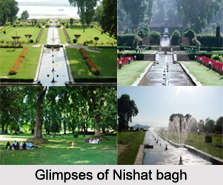 Architecture of Nishat Bagh exhibits the conventional architecture of Mughal era that is present in Mughal Gardens, Delhi. The architectural layout of Nishat Bagh was based on the basic conceptual model of the Persian garden. Later, it had to be remodelled to fit the topographic and water source conditions at the site chosen in the Kashmir valley in Jammu and Kashmir.
Patterns in Architecture of Nishat Bagh : The plan of Nishat Bagh instead of being central with four radiating arms in a square pattern as in the case of Chahar, was changed to an axial stream flow design to fit the hill condition with water source originating at the top of the hill end. This resulted in planning a rectangular layout rather than a square layout. This helped in dispensing with the long side arms. Thus, a rectangular layout with east-west length of 548 metres (1,798 ft) and width of 338 metres (1,109 ft) was adopted.
Terraces in Nishat Bagh : Nishat Bagh has a broad cascade of terraces lined with avenues of chinar and cypress trees, which starts from the lakeshore and reaches up to an artificial facade at the hill end. Rising from the edge of the Dal Lake, Nishat Bagh has 12 terraces representing twelve Zodiacal signs. However, it has only two sections, namely the public garden and the private garden for the Zanana or harem vis-a-vis the four sections of the Shalimar Bagh. This difference is attributed to the fact that the Shalimar Bagh catered to the Mughal Emperor, while Nishad Bagh belonged to a man of his court, a noble.
The first terrace is a water collection chamber that is also linked to the side flow from the garden. The second terrace is accessed through a gate. This terrace has five fountains that supply water from the third terrace, from where it flowed to the lowest terrace. The third terrace has a different design. The water chute has five arched open niches in the front and similar niches on the sides. A pavilion (baradari), a two-storied structure, which existed here when it was originally built, has since been dismantled. Stairways, on either side of the channel lead to the third terrace, which has a square chamber with five fountains. Moving up the flight of steps (four steps) on either side of the channel leads to the fourth terrace. The fourth terrace has two levels namely, a water channel and a square pool. Stairways with 7 steps lead to the fifth terrace. The fifth terrace is a stone bench provided across the channel to enjoy the scenic beauty. This also has a square chamber with five fountains.
The sixth terrace is at two levels with five fountains and distinctive paving pattern. The seventh terrace has the same pattern continuing. The eighth terrace is only a water channel or chute. In the ninth terrace, at the end of two stairways, there is an octagonal bench. The pool in this terrace has nine fountains. The stairways to the tenth terrace are along the side retaining walls where only the water chute with fountains is provided. The engraved paths lead to an impressive eleventh terrace, which has twenty five fountains in a pool. Up from this dramatic terrace is the last one. The zenana chamber, the twelfth terrace, is covered in the front by 5.5 metres (18 ft) high wall with a facade of blind arches. Only one arch in this blind facade provides an opening to the twelfth terrace. Two small octagonal towers on either side of the retaining walls provide views of the lower level terraces. A two-storey pavilion here is surrounded by a lovely garden with lush plantings.
Similarities with Shalimar Gardens and Nishat Bagh : There are some similarities with the Shalimar Bagh, such as the polished stone channel and terraces. The source of water supply to the two gardens is the same. Built in an east-west direction, the top terrace has the Zenana garden while the lowest terrace is connected to the Dal Lake.
Canal of Nishat Bagh : The central canal of Nishat Bagh that runs through the garden from the top end, is 4 metres (13 ft) wide and has a water depth of 20 centimetres (7.9 in). The water of Nishat Bagh flows down in a cascade from the top to the first terrace at the road level, which could be also approached from the Dal Lake through a shikara ride.
Water Flow to Nishat Bagh : The water flow of Nishat Bagh from one terrace to the next has over stepped stone ramps that provide the sparkle to the flow. At all the terraces fountains with pools are provided, along the water channel. At channel crossings, benches are provided for people to sit and enjoy the beauty of the garden and the cascading flows and fountain jets.
Geography of Nishat Bagh
Located on the bank of the Dal Lake, with the Zabarwan Mountains as its backdrop, Nishat Bagh is a garden with views of the lake beneath the Pir Panjal mountain range. Nishat Bagh includes a wide area of 544 X 328 sq. metres which was designed by Asaf Khan, Shah Jahan"s father-in-law and elder brother of Noor Jehan. As such Nishat Bagh has been popularly known for its history, architecture, layout and design which makes it most attractive and picturesque sights of Kashmir Valley in Jammu and Kashmir.
Recently updated articles in States of India
Bandare Waterfalls, Meghalaya
Bandare Waterfalls in South Garo Hills, Meghalaya, is a secluded natural attraction surrounded by dense subtropical forests and rugged mountain terrai...
History of Thissur District
Early History of Thissur District explains flourishing of the port cities. Now these port cities are transformed into archaeological sites.
Tippi Orchid Research Centre, Arunachal Pradesh
Tippi Orchid Research Centre in Arunachal Pradesh is renowned for its rich collection of exotic and endangered orchids. Surrounded by lush rainforest...

Tourism in Nashik District
Pilgrimage tourism in Nashik district involves visiting the various places of Hindu and Jain worship located here. Some of the holiest sites for Hind...
Mangadu, Kerala
Mangadu in Kerala’s Kollam district is a significant megalithic site known for its urn burials, cist burials, menhirs, and stone circles. Excavations...
Related articles in States of India
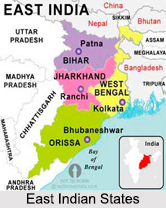
East Indian States
East Indian States comprises of Bihar, Jharkhand, West Bengal, Odisha and also the Union Territory of Andaman and Nicobar Islands. It defines the cult...
Purnia District in Bihar
Purnia District is located in Bihar and extends from River Ganga to Nepal. The district has a rich Hindu history and glorious past.
Hooghly district
Hooghly District along the bank of the river Hooghly is one of the principal trading ports of West Bengal.
Geography Of Chittoor District
Geography of Chittoor district is spread along the topography of the land which is divided into two natural divisions; Chittoor has a dry and healthy...

Districts of West Bihar
Districts of West Bihar is comprised of medieval monuments that were built by the different governors of Mughal era.