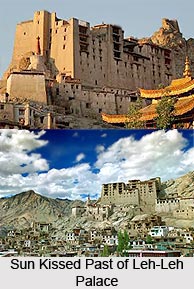
 Leh Palace, one of the centres of attraction in Leh district of Jammu and Kashmir, is an erstwhile royal abode of Leh kings.
Leh Palace is overlooking the Ladakhi Himalayan town of Leh from sun rise to sunset. Leh Palace is modelled on the Potala Palace in Lhasa, Tibet.
Leh Palace was built by King Sengge Namgyal in the 17th century. This palace is the epitome of the glorious medieval rule of Leh kings.
Structure of Leh Palace
Leh Palace is nine storeys high royal building. The upper floors of Leh Palace accommodated the royal family of Leh, while the lower floors of Leh Palace held the stables and store rooms.
Architecture of Leh Palace
Leh Palace displays an outstanding example of the medieval Tibetan architecture, resembling the Potala Palace in Lhasa of Tibet. The huge buttressed walls of Leh Palace and suspended wooden balconies are the exciting features of the Tibetan architecture of Leh Palace. Some frescos still beautify the walls of Leh Palace and eye witnessed the royal magnificence of the ancient and medieval era. Just above the Leh Palace, there is the famous Victory Tower that was built to observe the victorious brave soldiers of Ladakh who fought the invading armies of Balti Kashmiri army in the early 16th Century.
Leh Palace was abandoned when Dogra forces took control of Ladakh in the mid 19th century, and the royal family of Leh moved to Stok Palace, another palace in Leh District of Jammu and Kashmir.
The ruined palace of Leh is being restored by the Archaeological Survey of India. Leh Palace is open to the public and the roof provides panoramic views of Leh and the surrounding areas.
The mountain of Stok Kangri in the Zangskar mountain range is visible across the Indus valley to the south, with the Ladakh mountain range rising behind the palace to the north.
The Palace Museum of Leh holds a rich collection of jewellery, ornaments, ceremonial dresses and crowns. The Chinese thangka or sooth paintings which are more than 450 years old, with intricate designs, retain bright and pleasing colours derived from crushed and powdered gems and stones.
The construction of the Leh Palace on the Tsemo Hill was initiated by Tsewang Namgyal, the founder of the Namgyal dynasty of Ladakh in the year 1553 and was completed by his nephew Sengge Namgyal.