
Langdi is a traditional game popular among children, especially in the state of Maharashtra. It is similar to hopscotch and is played literally in every part of India on school level. Langdi is an ancient game of India played during Pandyan Dynasty called “Nondiyaattam”. It is described by Marathis as a sport with a Marathi ethos.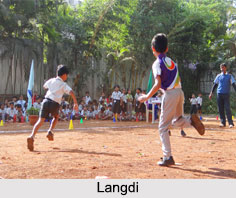
Langdi
Langdi is a traditional Indian field game which is similar to Hopscotch. The game has been included as regular game in Mumbai University. Played on one foot, it combines strategy with physical skill. Rooted in ancient history, Langdi is not only culturally significant but also serves as excellent training for other athletic disciplines.
Introduction
Evolution of Langdi
Over time, Langdi evolved in structure and spread across regions, eventually becoming closely associated with Maharashtra, where it's celebrated as a sport embodying the Marathi cultural spirit.
Traditionally played in four innings, Langdi involves two teams that alternate between chasing and defending. What makes the game distinct is that players from the chasing team must hop on one foot while trying to tag as many defenders as possible within a tight 9-minute window per inning. This unique format demands agility, endurance, and strategic thinking.
Beyond being a recreational pastime, Langdi has long been valued as a foundational training sport. Its emphasis on balance, coordination, and speed makes it particularly beneficial for athletes preparing for more structured disciplines like kho kho, volleyball, and gymnastics.
Langdi in Different States
Langdi is known by various names in different parts of India. In North Eastern States of India it is known as "Kukurazu", "Aroni" or "Gamosa", in Punjab as "Langda Sher", in Delhi as "Langdi Tang", in South as "Kuntata" and in Eastern states like Odisha as "Chuta Gudo".
Development of Langdi
After formation of Langdi Federation of India in 2009, this game is known as "Langdi" all over India. Then Hon. Secretary Langdi Federation of India Mr. Suresh Gandhi studied this Langdi game in deep and started to make unilateral and common rules in 2009. The main intention behind this was to procure organizational structure to Langdi which will help to get popularity, uniformity of Rules and develop and spread the game across all states of India. The game Langdi has been included as regular game in Mumbai University.
After its origin in 2009, Langdi made its entry into International Sports Field by its first appearance at Pokhara, Nepal in 2013. The National Langdi Federation received national recognition in 2010.
Rules of Langdi
The game Langdi consists of two teams. The rules of Langdi are as follows:
- Langdi is a team sport between two sides, played 12 players a side, and an additional three extra players.
- The team that wins the toss defends.
- The chasing team sends chasers who hop on one foot and try to tag the defenders.
- The chasers can step out of the ground as long as they keep on one foot.
- The defenders are declared out if they step out of the ground or commit a line fault.
- The team that tags most defenders is declared the winner.
Techniques of Langdi
This team sport in played in many ways in different parts of India. However, the most popular form is illustrated below.
- A standard Langdi match lasts 36 minutes, divided into four innings of 9 minutes each.
- Teams alternate roles—chasing and defending, after each inning.
- The match begins with a coin toss; the team that wins the toss starts as the defending team.
- During the chasing turn, players (chasers) must hop on one foot while attempting to tag defenders.
- Chasers are allowed to move outside the boundary, but must remain on one foot at all times.
- Defenders are declared out if they are tagged, step outside the playing area, or commit a line fault.
- Once all current defenders are out, a new batch enters from a designated entry zone.
- The chaser must return to their half of the field before attempting to tag new defenders.
- If a chaser loses balance and places both feet on the ground, they are replaced by a teammate.
- In the first chasing inning, chasers must hop on their right foot; in the next, they must switch to the left foot.
- The team that tags the most defenders over the four innings is declared the winner.
Another Variation of Langdi
Here is another variation of Langdi that is followed in some parts of India. In this version, the game begins with a single chaser.
- The single chaser attempts to tag all other players.
- The playing field is divided into quadrants, with one quadrant designated as the chaser's "house".
- Inside the “house,” the chaser is allowed to use both feet for movement.
- Outside the house, the chaser must hop on one foot while pursuing and tagging players.
- When a player is tagged, they join the chaser's team and begin helping tag the remaining players.
- The number of chasers increases progressively as more players are tagged.
- The game continues until all players have been tagged.
- The last player to be tagged becomes the starting chaser for the next round.
Recently updated articles in Traditional Sports in India
Abhinav Singh Bindra
Abhinav Singh Bindra is an Indian Olympic champion and former professional shooter who made history by winning India’s first individual Olympic gold m...
Raja-Rani Game
Raja-Rani is a traditional Indian sport widely played in the South Indian states. This fun game is influenced by the characters of Ramayana. The game...
Langdi
Langdi is a traditional Indian field game which is similar to Hopscotch. The game has been included as regular game in Mumbai University. Played on on...

Hardeep Singh - Indian Wrestler
Hardeep Singh is an Indian wrestler and he is a Greco-Roman wrestler haling from Haryana.
Traditional Sports of Arunachal Pradesh
There are numerous traditional sports in Arunachal Pradesh, which are played with equal enthusiasm by the native people of the state.
Related articles in Traditional Sports in India
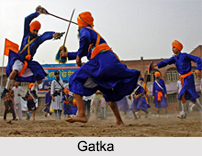
Gatka
Gatka is an ancient martial art developed to defend and display fighting skills and to better exercise self control.
Thoda
It is a martial form of Himachal Pradesh, practised by bows and arrows.
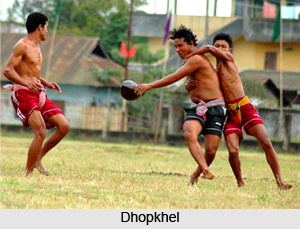
Dhopkhel
Dhopkhel is a very famous indigenous game of the Assamese. A rubber ball is used to play Dhopkhel and the players need great speed and other athletic...
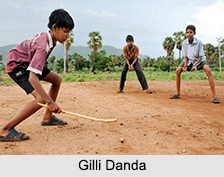
Traditional Games
Apart from the other famous traditional games, these other regional games have also been a part of our Indian culture.
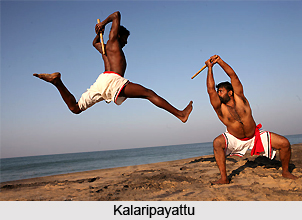
Kalaripayattu Martial Art
Kalaripayattu is an ancient form of martial art training and discipline of Kerala, which has its root back to the 12th century.