Ksemasana Yoga Asana

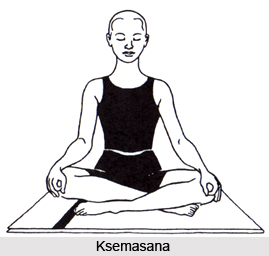
Ksemasana is a meditative yoga asana that is a variant of Sukhasana. This asana confers ease and comfort on the practicing yogis.

Ksemasana, a meditative asana, denotes the posture of sitting cross-legged. This is not an individual asana, but a derivative of Sukhasana which means to sit comfortably.

Ksemasana Meaning of Ksemasana
The term `Ksema` caters to various meanings in Sanskrit including prosperity, comfort, ease and happiness. Thus, Ksemasana may perhaps translate to a posture that confers these virtues, or the posture of those who possess these qualities.

Yoga Texts and Ksemasana
Few yoga texts mention the Ksemasana, except modern yoga manuals. This is understandable as it is essentially a variation on the Sukhasana, which is itself a comparatively recent addition to the yoga postures, mentioned first in two yoga Upanishads, the Darshanopanishad and Trisikhibrahmanopanishad. These texts do not specify any posture as a Sukhasana but merely state that a pose bringing courage and comfort, is a Sukhasana.

The Sri Tattva Nidhi, a later Hindu text (Ca. 19th century CE) does describe the Sukhasana, and the modern Ksemasana, is a variation only on the posture described in the Sri Tattva Nidhi.

Practice of Ksemasana
While practicing Sukhasana, when the hands are resting on the thighs near the groin, with the palms down and the body held erect, it is known as Ksemasana.

Effects of Ksemasana
Ksemasana confers much the same benefits as those offered by the Sukhasana. Sukhasana offers spiritual advantages so is Ksemasana.

This article is a stub. You can enrich by adding more information to it. Send your Write Up to content@indianetzone.com


Recently updated articles in Yoga

Khanda Manda Yoga
Khanda Manda Yoga Thumbnail

Khanda Manda Yoga

Khanda Manda Yoga is a difficult form of yoga where the Yogi cuts off his own arms and legs with a sharp cleaver, that is axe-like knife, and throws t...

Kaivalya Pada
Kaivalya Pada Thumbnail

Kaivalya Pada

Kaivalya Pada, the fourth chapter of Patanjali Yoga Sutra denotes an absolute, indivisible state of existence of the Yogi. The Kaivalya Pada is someti...

Vibhuti Pada
Vibhuti Pada Thumbnail

Vibhuti Pada

Vibhuti is the Sanskrit term for “power” or “manifestation.” In this third chapter, Patanjali introduces the final three limbs of Aṣṭanga Yoga, collec...

Sadhana Pada
Sadhana Pada Thumbnail

Sadhana Pada

Sadhana Pada in Patanjali Yoga Sutra denotes the idea of practicing yoga that leads to spiritual illumination. Sadhana, the Sanskrit term for “practic...

Samadhi Pada
Samadhi Pada Thumbnail

Samadhi Pada

Samadhi Pada is the first chapter of Patanjali Yoga Sutra. In this chapter, the author explains the essence of yoga, the nature of samadhi, and the me...