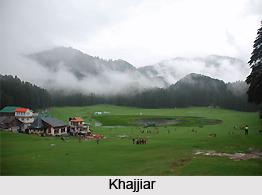
 Khajjiar is a prominent hill station located in Chamba district of the Indian state Himachal Pradesh, at a distance of about 24 kilometres from Dalhousie. Studded with spellbinding natural beauty, the place lies over a small plateau and hosts a beautiful stream-fed lake in the centre. Thick forests and lush green meadows enclose the hill station. It is situated at an altitude of 6,500 feet above sea level in the foothills of Dhauladhar ranges in the Western Himalayas. The mesmerizing snow veiled peaks of Khajjiar are visible even from a long distance. If forms a part of the Kalatop Khajjiar Sanctuary. Khajjiar exhibits a unique amalgam of three ecosystems comprising forest, pasture and lake.
Khajjiar as Mini Switzerland
Khajjiar was brought on the world tourism map, referring it as Mini Switzerland, by Mr. Willy T. Blazer, Vice Counsellor and Head of Chancery of Switzerland on 7th July 1992. A sign board of a yellow Swiss hiking footpath featuring Khajjiar`s distance from the Swiss capital Berne, 6194 km, has also been put by him. Khajjiar has been enlisted amongst the 160 locations of the world bearing topographical similarity with Switzerland. A stone has also been taken from the place by the counsellor, which has been placed in a stone collage around the Swiss Parliament as a memoir of the Mini Switzerland of India.
Tourism in Khajjiar
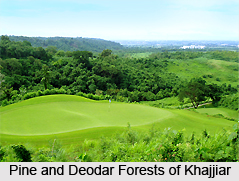 Khajjiar offers an exquisite ambience for the nature lovers. A casual walk around the lake or in the dense pine and deodar forests is an enthralling experience in Khajjiar. The slopped terrain of the place allows the children to have a pleasant roll-down to the lake without getting hurt. Horse riding is also greatly cherished here.
Khajjinag Temple
Khajjinag temple is the temple of Khajji Nag of 12th century AD and is situated at a little distance from Khajjiar Lake. Images of the Pandavas and the defeated Kauravas hanging from the circumambulatory path roof can be seen in the mandapa of the temple. Intricately carved wood structures the sanctum of the temple. The temple also houses some snake idols and Snake or Naga worship is performed there.
Khajjiar Lake
Khajjiar Lake is enclosed by saucer-shaped vibrant green meadow and a floating island. The small lake has a dense growth of weed, known as vacha, which has also made the land of the lake spongy.
Dauladhar Mountains
Being located at the base of Dauladhar Mountains, the place offers a panoramic view of the majestic mountains.
Visiting Information
The nearest major town of Khajjiar is Dalhousie from where it can be conveniently reached by bus within an hour.