Introduction
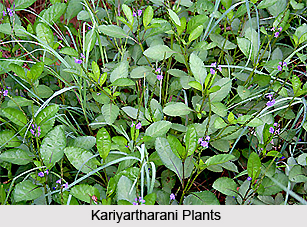
Kariyartharani is an Indian medicinal plant with several remedial properties. The scientific name of Kariyartharani is ‘Stachytarpheta jamaicensis’. The plant is native to United states but also found in parts of northern India, especially in the Himalayas in Kashmir and in some parts of Uttar Pradesh. Kariyartharani mainly grows at an altitude of 1,200 metres to 2,400 metres from the sea level.
Common Names of Kariyartharani
There are several other common names of Kariyartharani. For instance, in English it is known as ‘Aaron`s rod’ and ‘Jamaica false vervain.’ In Kannada, Kariyartharani is called as ‘kadu uttarani,’ ‘kariyuttarani’ and ‘uttirani.’ It has several other names also, in Malayalam it is known as ‘katapunuttu’ and ‘kattapunuthu.’ In Oriya, Kariyartharani is called ‘jalajali’ and in Tamil, this medicinal herb is called as ‘naioringi,’ ‘simainaivirunji’ and ‘simainayuruvi.’ This medicinal plant is a native of tropical America and naturalized in the Asian tropics. However, it is found as a weed across India and is occasionally cultivated. Sometimes, it is also called ‘blue snakeweed’ in India due to the blue color of the flower of this plant.
Physical Properties of Kariyartharani
Kariyartharani is a terrestrial, annual or perennial, erect,
glabrous, dichotomously branched subshrub with a white or brown taproot. It usually
grows up to 30 to 90 cm high.
Stalkless blue flowers appear in a slender terminal spike, with five blue petals and a white throat. The fruit is a nut. The overall physical structure of the plant is described below:
Structure: The bracts or plant structure is around 5 mm long, lanceolate, subulate. Further, it is membranous, tubular, short and acute and is generally of corolla deep blue or purple colour.
Branches: Its young branches are almost quadrangular, leaves are oblong-elliptic, generally 5 to10 cm long and around 2.5 to 3.8 cm wide, apex acute or obtuse, and margins are coarsely serrate. The base is tapering and decurrent (that is extending downward) into the obscure petioles. The flowers sessile of this plant borne in long, slender, nearly continuous glabrous spikes of up to 30 cm long. The rachis of this plant hollowed out beneath each flower.
Leaves: Leaves are simple, not lobed or divided, arranged oppositely, and stalked, with an elliptic or ovate shape measuring more than 2 cm in length or width. They are usually airy on both sides, with a coarsely dentate margin, an acute or obtuse apex, an obtuse or rounded base, and pinnate venation.
Stem: The stem is quadrangular, solid, and either glabrous or hairy, with stipules absent.
Fruits: Kariyartharani also bears pear-shaped and ribbed fruits (capsules), of around 3 to 4 mm long, enclosed in the calyx, breaking into 2 oblong pyrenes.
Seeds: The seeds of this plant are black and slightly
flattened.

Medicinal Properties of Kariyartharani
Kariyartharani has got various medicinal properties. This herb is used for treating intestinal worms, venereal diseases, ulcers, and erysipelas, dropsy and stomach ailments. A decoction of the plant is said to be used as an abortifacient. Further, it has been also effective in stopping vomiting. The juice of the leaves of Kariyartharani is used to remove cataracts. The leaves are rubbed on sprains and bruises or used as a cataplasm for boils. The decoction of the leaves is used to treat ulceration of the nose. An infusion of the bark is used to relieve diarrhoea and dysentery. In Brazil the plant is used externally to treat purulent ulcers and internally for treating fevers and rheumatic inflammation.