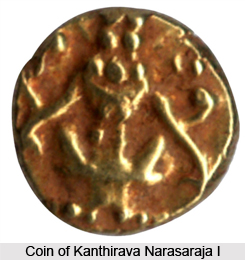
 Narasa Raja Wodeyar I was the ruler of Wodeyar Dynasty of Mysore. He ruled Mysore from 1638 to 1659. Chamaraja V was succeeded by his uncle, who in turn was quickly poisoned on the orders of the Prime Minister of Wodeyar Dynasty, Vikramaraya, within a year of becoming the Wodeyar King. The 23-year-old Kanthirava Narasaraja I, who was also known as Ranadhira Kanteerava Narasa Raja Wodeyar had earlier been adopted by the widow of Raja I, became, in 1638, the new Wodeyar of Mysore. Before becoming king of Mysore, he lived in Terakanambi near Gundalpet, Chamarajanagar district. Kanthirava Narasaraja I was also the first Wodeyar ruler of Mysore to generate the symbols related with sovereigns, such as establishing a mint and issuing coins named "Kanthiraya" (corrupted to "Canteroy") after him.
Accession of Narasa Raja Wodeyar I
Narasa Raja Wodeyar I ascended the throne of Mysore in the year 1638. Soon after the accession of Narasa Raja Wodeyar I, he was called on to defend Srirangapatna against the invasions of the Adil Shahis of Bijapur. It was a defence which he mounted with great loss for the enemy. In the fashion of the two Wodeyars before him, he continued to expand the Mysore State in building the Princely State of Mysore. This included taking Satyamangalam from the Nayaks of Madurai in the south, unseating the Chingalvas from their base in Piriyapatna in the west, gaining possession of Hosur (near Salem) to the north and delivering a major blow at Yelahanka to the rule of Kempe Gowda of Magadi, from whom a large tribute was exacted.
Works of Narasa Raja Wodeyar I
The Catholic missionaries had arrived in the coastal areas of southern India in the later half of his rule in Mysore. The Catholic Missionaries sheltered in the Coastal regions like Malabar Coast, the Kanara coast, and the Coromandel Coast starting early trade in the early phase of sixteenth century. They did not begin work in land-locked Mysore until halfway through the seventeenth century. Mysore Mission was established in Srirangapatna in 1649 by Leonardo Cinnami, an Italian Jesuit from Goa, during the rule of Narasa Raja Wodeyar I. Although a few years later Cinnami was expelled from Mysore on account of opposition in Kanthirava`s court, the ruler himself was not seen by the Jesuits as unsympathetic, and towards the end of Narasa Raja Wodeyar I`s rule. Cinnami returned to establish missions in half a dozen locations. During his second stay, Cinnami obtained permission to convert Narasa Raja Wodeyar I`s subjects to Christianity; however, he was successful mostly in the eastern regions of Narasa Raja Wodeyar I `s dominions, regions that later became part of the Madras Presidency of British East India Company.