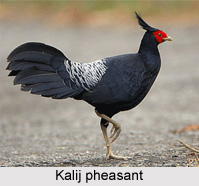
Kalij Pheasant with a scientific name "Lophura leucomelanos" is an Indian pheasant found in forests and thickets, especially in the Himalayan foothills region, from the Himalayas of Nepal to western Thailand.
Genders of Kalij Pheasant
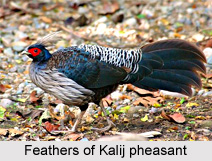
The males are rather variable depending on the subspecies involved, but all have an at least partially glossy bluish-black plumage, while females are overall brownish. Both sexes have a bare red face and greyish legs (the latter separating it from the red-legged silver pheasant). It is generally common and widespread, though three of its eastern subspecies (oatesi, lineata and crawfurdi) are considered threatened and moffitti is virtually unknown in the wild.
Kalij Pheasant as a Gem Bird
The name of Kalij pheasant is also spelt "kaleege" in old texts, such as Game Birds of India and Asia by Frank Finn, though no longer in his Indian Sporting Birds.
 It has also been introduced to Hawaii, where it is considered an invasive species because it consumes and disperses seeds of invasive plant species.
Relation with Other Species
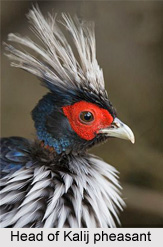 Kalij pheasant is closely related to the silver pheasant and the two are known to hybridize. The placement of the taxa lineata and crawfurdi has been a matter of dispute, with some treating them as subspecies of the Kalij pheasant and others as subspecies of the silver pheasant. They have greyish legs as in the kalij pheasant, but their plumage is closer to that of some subspecies of the silver pheasant.
Structure of Kalij Pheasant
The Male form of Kalij pheasant has a total length of 63 to 74 centimetres (25 to 29 in) and females 50 to 60 centimetres. It is being found in the western and central part of the species` range, while the second (williamsi, oatesi, lineata and crawfurdi) is found in the eastern part. In the males of the first group most of plumage is glossy blue-black, though with white to the rump or under parts in most subspecies, and in hamiltoni, the westernmost subspecies. The females are brownish. In some subspecies the under parts are distinctly marked in whitish and black, while in others most feathers are pale-edged, resulting in a scaly appearance.