
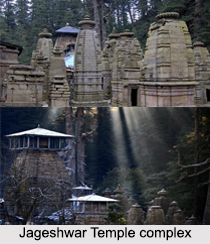
 Jageshwar Temples, also called Jageswar Temples or Jageshwar valley temples, are a group of over 100 Hindu temples dated between 7th and 12th century. The temple complex is located near Almora, in Uttarakhand. The valley has two major clusters of Hindu temples which are Dandeshwar and Jageshwar sites. Together these clusters over the valley consist of over 100 structural temples built in rock cut architecture.
Jageshwar is a Hindu pilgrimage town and one of the Dhams in the Shaivism tradition. The site is protected under Indian laws, and managed by the Archaeological Survey of India. The complex includes Dandeshwar Temple, Chandi-ka-Temple, Jageshwar Temple, Kuber Temple, Mritunjaya Temple, Nanda Devi or Nau Durga Temple, Navagraha temple, a Pyramidal shrine and Surya Temple.
Temples of Jageshwar
Jageshwar Temples are a group of over 100 Hindu temples dedicated to Lord Shiva. The temple site is located in Jageshwar town near Almora, Uttarakhand.
Introduction
About Jageshwar
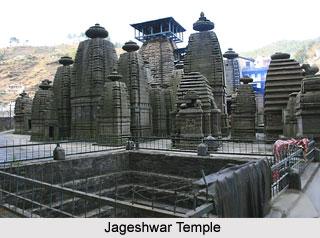 Jageshwar town is located at an altitude of 1870 meters above sea level. The temple complex is situated 36 km northeast of Almora, in the Kumaun region. The temple clusters begin from satellite road branching off east from the Artola village on the Almora Pithoragarh highway, at the confluence of two streams Nandini and Surabhi after they flow down the hills in the narrow valley. The site is about 3.5 km long along the Jataganga rivulet. Jageshwar is a temple city that consists of a cluster of 124 large and small stone temples. Jageshwar is believed to be the site of first of the twelve Jyotirlingas, Nageshvara Jyotirlinga. `Jageshwar Monsoon Festival` is held between 15 July and 15 August during the Hindu calendar month of Shravan. The annual `Maha Shivratri Mela` or Shivratri festival takes place during spring. Various evidences show that these temples belong to the post-Gupta and pre-medieval eras and are estimated to be about 2500 yrs old.
 It is believed that Adi Shankaracharya visited Jageshwar and renovated and re-established many temples. Most of the temples have a stone lingam, surrounded by stone sculptures of various deities. The pilgrimage to Jageshwar is considered as sacred as the famous chardham yatra.
History of Jageshwar Temples
Structure of Jageshwar Temples
Architecture of Jageshwar Temples
Temple 47: Temple 47 is a part of the Jageshwar site. The temple is built with Valabhi Nagara style with a wagon vault from the 7th or 8th century. Its western wall is capped with a Vinadhara Shiva stele (lute bearing Lord Shiva), the northern wall with Ganesha stele, and the eastern wall with yoga performing Saptamatrikas (seven mothers, Shaktism tradition).
Temple 2: This temple is also found in Jageshwar site. It is another early temple with a tiered tower in the curvilinear latina Nagara style. Its square sanctum is preceded by a short vestibule (antarala). The temple also has a 7th or 8th century relief carving showing Lakulisa seated on lotus in water.
Temple 145: Temple 145 is part of the Dandeshwar site and it is also a 7th to 8th century temple exhibiting a different architectural style. Its tower consists of stacked series of amalaka in the form of cogged discs of shrinking diameter. Below is the square sanctum (garbha griya) whose doorframe and mandapa are formed by square pillars. Inside the sanctum is a chaturmukha Shiva Linga, each face of which is looking at a cardinal direction.
Temple 76: This temple of 1st millennium is found at the Jageshwar site. It is dedicated to Mrityunjaya form of Shiva, the one who conquered death. The temple is built in the middle of Shiva Lingas and smaller shrines. Temple 76, also called the Mrityunjaya Mahadeva temple, is a large temple with the latina Nagara style architecture. It has a four pillared entry mandapa, then the mukha-mandapa which leads to an antarala (vestibule) then on to the square sanctum. The tower is curvilinear. The wall of the temple is covered with frieze and niches in a format that belongs to the 850-950 CE.
Temple 37: Temple 37 comes under Jagesvara site. The temple is integrated with four entrances, including intricate carvings on its tower. The sanctum has two unusual dvarapalas added in the 14th-century or later. One four-armed dvarapala holds a skull in the tradition of the Pashupata-Kapalikas in one of his hands, a rosary in other, a fruit in third hand and the fourth hand cradles an object. A bull is situated at his pedestal.
Festivals in Jageshwar Temples
Recently updated articles in States of India
Bandare Waterfalls, Meghalaya
Bandare Waterfalls in South Garo Hills, Meghalaya, is a secluded natural attraction surrounded by dense subtropical forests and rugged mountain terrai...
History of Thissur District
Early History of Thissur District explains flourishing of the port cities. Now these port cities are transformed into archaeological sites.
Tippi Orchid Research Centre, Arunachal Pradesh
Tippi Orchid Research Centre in Arunachal Pradesh is renowned for its rich collection of exotic and endangered orchids. Surrounded by lush rainforest...
Tourism in Nashik District
Pilgrimage tourism in Nashik district involves visiting the various places of Hindu and Jain worship located here. Some of the holiest sites for Hind...
Mangadu, Kerala
Mangadu in Kerala’s Kollam district is a significant megalithic site known for its urn burials, cist burials, menhirs, and stone circles. Excavations...
Related articles in States of India
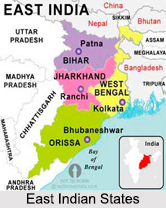
East Indian States
East Indian States comprises of Bihar, Jharkhand, West Bengal, Odisha and also the Union Territory of Andaman and Nicobar Islands. It defines the cult...
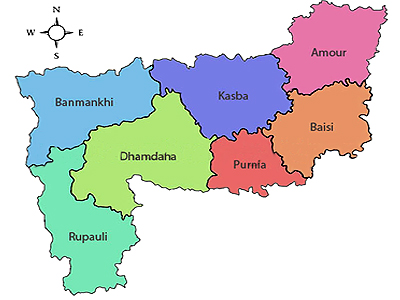
Purnia District in Bihar
Purnia District is located in Bihar and extends from River Ganga to Nepal. The district has a rich Hindu history and glorious past.
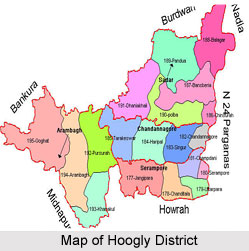
Hooghly district
Hooghly District along the bank of the river Hooghly is one of the principal trading ports of West Bengal.
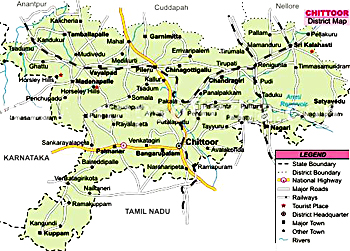
Geography Of Chittoor District
Geography of Chittoor district is spread along the topography of the land which is divided into two natural divisions; Chittoor has a dry and healthy...
Districts of West Bihar
Districts of West Bihar is comprised of medieval monuments that were built by the different governors of Mughal era.