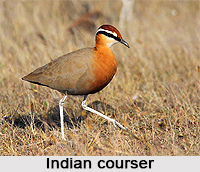
 Indian Courser is an Indian bird that has a scientific name "Cursorius coromandelicus". The bird mainly inhabits in dry rocky terrains and is mainly found in Peninsular India. Indian Courser generally moved in small flocks.
Concentration of Indian Courser
Indian Courser is a species of Courser found in mainland South Asia, mainly in the plains bounded by the Ganges and Indus river system. Indian Courser is a ground bird that can be found in small groups as they forage for insects in dry open semi-desert country.
Residence of Indian Courser
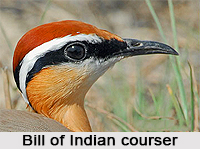
Indian Courser is widespread in South Asia and overlaps with some other species such as the similar looking cream-coloured courser. This species is however brighter coloured than the cream-coloured courser and has a broader black eye-stripe that begins at the base of the beak. The crown is chestnut and the breast is rufous. The nape has a dark black patch where the long feathers forming the white stripe meet. In flight, the rump appears white and the wing tip is not as contrastingly black as in the cream-coloured courser. The sexes are alike. The long legs are whitish and as in other coursers have only three forward pointing toes.
Countries where Indian Courser Found
Indian Courser inhabits in dry stony, scrubby or rocky country but rarely on sandy terrain from the Indus Valley East short of Bangladesh and south to the tip of Peninsular India. It sometimes occurs in the dry zone of northern Sri Lanka. The wet forest zones are avoided. In southern India, the drier zone on the east coast, the Coromandel region, where it is not uncommon and gives it the species name. It is also found patchily distributed in other parts of the peninsula. Other areas where they are commonly seen include the Deccan plateau and the arid regions of north-western India in Rajasthan and Gujarat. It is resident in some areas but makes local movements.
Behaviour of Indian Courser
Indian Courser is usually seen in small flocks. They are usually found where the grass is not taller than them, since the tall grass blocks their view. They feed on insects mainly termites, beetles, crickets and grasshoppers picked up from the ground in stubbly or uncultivated fields. They run in spurts on the ground but take to flight with a hoarse creaky gwaat call. The flight is strong with rapid wing beats. They fly low and begin to run after landing.
Breeding of Indian Courser
Indian Courser breeds mainly from March to August. Records exist from mid May in southern India and Sri Lanka and mid April in Darbhanga Region of Bihar.
 They nest in a scrape on bare stony ground laying 2 or 3 speckled and well-camouflaged eggs that are very spherical. The chicks are protectively coloured and on alarm crouch and remain immobile making them extremely difficult to spot. Adults do not call or display when the nest or chicks are approached. The chicks are able to move upon hatching but are initially fed by the parents and begin to forage on their own after a week
Threats to Indian Courser
The arid and open habitats used by Indian courser are threatened by human activities such as construction and agriculture. In parts of Gujarat, Rajasthan, Goa the species was very common in short-grass covered open and fallow lands but has vanished in many areas. In some areas, vehicular activity and industrialization have destroyed habitats where they formerly occurred.