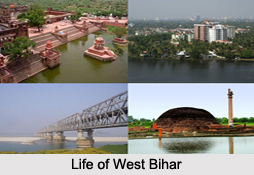
 History of Hyderabad district in Telangana, a newly formed state in India is one of bewitching palaces, timeless corridors, fairy-tale courtyards and whispering water ways.
Hyderabad, the capital city of Telangana and Andhra Pradesh for 10 years consists of the twin cities of Hyderabad and Secunderabad and is a bustling 400-year-old metropolis with an urban population of 6 million people approximately.
Hyderabad is famous as the former seat of the fabulously wealthy Nizams of Hyderabad. Built on the banks of the Musi River, and surrounded by huge prehistoric rock formations like petrified, grey elephants, Hyderabad is a blend of the fairy tale and earthy, a pot pourri of old and new.
Medieval History of Hyderabad District
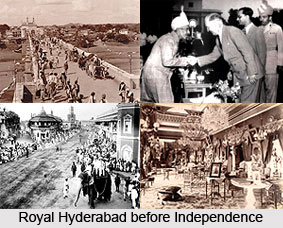
Hyderabad, India`s fifth-largest city was founded in 1590 AD by Muhammad Quli, the fourth king of the Qutab Shahi dynasty. They ruled this part of the Deccan from 1512 until 1687. Formerly, Hyderabad was known as Bhagyanagar. This was named in the sweet memory of the Sultan`s beloved Bhagamathi. After her death, the name Bhagyanagar had 2 or 3 changes and at last, it was named as Hyderabad Deccan. Before founding Hyderabad, the Qutab Shahi kings ruled from the fort city of Golconda, 11 km to the west. After Aurangzeb`s death in 1707, Mughal control over this part of India rapidly waned and the Asaf Jahi viceroys who had been installed to look after the interests of the Mughal dynasty broke away to establish their own independent state. They gave themselves the titles `subahdar` and `nizam`. There were 7 Kings of the Asif Jah Dynasty, the last of whom was Mir Osman Ali Khan, Asif Jah-VII. He died in 1967 and nominated his grandson, Nawab Mir Barkat Ali Khan as his successor. The period of Mir Osman Ali Khan can be called the golden age of the Nizams of Hyderabad.
 Modern History of Hyderabad District
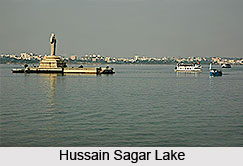
In 1798, a subsidiary alliance system for military and political cooperation was signed between the Nizam and the British East India Company. Thereafter an area north of what is now the Hussain Sagar Lake was established as a cantonment. The area was named Secunderabad after the then Nizam, Sikander Jah. Both Hyderabad and Secunderabad grew together and have now merged. An imaginary line drawn across the Tank bund is still used to distinguish the two cities. Hyderabad is among the few Indian cities, which has a well-preserved cultural heritage. Hyderabad invokes nostalgia among old residents for its culture, fine arts and certain sophistication in manners. Much more than anything, Hyderabad presents a true picture of secularism.
Hyderabad is the fifth largest cosmopolitan city in India, rich in culture, enduring history and industrial growth. It is unique in being one of the few cities where tradition and technology co-exist. With a dynamic leadership, the state is steering the nation to new dimensions in the fields of Information Technology, Biotechnology, Pharmaceuticals, and Business Management to emerge as a city of immense business opportunities.