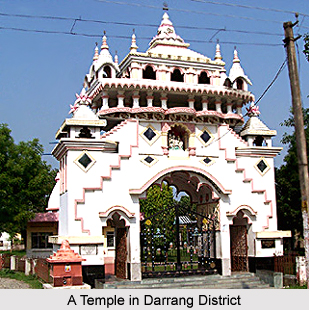
 History of Darrang District suggests the origin of its name. It states that the name Darrang seems to have originated from the Sanskrit word `Dwaram` which means a `Duar` or a pass. In the past, there were some fixed passes on the northern side of the district from which the various hill tribes descended to the plains from the Himalaya Mountains ranges. Interestingly, some of the areas still have a suffix `Duar` to their names and one of the six passes on the northern side of the present district is called `Khaling Duar`. Another possible origin of the name is the word `Devaranga` which means the playground of Devas. The names of several places in Darrang district like Athrikhat, Khalingduar, Dhwalpur, Markandasram etc. show their earliest connection with the mythic sages like Markedeya, Kaulinya, Atri, Yagyabalka etc.
Further, many archaeological sites like Narikali, Tamreswar, Bijulibari, Lakshimpur, Bhairavkunda, Mathajhar, Murhadeor, Dhawalpur, etc., point the grey past of this district. However, no definitive historical records about Darrang District are available for the pre-medieval period. According to some surveys and researches, Darrang District became famous only after the middle age, up-rising of the king Biswa Singha Naranarayana. It perhaps formed a part of the ancient kingdom of Kamrupa and with its decline; Darrang has been under the rule of the Bodo-Kacharies and the Bhuyans.
In 1581, the famous Koch king Naranarayan gave a part of his kingdom to his cousin Raghudev, son of Sukladhwaj who was known for his military powers. Raghudev`s part included Mangaldai subdivision and also the Kamrup District and Goalpara District. This part has been referred to as the kingdom of eastern Kochs. Raghudev did not exercise any independent authority and he and his successor`s attempt to achieve freedom only got them involved in quarrels first with the Mughal Dynasty and then with the Ahoms.
History of Darrang District recounts that some northern parts of the Brahmaputra River also formed a part of then Darrang. Raghudev established his capital at Darrang region. It was later on shifted to Mangaldai during the time of his son and successor Sundarnarayan. Friction however continued with the Mughals and with the Ahoms, and the efforts of the Darrang kings to assert independence did not succeed. In the year 1826, Darrang, like the rest of Assam passed into the hands of the British after the treaty of Yandabu (Yandabu Sandhi). Having established their authority, the British East India Company began the work of reconstructions and in 1933; Darrang became a district with Mangaldai as its headquarters. In 1935, the headquarters was shifted to Tezpur. The same position was maintained until the sub-division of Mangaldai was transformed into a district in 1983.
Interestingly, Darrang District has a long history of confrontation against any oppressive rule. The great event of 1894, popularly known as `Patharughatar Ran` (Battle of Patharughat) is one such instance. It is popularly known as Assam`s Jalianwalabagh Massacre. Further, during the freedom struggle, Darrang also played a glorious part. People actively participated in the various aspects of the movement and thereby contributed to the achievement of Indian independence. The district has also not lagged behind in contributing to the richness of Assam`s culture and civilization. The various temples and other objects of art though much ravaged by the passage of time, speak highly of the artistic genius of the artisans of Assam. Under the patronage of Darrang Rajas many books on different subjects were also composed. One such look is Darrang Rajvansavali, written by Suryakhadi Daivagna. It is a metrical chronicle of Darrang Rajas composed at the initiative of its tenth ruler Samudranarayana.
History of Darrang District speaks about the colourful heritages of the region. However, many aspects of the culture of the district remain unexplored.