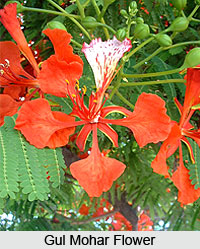
 The beautiful flower Gul Mohr attracts the eyes of almost everyone whosoever passes under the tree. The Scientific name of Gul Mohr is Delonix Regia. The family of this flower is Leguminosae and its sub-family is Coesalpineae. Almost all the trees, shrubs and climbers of native and warm countries belong to this sub-family and it also contains some of the most beautiful trees in the world. The origin of the trees is Madagascar, from where trees were taken to Mauritius about 1824. Seeds from these trees were then taken to England and now it is to be found in most tropical countries.
The name of the flower `Gul Mohr` differs in various languages. When it is called `Gul Mohr` in Hindi, its called as `Rakta Chura` in Bengali. The Tamil people call it as `Mayarum` and it is `Alasippu` in Malayalam. `Shima sankesula` is the name in which the Telugu people call it and the Sinhalese call it as `mal Mara`. But it`s famously known as `Peacock Flower` or `Flamboyant` all over the world as it is called so in English.
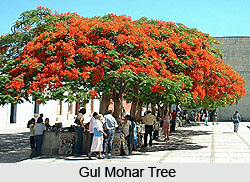
The Gul Mohr is amongst those rare trees in India that are extra-ordinarily striking and ornamental. When the month of April comes, everyone just wonder about thinking how a bare, skinny tree that is standing on a dry and hard earth can create such a glorious wealth of bloom. Just a few days after the first blossom appears, the whole tree starts shining with various splashes of crimson and orange. In the Month of May, the soft, whitish, rich green of the new plants spread out and the tree develops a light and soft beauty. The long ugly, black pods and bare, gray branches stays hidden and the spreading sunshade of green lace and cherry blossoms get the loveliest beauty. There is always a rich variety in the shades of crimson and cherry. Some trees become almost orange and some other take a deep red shade. All the variety of colour has their respective admirers.
 The usual size of the Gul Mohr flower is 12.5 cm across. The large ones put up with numerous, combination of blooms and roundish drowsy buds. The design of the flower is somewhat uncommon. Five thick crimson sepals curve back and display their lime-green lining and bright yellow rims from the spaces between them. If you spread out the five spoon-shaped, curvy and crinkle-edged petals you will find one of them is larger. Its-white or yellow center splashes with scarlet. Ten long stamens spread and curve from the center. After the fall of the flowers the soft, green pods make their appearance. But soon they become hard and black, they are the long ugly straps hanging amongst the leaves. They wait there throughout the year for the next year`s flowers to appear. These leaves are just like those of several other trees.
Another very interesting thing about Gul Mohr is that one can very easily recognize it even when there is no flower in it. Because of its smooth, gray limbs and the characteristic formation of outward spreading branches and leaves, it becomes easily recognizable. Gul Mohrs are some excellent light-shade trees that can grow up to about 12m. People normally plant them in such avenues where most of the trees are of same height and there they form a superb landscape. The advantage of the trees is that they grow readily from seed, although they often take a long time to germinate. As a garden tree it has some disadvantages as well. That are the limbs of these trees break easily in strong winds and that grass and other plants do not grow well beneath it.
However, there is some controversy over the meaning of the name of this popular tree. There are some people who say the word is `Mohr` that means peacock, while `Gul` is flower. To some others the word is `Mohur` that is coin. But everybody does agree with the matter that the name `Gold Mohur`is not adequate in illustrating the aesthetic appeal of the flower. In fact the most attractive of its names are those given by the French that are `feur de Paradis` and `Flamboyant`.