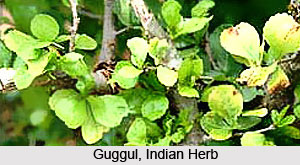
 Guggul thrives in semi-arid climatic regions and is capable of tolerating soil of inferior quality. It possesses a thin papery bark, thorny branches and grows till a height of about 4 metres; therefore it can be referred to as a small tree or a shrub. The ovate leaves are trifoliate or simple and have a breadth of about 2.5 cm and a length of nearly 1 to 5 cm. Some guggul plants bear male as well as bisexual flowers, while there are some other plants which possess only female flowers. Therefore, guggal plant is gynodioecious, with red or pink flowers having tiny petals.
Guggul and Gum Guggulu are the names given to a yellowish resin produced by the stem of the plant. This resin has been used historically and is also the source of modern extracts of guggul. The classical treatise on Ayurvedic medicine, `Sushruta Samhita`, describes the use of Guggul for a wide variety of conditions, including rheumatism and obesity. One of its primary indications was a condition known as medoroga. This ancient diagnosis is similar to the modern description of atherosclerosis.
Standardized guggul extracts are approved in India for lowering elevated serum cholesterol and triglyceride levels. Due to the overuse of guggul plant, especially in the states of Rajasthan and Gujarat, it has been enlisted in the category of endangered species in the Red Data List declared by the World Conservation Union or IUCN. Since it contains the steroid Guggulsterone, it enables the synthesis of cholesterol in the liver.
Guggul contains resin, volatile oils, and gum. The extract isolates ketonic steroid compounds known as guggul-sterones. These compounds have been shown to provide the cholesterol- and triglyceride-lowering actions noted for Guggul. Guggul significantly lowers serum triglycerides and cholesterol as well as LDL and VLDL cholesterols (the `bad` cholesterols). At the same time, it raises levels of HDL cholesterol (the `good` cholesterol). Guggul has also been shown to reduce the stickiness of platelets - another effect that lowers the risk of coronary artery disease. One double-blind trial found guggul extract similar to the drug clofibrate for lowering cholesterol levels.
Early studies with the crude oleoresin reported numerous side effects, including diarrhoea, anorexia, abdominal pain, and skin rash. Modern extracts are more purified, and fewer side effects (e.g., mild abdominal discomfort) have been reported with long-term use. Rash was reported, however, as a fairly common side effect in one recent study. People should use Guggul with caution with liver disease and in cases of inflammatory bowel disease and diarrhoea.