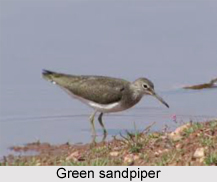
 Green Sandpiper is an Indian bird that bears the scientific name "Tringa ochropus" concentrated in the wetland regions of Indian states like Odisha, West Bengal, Kolkata, Kerala and Karnataka.
History of Green Sandpiper
Green Sandpiper is a small wader and it is a shorebird of the Old World. It represents an ancient lineage of the genus Tringa; its only close living relative is the solitary Sandpiper.
Structure of Green Sandpiper
Green Sandpiper both has brown wings with little light dots and a delicate but contrasting neck and chest pattern. In addition, Green Sandpiper has their nest in trees, unlike most other scolopacids.
Colour of Green Sandpiper
Green Sandpiper is a somewhat plump wader with a dark greenish-brown back and wings, greyish head and breast and otherwise white under parts. The back of Green Sandpiper is spotted white to varying extents, being maximal in the breeding adult, and less in winter and young birds. The legs and short bill of Green sandpiper are both dark green. It is conspicuous and characteristically patterned in flight, with the wings dark above and below and a brilliant white rump. The latter feature reliably distinguishes it from the slightly smaller but otherwise very similar solitary sandpiper (T. solitaria) of North America. In flight, Green Sandpiper has a characteristic three-note whistle.
Breeding of Green Sandpiper
Green Sandpiper breeds across sub arctic Europe and Asia and is a migratory bird, wintering in southern Europe, Indian states like eastern India and western India, southeast Asia, and tropical Africa.
Feeding of Green Sandpiper
The food of Green Sandpiper is small invertebrate items picked off the mud as this species works steadily around the edges of its chosen pond. This is not a gregarious species, although sometimes small numbers congregate in suitable feeding areas. Green Sandpiper is very much a bird of freshwater, and is often found in sites too restricted for other waders, which tend to like a clear all-round view.
Eggs of Green Sandpiper
Green Sandpiper lays 2-4 eggs in an old tree nest of another species, such as a fieldfare. The clutch takes about three weeks to hatch. The Green Sandpiper is one of the species to which the Agreement on the Conservation of African-Eurasian Migratory Water birds (AEWA) applies. Widely distributed and not uncommon, it is not considered a threatened species by the IUCN on a global scale.