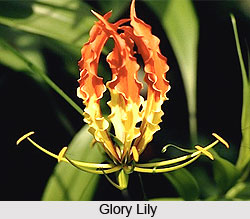
 The `Glory Lily` is a popular plant in the tropical countries. This is called as `Gloriosa Superba` in science. It belongs to the family of `Lilyaceae`. In Hindi language, the name of the plant is `Cariari`. In Bengali, it is known as `Bishnangul`. The Tamil people call it as `Coatijan` or `Kannuvelli` and it is `Mettonnt` and `Matattamara` in Malayalam. It has quite a few names in Telugu as `Adivi-nabhi`, `Kalappa-gadda`, `Pottidumpa` and `Ganjeri`. It is also called as `Tiger`s Claws Climbing Lily` in English.
If you walk through countryside, you will easily notice the flaming colours of the `Glory Lily` and see the plant twists among the bushes. This is a nonwoody climbing plant that dyes down during the Summer. The fleshy underground stem or root of the plant remains inactive until the following Rainy season. For this reason, it can be said that it is a fragile plant that bear soft, circular, green coloured stems. The leaves of the plant are bright and silky. They are variable in their length and breadth and they do not have any stalks. They frequently terminate in twisting tendrils that stick persistently to anything they touch. The leaves grow singly or in opposite direction and they like lances in shape. They have a bulgy middle and they fold over at the base.
The flowers are very much prominent against the fresh green of monsoon growths. They change their colours when they open and present some lovely variations of yellow, orange and pink colour. They grow singly on long stems. The stems bend over at the tip. The flowers of the `Glory Lily` are like ovals in shape and held from above when they are buds. That time they also bear some prominent curved wings. There are six long and decorative petals. These petals bend right back from the small keel on the opening. The keel remains lying in each directed base. The petals are green at the bottom. They shade to pale yellow and suddenly become orange coloured at the end. The centre rib and the edges remain yellow in colour.
The six projecting stamens are similar to yellow mallets in shape. They soon open out into spoke formation and the orange colour of the petals turns into vermilion. The pistil sticks out sideways from the large, green coloured ovary. The yellow colour of the petals changes to orange with age. After that, each petal becomes completely crimson and the stamens and the petals lie down alongside. The fleshy tubers of the `Glory Lily` can become poisonous sometimes. Though, there are some people who say that it has not been proved to be a dangerous poison yet, it is generally agreed that, like many other poisons, small doses of this one are definitely tonic. The village women widely use the roots of the plant to promote labour.