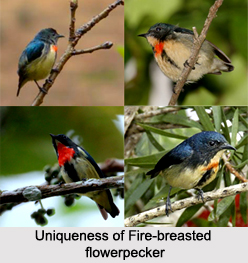
 Fire-Breasted Flowerpecker is an Indian bird that bears a scientific name "Dicaeum ignipectus", and is a family member of Dicaeidae.
Description of Fire-Breasted Flowerpecker
Fire-Breasted Flowerpecker was first described by Edward Blyth in 1843 based on a specimen obtained from Nepal by B H Hodgson. The name was based on Hodgson`s manuscripts but published by Blyth. The type specimen said to be deposited at the British Museum is said to be lost, but may exist in the collection of the Asiatic Society museum in Kolkata.
Category of Fire-Breasted Flowerpecker
Fire-Breasted Flowerpecker is a species of bird in the Dicaeidae family found in South and Southeast Asia.
Feeding of Fire-Breasted Flowerpecker
Fire-Breasted Flowerpecker bird feeds on fruits and plays an important role in the dispersal of fruiting plants. Unlike many other species in the genus, this species has marked sexual dimorphism with the male having contrasting upper and lower parts with a distinctive bright orange breast patch. The female is dull coloured.
Structure of Fire-Breasted Flowerpecker
Fire-Breasted Flowerpecker is a small Flowerpecker with a small and dark bill. The male has glossy blue-black upperparts. The underside is buffy but a bright red breast patch and starting below it and along the middle is a short black stripe going down till the belly. The female is dark olive above and buff below. The sides are olive and the bill has a pale base.
Weight of Fire-Breasted Flowerpecker
Fire-Breasted Flowerpecker has the weight ranging just 7-9 g and measuring under 7 cm (2.8 in) long, it is one of the smallest flowerpeckers. They are usually found at the top of the trees especially on mistletoes. They have a shrill call given regularly and has been likened to Snipping Scissors and a Staccato Tsit.
Distribution of Fire-Breasted Flowerpecker
Fire-Breasted Flowerpecker is found widely distributed along the sub-Himalayan Mountain Range region in India, Nepal, Bhutan, Bangladesh and extends into Southeast Asia into China, Indonesia, Laos, Thailand, Vietnam, Taiwan, Malaysia and the Philippines.
Habitat of Fire-Breasted Flowerpecker
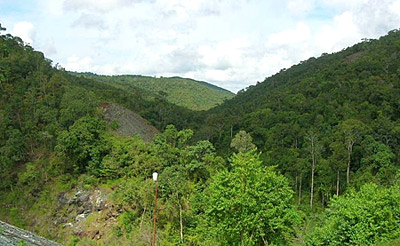
Fire-Breasted Flowerpecker"s natural habitats are temperate forests, subtropical or tropical moist lowland forests, and subtropical or tropical moist montane forests.
Population of Fire-Breasted Flowerpecker
Several populations have been named as subspecies. The nominate ignipectus found along the Himalayas into Southeast Asia on the mainland. The remainings are insular populations and include formosum of Taiwan, luzoniense of Luzon, bonga of Samar and apo of the Negros and Mindanao. The species itself forms a superspecies complex with Dicaeum monticolum, D. celebicum, D. sanguinolentum and D. hirundinaceum which are sometimes all treated as one species. Hybridization with Dicaeum cruentatum has been suggested. Many island forms show patterns of very restricted ranges or micro-endemism and it has been suggested that these be treated with care for conservation planning. The populations found in the Philippines have males with the under parts similar to D. monticolum while the females have a steel-green gloss on the upperparts unlike the dull green of more northern forms. The Sumatran population beccarii is the most distinct form and differs also from D. sanguinolentum. The males have a steel-green gloss on the upper parts and lack the throat patch while the females have greenish upperparts and lack the red rump.
Breeding Season of Fire-Breasted Flowerpecker
Fire-Breasted Flowerpecker are said to breed in June and July. The nest is pendant and purse like, opening on the side towards the top. The nest is thin and felt like, made up of the hairy coverings of stems from mistletoes. The nest is lined with moss and soft grass. Two or three eggs are laid and both sexes incubate and take care of the young.
In Hong Kong, the population of Fire-Breasted Flowerpecker is believed to have increased due to maturation of the forests following their restoration. They were first recorded in 1954 but have been seen to breed regularly since 1975.