
Dvaitadvaita Philosophy of Nimbarka discusses three aspects of existence: Chit, achit and Isvara. Chit and achit have Guna and Swabhaava which are different from those of Isvara. Isvara is independent while `chit` and `achit` have existence dependent upon the supreme.
According to Nimbarka`s Dvaitadvaita, Brahman is the highest reality. Brahman is a personal God. There is nothing equal or superior to him. Due to his greatness, nature and qualities he is known as Brahman. He is considered as beyond any limit. Brahman is considered as the sole cause of creation, maintenance and destruction of the Universe.
Brahman is material cause and the efficient cause. It enables its natural shaktis that needs to be manifested in gross forms. It is the efficient cause as it unites the individual souls with their respective fruits of actions and means of enjoyments. There are two types of Brahman discussed by Nimbarka. Brahman is considered as eternal and great which is one aspect and the other aspect is the abode of infinite beauty and intimate connection with the soul.
Brahman has several attributes and has four forms (Vasudeva, Sankarsana, Pradyumna, and Aniruddha) and appears under various incarnations like Matsya, Kurma and so on.
The individual soul is of the nature of knowledge. Jiva is the knower and he can be knowledge and the possessor of knowledge. There is a difference and a non-difference between the dharmin and dharma. The extreme similarity between them implies a non-perception of their difference.
The jiva is also considered as ego. This persists in the state of deep sleep and in the state of liberation. It belongs to the Parabrahman also. The jiva is also active. No matter in whatever condition it is this quality is persistent. The jiva is also enjoyer. For knowledge and activity the jiva depends on Hari. Jiva is atomic in size and omni-present.
There are three types of Achit: prakrta, aprakrta and kala. Prakrta is derived from Prakriti, is the primal matter. Aprakrta is something which is not the product of prakriti. Prakriti is the primal matter and it consists of three qualities of sattva, rajas and tamas. The true form of Jiva is distorted and obscure due to his contact with karma. In order to achieve deliverance jiva has to start with a full submission to the soul. This is Mukti. Nimbarka speaks of four methods of sadhanas: Karma, Vidya, Upasana and Gurupasatti.
Dvaitadvaita Philosophy
Dvaitadvaita Philosophy was proposed by Nimbarka, a Vaishnava philosopher. His philosophical position is known as Dvaitadvaita.
Recently updated articles in Indian Philosophy
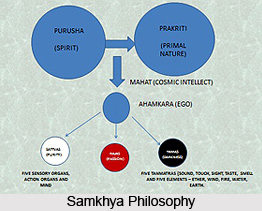
Samkhya Philosophy
Samkhya philosophy is one of India’s oldest intellectual traditions, explaining reality through the interplay of Puruṣha (pure consciousness) and Prak...
Maya, Prakriti in Hinduism
Maya or illusion is a very potent instrument of the Divine Prakriti, the Primal nature. In Hinduism one must be able to come out of Maya in order to a...
Samadhi in Hinduism
Samadhi is the result of meditation or that state of mind when there is an absence of all idea of individuality.
Samadhi in Buddhism
According to Buddhism, oen can only achieve samadhi through strict meditation and right concentration.
Abdul Rehman Jilani Dehlvi
Syed Abdul Rehman Jilani Dehlvi was a renowned Sufi saint of the Qadri Order in India.
Related articles in Indian Philosophy

Ajivika Philosophy
Ajivika philosophy is different from the mainstream religion
Indian Philosophy In The Vedic Period
Indian Philosophy in the Vedic Period was primarily based on the concepts of nature worship.
Achintya Bheda Abheda Philosophy
Achintya-Bheda-Abheda is a School of Vedanta that represents the philosophy of unimaginable one-ness and difference in relation to the power creation...
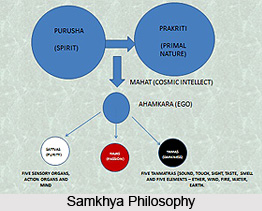
Samkhya Philosophy
Samkhya philosophy is one of India’s oldest intellectual traditions, explaining reality through the interplay of Puruṣha (pure consciousness) and Prak...
Charvaka Philosophy
The Charvaka Philosophy believes that only those things that can be perceived is the ultimate reality.