About Buddhist Art In India
The main purpose of Buddhist art in India was to popularise the religion of Buddhism. Buddhist art in India came into being after the historical life of Gautam Buddha during the sixth to fifth century B.C. and then it developed by contact with other cultures as it spread all through Asia and the world.
The presence of Lord Buddha was portrayed by the symbols of empty throne, a pair of foot prints, a lotus, or a Bodhi tree. The sculpture developed later on into more precise and explicit definition of the episodes relating to the life of Lord Buddha and his teachings. It is in north India that the first anthropomorphic representation of Buddha is said to have emerged. The two main proponents of Buddhist art in India is the Gandhara School and the Mathura school of art.
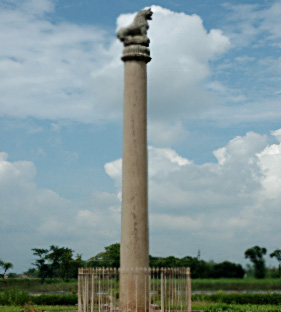
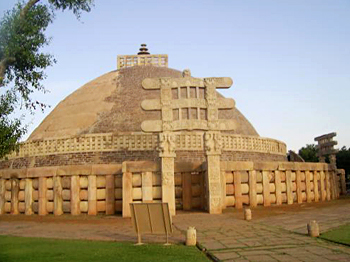
Buddhist art flourished in the panorama of Indian art during the Maurya dynasty under the reign of emperor Ashoka, who embraced Buddhism. The several stupas like the one in Sanchi and the pillars adorned with Buddhist symbols were the earliest instances of Buddhist art in India. These stupas comprise a hemispherical dome with a harmika supporting the umbrellas. The sculpture of Bharhut depicts stories from the life of Lord Buddha and also tales from Jataka. The sculpture dealing with the life of Gautam Sakyamuni includes Buddha`s enlightenment, the vision of Maya, and the defeat of Mara among others. In the sculptures of Bharhut, Amravati and Sanchi the worship of the Bodhi tree is widely prevalent. The Buddhist art in south India during this era is best represented by the Maha chaitya at Amravati which resembles the art at Bharhut. The Buddhist art at Amravati is noted for its sophistication and elegance.
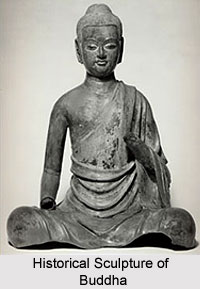
The Kushana dynasty came into power after the Mauryas and it was under their reign that the two major centers of the creation of the Buddhist art evolved namely the Gandhara School of art and the Mathura school of art. The art and sculptures of Gandhara had a strong influence of Greco- roman culture and thus was an amalgamation of Indian and foreign motifs. The art of Mathura on the other hand is completely Indian in style and form and draws heavily from the ancient school of art. Lord Buddha was illustrated both as a man and a god and this became the iconographic cannon for ensuing Buddhist art. Under the Gupta period which extended from fourth to sixth century A.D.
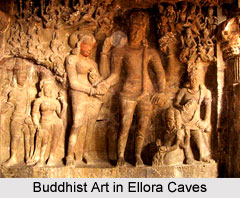
Buddhist art in India gained more prominence. It was combined with restraint and aesthetic sense. Nalanda, Sarnath and Mathura were the three pivotal regions which marked the Buddhist art in this period. The images of Lord Buddha from Sarnath and Mathura are hallmark of Buddhist Indian art. The caves of Ajanta contain illustrations depicting stories from Buddha`s life and also tales from the Jatakas. There are numerous statuettes of Buddha and Bodhisattvas present in the Ellora caves.
By the seventh century A.D. with the invasion of the Huns Buddhist art gradually disappeared from the northern India leaving its trace only in Bengal and Nalanda. Buddhist art in this last phase of its development in India was produced under the patronage of the Pala and Sena Dynasties. The principal site of this last centre of Indian Buddhism and its art was the great university of Nalanda. The architecture reveals a style that is a continuation of the architectural form of the Gupta period. This last phase of Buddhist art flourished in Bengal from the eighth century until the extirpation of the religion by the Mohammedan invasions. Buddhist art in India gradually came to an end in the twelfth century A.D.
Development of Buddhist Art in India
Buddhist art developed to the north through Central Asia and into Eastern Asia to form the Northern branch of Buddhist art. It had spread to Southeast Asia to form the Southern branch of Buddhist art. In India, Buddhist art prospered and influenced the development of Hindu art. Buddhist art is meant for those monuments and paintings whose main purpose is the edification of Buddhism.
Pre Buddhist Art in India : During the Vedic period, Hindu art was not found probably because of the perishability of the medium or because of absence of idol-worship. The art is non-Aryan which is mainly found in the Indus valley. This art is based on elements and materials of popular religion and folklore. The Indus art was represented by large towns, seals, sculpture, pottery, jewels and figurines. The art was utilitarian represented by baths and granaries. In the Central plateau there are paintings on rocks. Such paintings are found for instance in the Son Valley in Mirzapur district, in Manikpur and its neighbourhood, in Hoshangabad District and in Panchmarhi. They depict hunting scenes, pastoral life and dancing. The primitive art was concerned with worshipping the deities like the Yakshas, Nagas and feminine deities that signify powers of fertility. This popular art was the precursor of the art of the cultured classes, attaining its first great development in the time of Ashoka and it is seen in his pillars.
Early Buddhist Art in India :
It is represented by religious monuments which are of two kinds, namely, rock-cut and structural. The latter comprises of two principal varieties, the Stupa and the temple. There is no representation of Buddha himself. He is being represented by symbols like footprints. Structural monuments are found in Sanchi Stupa, Sarnath, Bharhut, Taxila, Amravati, and Nagarjunakonda. Rock cut architecture in Barabar and Nagarjuni hills in Bihar, Bhaja, Bedsa, Elephanta caves, Ajanta caves and Ellora caves in Western India, Mahabalipuram, Undavalli and Bhairavakonda in Madras while those of the temple are found in Sanchi, Besanagar, Taxila, Deogarh, Bhitargaon, Badami, Bodh-Gaya and Nalanda. Asokan sculptures are masterpieces in style and technique. The Asokan capital at Sarnath is a great example.
Buddhist styles are natural in design; with a distinct element of sensuousness, its wood-carving technique, and the general absence of foreign influences make it distinct. Animals are represented beautifully.
Itushan or Graeco-Buddhist Art in India : In this phase there are controversies as to how the Buddha statue developed. The statue was a foreign importation or an indigenous evolution is doubtful. Lord Buddha was first represented by his relics, personal possessions and trees, then by his life and later through his material form. Mathura and Gandhara schools of art claim this honour and it may probably be the case that both developed this form simultaneously. Buddha with a moustache as in the Gandhara style is Greek and unthinkable in the Indian system where Buddha the Yogi reminds one of the Vedic conceptions. The Mathura style resembles the forms of divinities as found in Bharhut. Thus the Buddha image is Indian in both conception and origin and is fashioned strictly according to the iconographic traditions embodied in the older indigenous works. The Kushan art is to be found in Afghanistan, Mathura, Kashmir, Besanagar and Amravati. The Gandhara art is a fusion in which provincial Roman forms are adapted for the purpose of Indian imagery. Mathura art is natural, direct and vibrant.
Colour Symbolism in Buddhist Art
The historical and inspiring life of Gautama Buddha had generated the concept of Buddhist art in India. With the spread of Buddhism and the Indian culture to other parts of the world, particularly in Asia, Buddhist art has also evolved over the periods. According to Buddhism, each of the five basic colours, the Pancha-Varna, white, blue, yellow, green, red, has special significance and depicts a celestial Buddha, and a state of mind and soul.
The concept of Rainbow body, state of meditation, in Buddhism, is the penultimate and transitional form, where substance is converted into pure energy of light. The details and shades of the colours may vary but the number of five basic colours remains static. There are five different aspects of the transcendental Buddha-
* The white bodied, Vairochana
* The Blue bodied, Akshobhya
* The yellow bodied, Ratnasambhava
* The Green bodied, Amoghasiddhi
* The Red bodied, Amitabha
Each of the Buddhas and their respective colours are believed to initiate the process of converting particular negative human emotions into positive traits, by just meditating on a particular colour. The symbolism and transformative properties of each colour are mentioned below:
White
White is which is comprised of all other colours and occurs when the entire spectrum is viewed collectively. Thus it is considered that every aspect is present in this colour. White is assumed to possess the qualities of extreme cold, as in ice, and excessive hot, like a blazing metal. Both the extremes can be life saving as well as fatal. White not only involves the entire spectrum but also has the ability set matter apart and brings termination to anything, including life. White is inherently involved in Buddhism, the most renowned being the birth of Siddhartha.
Blue
According to Buddhism, the colour Blue, both light and dark shades, are of ample significance. Blue is generally associated with infinity, healing, coolness and purity. But it is also believed to harbour the emotions of anger and rage. In Buddhism, meditating on the colour can transform such negative feelings into clear wisdom and purify and heal the soul. Turquoise, which boasts the lighter shade, is believed to reassure a secure journey when used in the form of a ring, and if the stone is found, then it is believed to fetch good luck. The Blue Buddha or the healing Buddha depicts the influence of the darker shade in Buddhist art. This colour signifies the pure and rare.
Yellow
Due its close resemblance with daylight, yellow is considered to the most symbolic value in Buddhism. All the Buddhist monks usually wear saffron robes which depicts renunciation, desirelessness and rootedness. Gautama Buddha selected yellow, which signified his modesty, humility severance from materialistic world. Yellow, the colour of earth, denotes equability and calmness on earth.
Green
The colour green appears in the middle of the seven coloured spectrum or the rainbow, and thus denotes the traits of equilibrium, balance, stability and harmony. Green is the colour of nature and symbolises vigour, youth and activity. Meditating on green can transform feelings of jealousy into wisdom of accomplishment. Amoghasiddhi, restates that green is the colour of action.
Red
The colour red is considered as the colour of passion, life, preservation, fire, and the sacred and is believed to transform illusion of attachment into the wisdom of judgment. Red is seen as the colour of rituals. The precious coral, which encompasses red, is believed to instil flexibility and flow and signifies energy of life force. It is believed to possess the protective qualities. Amitabha embodies this colour, and thus red is the only other colour which can be seen in monk`s robes and garments.
The symbolism of the red colour is illustrated in Buddhist painting type of Red Thangkas, which necessitates expert technical intelligence. All the elements in this style of painting include shades of red in some way.
Other than these the colour black is also worth mentioning in Colour Symbolism in Buddhist art.
Black
Black denotes the primal darkness. Paintings in black, which appeared relatively late in Buddhist art, provided another dimension to artists to illustrate magnificent worlds. The aggressive deities who are portrayed in the Black Thangkas portray the inner darkness of hate, jealousy and ignorance, and also it`s importance in the re-emergence of truth and purity. Black symbolises of hate, and transforms hate into compassion. Darkness embodies the immediacy of the supreme.
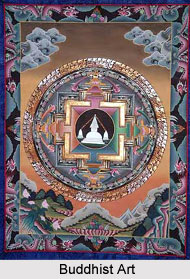
It is stated in the Mahavairochana-Sutra, that the Mandala, the symbol of Tibetan Buddhism, should ideally be portrayed in 5 colours. According to then The Chakrasambhara-tantra, the Mandala, painted in 5 colours, should use black in the core followed by white, yellow, red and green. In particular Mandalas, different directions are portrayed in different colours, like east is indicated by white, west by red, north by green, and the south by yellow while the centre is painted blue. But a different routine is suggested by the Kalachakra-tantra, the black signifies east, yellow signifies west, white signifies north, and red indicates the south. The protecting circle of a Mandala is typically portrayed in red. The elements of fire, water, air and earth are also shown with four separate colours, red, white, blue and yellow respectively.
Buddhist art have been modified from basic conventional principles, and it has never bothered to imitate or portray the outside world. The main objective of Buddhist painting was to arouse beaming internal symbols, in order to enhance the mind, body and soul with the teachings of Buddha and the principles of Buddhism.
Buddhist Art In South India
The towering point of development in South Indian Buddhist art was attained in the Later Andhra Period in a collection of monuments dedicated by the Andhra sove¬reigns at Amaravati at the mouth of the Krishna River. The ruins of great stupas with surrounding monasteries have been found at Ghantasala, at Nagarjunakonda, at Goli Village, and Gummadidirru. The most famous of all the later Andhra shrines was the Great Stupa at Amaravati.
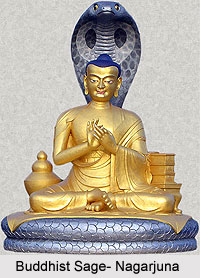
The construction of the original structure of the great Stupa of Amaravati had begun as early as 200 B.C. but structure was enlarged and embellished with great richness in the second century A.D. The inscriptions of Amaravati prove that the railing and casing slabs of the Great Stupa were added during the time of the Buddhist sage Nagarjuna"s residence in the Andhra region. The diameter of the dome of the Stupa at ground level was roughly around one hundred and sixty feet and its over-all height about ninety to one hundred feet; it was surrounded by a railing thirteen feet high con¬sisting of three rails and a heavy coping. Free¬standing columns surmounted by lions replaced the toranas of earlier structures at the four entrances to the pradaksina enclosure. Like Sanchi, the Amaravati Stupa had an upper processional path on the drum of the structure; this path also had an enclosing railing consisting of uprights joined by solid rectangular panels. Originally, not only the parts of the two railings, but also the drum, were covered with elaborate carvings in the greenish-white limestone of the region. Plaster reliefs substituted the stone casing for the decoration of the cupola because of the difficulty in fitting a stone revetment to a curved surface. Another unusual feature of the Stupa is that it consists of offsets or platforms located at the four points of the compass and surmounted by five pillars carved with representations of Buddhist symbols such as the Wheel and Stupa. In the decoration of the base a number of images of the Lord Buddha can be seen, a clear indication that, although probably originally dedicated to Hinayana Buddhism, the shrine was, under the influence of Nagarjuna, transformed into a Mahayana sanctuary.
In the centre of the wall painting at the top there is an image of the seated Buddha. On either side of this representation of the Temptation of Mara with the Buddha in anthropomorphic form are symbolical por¬trayals of the empty throne beneath the Bodhi tree. It is as though the Later Andhra Buddhists, even though followers of the Great Vehicle, were loath to give up the old Hinayana em¬blems, or perhaps attached a certain authority and appropriate sanctity to the early forms of the art of their religion. To right and left of the main section of the relief are vertical framing panels with representations of stambhas with lion capitals upholding the Wheel of Dharma. At the foot of each pillar there is an empty chair signifying the presence of the Buddha. In addi¬tion to the reliefs a number of free-standing Buddha images were found in the Stupa area placed round the base of the monu¬ment.
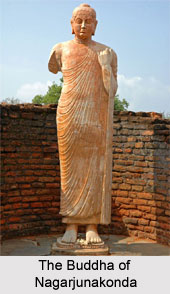
The Buddha, excavated at Nagarjunakonda, is represented standing wearing the Buddhist robe with the right shoulder bare. The heavy, colossal conception of the figure, together with the definition of the drapery by a combina¬tion of incised lines and overlapping ridges indicating the course of the folds and seams, is distinctly reminiscent of the Buddha images of the Kushan School. Iconographically, the con¬ception is related to Gandhara sculpture in the repre¬sentation of the Buddha wearing the monastic robe, but beyond this there is no indication of any direct stylistic influence from this centre of Greco-Roman art. Peculiarly characteristic of the Buddha images of the Amaravati region is the heavily billowing fold at the bottom of the outer mantle where it falls above the ankles. A typical head of a Buddha from Amaravati reveals a certain relationship to the heads of Kushan images in the general fullness and warmth of conception. In contrast to the roundness of the facial curve of the Mathura Buddhas, the heads from Amaravati are of a more narrow oval shape. All the heads of Buddha from this site invariably have the hair represented by snail-shell curls, following the scriptural account of the Buddha`s appearance. In many respects these Later Andhra heads are more softly and plastically modeled, with less reliance on linear definition of the features.
The relief compositions at Amaravati are iconographically much more complicated in their illustration of the Buddha legend than anything found in either Gandhara or Mathura. Stylistically the Amaravati sculptors have a fondness for a very complicated and perhaps un-Indian arrangement of figures and settings in a number of planes. The Great Stupa at Amaravati is only the most important monument of a great style and other sculptural fragments no less distinguished in execution have been found at Nagarjunakonda and at Goli Village, both in the Krishna region. There are some indications based on recent excavations in the Amaravati region that the so-called Later Andhra style may have survived there even after the rise of Gupta power in the fourth century; indeed, until the rise of the Pallavas. The persistence of this late phase of Andhra sculpture is represented largely by Bud¬dhist images. This disappearance of Buddhism and its art in South India is probably to be explained by the gradual rise of Hinduism.