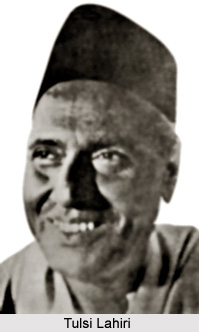
 Development of drama in the twentieth century saw a process of ups and downs till its final revival in the 1940`s. In West Bengal, drama has always lacked the popularity that has been enjoyed by its counterparts in prose and poetry. Following the explosion of activity in the late nineteenth and early twentieth-century, dramatic writing in West Bengal underwent a rather steep decline. It was revived during the 1940`s on the request of the Indian People`s Theatre Association (IPTA), a cultural wing of the Communist Party of India. This association encouraged the various playwrights like Bijon Bhattacharya and Tulsi Lahiri (1897-1959) to write new plays in a realistic mode that depicted the lives of the downtrodden. This ultimately led to the emergence of the New Drama Movement.
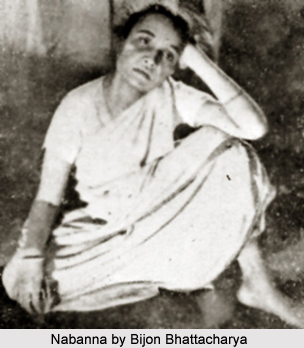
Bhattacharya wrote Jabanbandi (The Statement) and Nabanna (New Harvest) in 1944, both of which had considerable impact on the Bengali theatergoers. Lahiri wrote Pathik (Traveler, 1949) and Cherha Tar (The Broken String, 1950). As a result of the work of the IPTA in the late 1950s and early 1960s, a number of theatre groups emerged. They launched what is known as the Group Theatre Movement which, in its turn, took the New Drama movement to different realms and updated Bengali theater with what was happening in the West. New Drama, however, did not produce as many original playwrights, since it was mainly interested in bringing the best of Western theater- Ibsen, Chekhov, Pirandello, Brecht, Wesker, Miller, and others- to the Bengali audience rather than creating its own. However the playwrights who adapted foreign plans in great profusion also wrote a number of significant original plays.
 There was, for instance, Sombhu Mitra (1915), who adapted Ibsen and translated Sophocles for the first time in Bengali, wrote Terodyaktil (Pterodactyl) and Chand Baniker Pala( The merchant Chand`s pala), Ajitesh Bandyopadhyay (1933-83), who specialized in adapting Chekhov and Brecht, wrote Saodagarer Nauka (The Merchant`s Boat); and Chittaranjan Ghosh, who translated Annouilh (1928), wrote Nidhubabu and Dao Phire Se Aranya.
Utpal Dutta was a dramatic writer who prolifically wrote original plays in Bengali. In an amazing display of versatility as producer-director-actor-writer, Dutta wrote more than 30 original plays in Bengali on subjects ranging from the Sepoy mutiny, 1857 to the Germany of World War II. Some of his celebrated plays include Angar (Coal, 1959), Kallol (The Sound of Waves, 1968), Tiner Taloar (The Tin Sword, 1973), Duhswapner Nagan (Nightmare City, 1974), and Barricade (1975). Two important playwrights came into prominence in the 1970s- Manoj Mitra (1937) and Mohit Chattopadhyaya (1935). Some of Mitra`s major plays are Chakbhanga Madhu (The Stolen Honey, 1972), Narak Guljar (Heaven out of Hell, 1976), Sajano Bagan (The Well-Nursed Garden, 1977), and Rajdarsan (To See the King, 1982). Mohit Chattopadhyaya will be best remembered for his play Rajrakta (Royal Blood, 1971) and Socrates (1986).
These writers, i.e., Utpal Dutt, Mitra and others, were writing mostly realistic plays that were meant for the stage, the Bengali alternative avant-garde theater was fed by Badal Sircar, who started with the proscenium stage but rejected it in favor of the arena form that he identified as the "third theatre." Ebang Indrajit (And Indrajit, 1962), Baki Itihas (The Remaining History, 1967), Kabi Kahini (The Poet`s Story, 1968), Sara Rattir (All Night, 1969), Ballabhpurer Rupkatha (The Fairy Tale of Ballabhpur, 1970), and Pagla Ghora (The Crazy Horse, 1971) are best known among Badal Sircar`s plays for the proscenium stage, while Trihgsa Satabdi (Thirtieth Century, 1975), Michil (Procession), and Bhoma (1976) are his best-known arena "third theater" plays.
Manmatha Ray, Bidhayak Bhattacarya, Kiran Maitra, Dhananjay Bairagi, Sailes Guha Niogi, Jyotu Bandyopadhyaya, and others are among the lesser playwrights whose careers have spanned the 1950s through the 1970s. Among the major modern playwrights are Chanda Sen, Debasis Majumdar, Samir Dasgupta and Indrasis Lahiri.