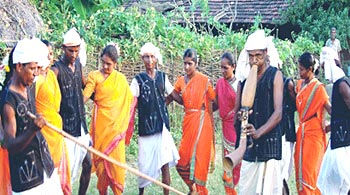
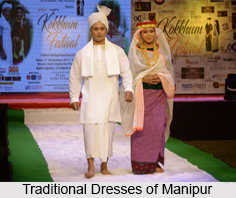
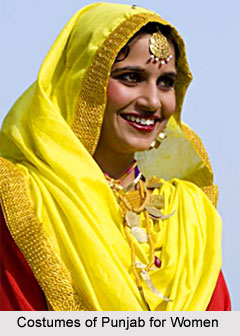
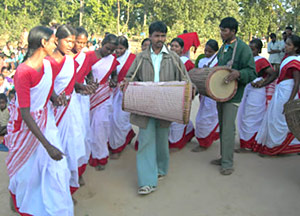
 Designs of Indian Sarees have a wide range of variety as different state has their own style and cultural background. Sarees play a pivotal role in promoting Indian ethnic culture and Indian women in saree are considered as the most beautiful in the world. Depending on these, the fabric of saree is highly structured and their design vocabularies are constructed in a very sophisticated way. The sarees are created keeping in mind the draping styles and the occasional usage. The Indian woman of every age prefers to wear sarees in the auspicious occasion of her life.
Designs in Indian Sarees
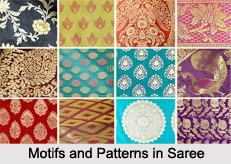
Designs of Indian Sarees are divided into 3 areas that are the longitudinal borders; the end piece; and the field. Estimating the social status, regional identity and community of a woman, the designs and the patterns of a saree is constructed for certain colours and motifs are region and community specific. Its size and elaboration are the indication of a family"s wealth because added ornamentation takes more weaving time, and so adds to the cost of the saree. Motifs in Indian sarees have often been derived from temple architectures, sculpture, painting and literature.
Borders in Indian Sarees
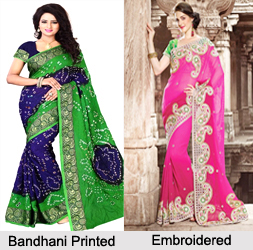
Borders usually extend the full length of the saree either as a woven design created by contrasting supplementary-warp or weft-weaving through the warp threads being a different colour to the warps making the field or by printing or embroidery.
Most of the regions, and even towns and villages, have their own traditional distinctive borders. In some states like West Bengal, the weavers are specialised in specific designs. Even though the width of borders tends to follow the present fashion rather than tradition, the regional origins of many border designs can still be recognized for their exclusivity. The well ornamented and costly sarees have larger and more elaborate end-pieces or pallu in comparison to the less costly ones.
The field of a saree is also embellished according to regional rules. In many parts of India the field of a saree are decorated with woven designs, embroidery or printing for the purpose of wedding ceremony. Following the tradition, artisans of some states make the field of the saree unadorned.
The designs of Indian sarees have now taken a new form as the artisans create a fusion of tradition and modern trend. This amalgamation has made the sarees achieve a height of appreciation in the modern market.