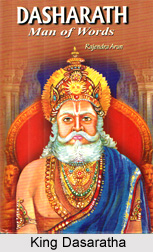
 Dasaratha was the Great King in the epic "Ramayana", who was the father of Lord Rama, the hero of the epic and the avatar of Lord Vishnu. Dasaratha was the scion of Raghuvamsa and the King of Ayodhya. He had three wives namely Kaushalya, Kaikeyi and Sumitra. The son of Kaushalya was Rama, son of Kaikeyi was Bharata and son of Sumitra were Lakshman and Shatrughna. Dasaratha and Kaushalya had one daughter, named Shanta, who was the wife of Ekashringa.
Four key events of Ramayana direct the entire tragedy of King Dasaratha`s life.
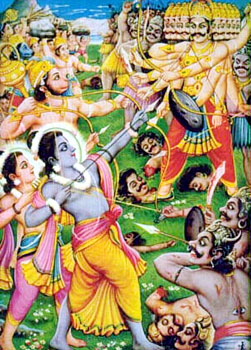
Event 1: The first story is about Dasaratha and Ravana. Hearing Dasaratha`s fame Ravana felt jealous and sent messengers to his court asking for his homage and regard otherwise threatened for the war. In reply Dasaratha shot off arrows and told the messengers that when they will return to Lanka they would found that main gates of Lanka to be shut closed by the arrows. Ravana felt humiliated at this defeat and took it as his insult. He also realized that King Dasaratha was superior to him. Then Ravana took a severe penance to pacify Lord Brahma. When Brahma appeared before Ravana, he asked him not to bless Dasaratha with the gift of child.
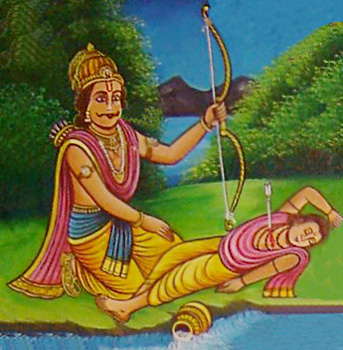
Event 2: Dasaratha was famous for his miraculous ability to hunt blind and shooting arrows by hearing the sound only. Once during one of his hunting expeditions, Dasaratha heard a noise resembling elephant drinking water and shot an arrow in the direction in quest of his prey.
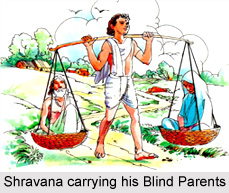
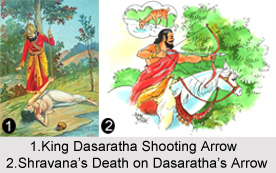 But to his astonish Dasaratha noticed that he had instead shot an young boy named as Shravana Kumar who was collecting water in a pitcher for his blind parents. Shravana Kumar was the only child of his parents and his parents were totally dependent on him. Shravana used to carry his parents everywhere on two pans of balance supported on his shoulder and collect water to quench their thirst.
At his death Shravana was inconsolable at the thought that his parents would be without any support to protect them. As his dying wish, Shravana asked the king to carry water to his thirsty parents. Dasaratha carried the water to the old couple and they drank the water without knowing that it was not being offered by their son. The king then hesitantly narrated the death incident of Shravana Kumar to his parents. The old couple was so distressed at the pathetic news of the death of their son that Shravana`s father cursed king Dasaratha that one day he too would suffer from "Putrasoka"; grief of separation from one`s son. The old couple then sacrificed their lives, as they did not want to live anymore after consuming water offered by their son`s killer.
Event 3: King Dasaratha also fought for the gods in the battle against Asuras and Kaikeyi acted as his charioteer. Kaikeyi saved Dasaratha`s life during the battle. Dasaratha was so pleased with Kaikeyi that he asked her to wish two boons, on which Kaikeyi said that she would ask when she wished to avail them. These three incidents played a significant role to make Dasaratha`s fate.
Event 4: By Ravana`s wish he had no sons, which he was able to overcome by performing the horse sacrifice to obtain children. Dasaratha was blessed with four sons. When the boys were grown up, Dasaratha decided to retire and embrocate his eldest son Rama to the throne of Ayodhya. Before the anoint ceremony took place Kaikeyi asked Dasaratha to grant him boons according to good old promise. She asked for the first boon her son Bharata`s enthronement instead of Rama and for the second boon she asked Rama`s exile to forest for 14 years. Dasaratha was helpless and he must grant the boons to maintain the truth, which was "Kshatriya dharma". After Rama left Ayodhya Dasaratha could not bear the pain of the separation from his most beloved son. Unable to withstand the anguish, the dispirited king Dasaratha died out of grief and pain and thus Shravana`s blind parent`s curse came true.
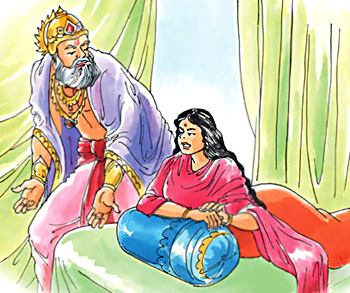 The Dilemma of King Dasaratha is included in the Ayodhya Kanda. Dasaratha, the king of
 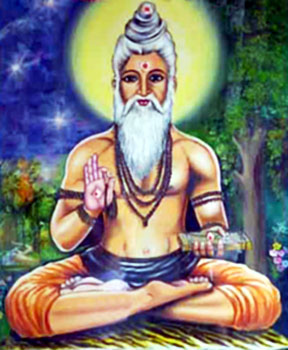 Horse Sacrifice of Dasaratha is one of the incidents narrated in the Bala Kanda of Ramayana by Valmiki. There was once a beautiful and a great city known as Ayodhya which was unconquerable in the country of Koshala. The subjects were righteous and happy, well read and contented, truthful, well provided with goods, self-restrained and charitable and full of faith. Their ruler was Dasharatha, a veritable Manu amongst men, and a moon amongst the stars. He had many wise counsellors including Kashyapa and Markandeya, and had two other saintly priests attached to his family, called Vashishtha and Vamadeva. To another great sage, Rishyasringa, he gave his daughter Santa. His ministers were such men who counsel and judge things finely; they were well versed in the arts of policy and ever fair-spoken. Only one desire of Dasharatha which was unsatisfied was that, he had no son to carry on his line.
 All the deities assembled in front of Brahma and requested him to help them from the evil works of the notorious rakshasa Ravana whom Lord Brahma granted a boon that he will not be slain by gandharvas, or yakshas, or rakshasas, or gods. Brahma replied that the evil rakshasa disdained to ask from him immunity from the attack of men and thus by man only the demon shall be slain. By hearing this, the deities rejoiced. At that time, arrived the great God Vishnu, clad in yellow robes, bearing mace and discus and conch, and riding upon Garuda. The deities reverenced, and prayed him to take birth as the four sons of Dasharatha for the destruction of the wily and irrepressible Ravana. Then that one of lotus-eyes, making of him four beings, chose Dasharatha for his father and disappeared. In a strange form, like a flaming tiger, he reappeared in the sacrificial fire of Dasharatha and, greeting him, named himself as the messenger of God. He told Dasaratha to distribute the divine milk and rice amongst his wives.
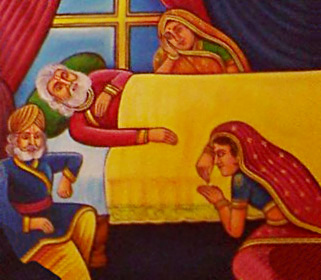
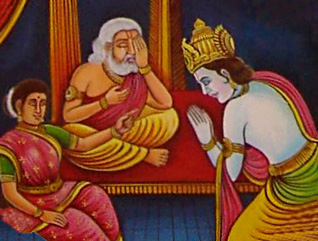 Death of Dasaratha after the exile of Rama, Lakshmana and Sita is narrated in the Ayodhya Kanda. Rama, after hearing from Kaikeyi about the two boons granted to her by Dasaratha, decided at once to go to the forest and asked for the coronation of Bharata to the throne of Ayodhya. Hearing about the banishment of Rama to the jungle for fourteen years, Lakshmana and Sita also decided to go along with Rama. Rama, Lakshmana and Sita together left Ayodhya for the jungle. Dasaratha, the king of Ayodhya, loved Rama very much and thus after Rama`s depart he was utterly struck with grief and remembered the curse which was given to him by a sage and his wife long ago.
 Long ago, when
  Bharata inquired if all was well with his father and mothers and brothers, and was assured that it was even so. Then the ambassadors delivered their message, and Bharata told his uncle and his grandfather, and took leave to go to Ayodhya. They conferred on him many gifts, as woolen clothes and deer-skins and elephants and dogs and swift horses; but he, filled with anxiety because of the dreams and the very hasty journey of the envoys, had little pleasure in the gifts, and taking with him