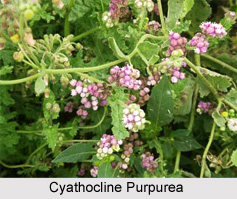
 Cyathocline Purpurea is a rare Indian plant with medicinal values. Its occurrence is reported as common to occasional and is considered a weed. As the plant has a rare existence, so it is not popular among the local inhabitants. Instead of its rare being, this plant is used for pharmaceutical usage. It belongs to Sunflower family and the whole plant is strongly aromatic.
Common Names of Cyathocline Purpurea
The plant is called by different names like it is known as Bandhaniya in Hindi; Gangotra in Marathi and Gal phulle in Nepali. Cyathocline Purpurea is the botanical name of this plant.
Habitat of Cyathocline Purpurea
This plant is commonly found in moist habitats such as along watercourses and in rice fields or on the banks of river streams throughout most of peninsular and northern India. It is also available in the western and the central Himalayas. It is found growing at an altitude of 800-1,800 m. The places where it is usually found include Himalaya (Kashmir to Bhutan), Assam, India, Burma, Thailand, Indo-China and China.
Characteristic Features of Cyathocline Purpurea
This Indian medicinal plant is an erect, delicate, gregarious, strongly aromatic, glandular hairy annual or biennial herb. It grows up to 20-50 cm high. The stems of this plant are usually reddish or purplish tinged, branched from the base and glandular-pubescent. The leaves are sessile, variable in size and shape, 5cm to 15 cm long, upper leaves are smaller; segments are serrate-dentate to lobed and are covered with thin hair.
Flowers and Fruits of Cyathocline Purpurea
The flowers are usually in purple colour and occur in corymbs at the end of branches. The corolla is composed of marginal filiform flowers that are 1.2 mm to 1.4 mm long and disc flowers are 2 mm long with glandular-hairy lobes. The fruits or achenes are 0.3 mm long and usually bear a persistent or deciduous pappus.
Medicinal Uses of Cyathocline Purpurea
This Indian plant has several medicinal uses. The roots of Cyathocline Purpurea are reportedly used to relieve stomach pain. This plant releases an essential oil that reportedly owns antimicrobial, anthelmintic and hypotensive properties.