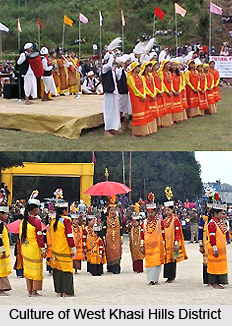
 Culture of West Khasi Hills District is principally tribal in character as this district is inhabited by Khasi Tribe. Khasi society has greatly been transformed by many factors in the recent times. Adoption of the western style of life, especially among the literate and educated, has been quite rapid although the matrilineal laws of inheritance and succession and the other cultural traits are still retained in a Khasi tribe.
The social and cultural events of West Khasi Hills District are similar to that of East Khasi Hills District. The dances of significance with a distinctive style of West Khasi Hills District are the `Lyngngam dance` where men in dhoti and turban and women in sarong type of clothing dance to the beat of different drums (Ksing) and flute (Besli), the Shad Kiew Iing, Shad Mastieh and the Shad Suk Mynsiem. Traditional as well as modern dresses are worn by the Khasi people. A head cover (Tapmohkhlieh) is used by the women. However, most males still use the wrapper (Ryndia Tlem) over their coats, during the cold season.
Traditional sports, arts, crafts, festivals and their religious beliefs form an integral part of the culture of West Khasi Hills District. Archery is the most popular traditional sport in rural parts of the district while among modern games; football, basketball and badminton have gained popularity with majority of the young people. Hunting and fishing are the seasonal sports which are considered as recreational activities, and community hunting by using tracking dogs is still being practiced in the region. Another recreation activity is bull fight which is being organized occasionally for gambling and betting.
Music occupies a central position in the cultural life of the people of West Khasi Hills District, especially the youth. Indigenous instruments such as the `duitara` (4-stringed instrument), `besli` (flute), `nakra` and `bom` (percussions) are still in use. The district boasts of a number of composers, radio and stage artistes. Another significant social factor of West Khasi Hills District is an `8 days-a-week` market system, which is still being adopted by the people. The distinct characteristic of these markets, commonly known as `Iew`, is that they serve not only as places for trading activites but also as a place for socialization, business transaction and other festivities like holding of fairs, sports and games, etc. These markets are held after eight days in different places of the district. Thus, it is clear that culture of West Khasi Hills District reflects the traditions and beliefs of the Khasi tribe.