
 Morigaon District is an administrative district of Assam. This district is bounded by Brahmaputra River in the north, in the south by Karbi Anglong District, in the east by Nagaon District and by Kamrup District in the west. Morigaon District is an agrarian district. It is situated between 26.15 degrees north and 26.5 degrees north latitude and between 92-degree East longitudes. Morigaon town, headquarter of the district is located at 78 kilometres from Dispur. This district is the second smallest district of Assam. Morigaon District was a sub-division of Nagaon district since 26th January 1972. Morigaon District occupies a total area of near about 1450 sq km.
Morigaon District
Morigaon District is one of the districts of Assam. This district is covering an area of 1450 sq km. Economy of Morigaon District is mainly agriculture based.
Introduction
Morigaon District is an administrative district of Assam. This district is bounded by Brahmaputra River in the north, in the south by Karbi Anglong District, in the east by Nagaon District and by Kamrup District in the west. Morigaon District is an agrarian district. It is situated between 26.15 degrees north and 26.5 degrees north latitude and between 92-degree East longitudes. Morigaon town, headquarter of the district is located at 78 kilometres from Dispur. This district is the second smallest district of Assam. Morigaon District was a sub-division of Nagaon district since 26th January 1972. Morigaon District occupies a total area of near about 1450 sq km.History of Morigaon District
History of Morigaon district has not been fully explored yet. Arimatta is a well known traditional ruler of this region. The history of this ruler is also unknown. Jongalbalahu, the son of Arimatta, took over his throne after his death. Jongalbalahu was later killed by the Kacharis, near Kajalimukh, using a bamboo spear. Legends say that, to save himself Jongalbalahu got submerged in Kollong River and emerged at Raha for quenching his thirst. He then dived again and emerged at Jagi. The places Raha and Jagi take their name from this incident.
 History of Morigaon district and its adjacent areas has been deciphered to some extent by the writing of Bhimsingh. Six rulers independently ruled over the region. During this era, two princes belonging to Darrang namely Makardhvaj and Supradhvaj fled away from their land owing to some internal clash. They crossed the Brahmaputra River and settled at Bahakajari. Supradhvaj later married the daughter of the king of Baghara, Mangalsingh. Supradhvaj was then coronated as the seventh king of this region and was given a separate kingdom of his own.
During the period of Lachit Borphukan, another two princes namely Bhimsingh and Ram Singh, belonging to Darrang had crossed Brahmaputra River to search for plain lands. The settlement of Bhimsingh was followed by the return of Ram Singh for his homeland. Bhimsingh could never be liked by the local folks and hence moved and settled in Mori Beel. This place later came to be known as Morigaon.
Morigaon acquired the status of a district on 29 September 1989, after its separation from Nagaon district.
History of Morigaon district and its adjacent areas has been deciphered to some extent by the writing of Bhimsingh. Six rulers independently ruled over the region. During this era, two princes belonging to Darrang namely Makardhvaj and Supradhvaj fled away from their land owing to some internal clash. They crossed the Brahmaputra River and settled at Bahakajari. Supradhvaj later married the daughter of the king of Baghara, Mangalsingh. Supradhvaj was then coronated as the seventh king of this region and was given a separate kingdom of his own.During the period of Lachit Borphukan, another two princes namely Bhimsingh and Ram Singh, belonging to Darrang had crossed Brahmaputra River to search for plain lands. The settlement of Bhimsingh was followed by the return of Ram Singh for his homeland. Bhimsingh could never be liked by the local folks and hence moved and settled in Mori Beel. This place later came to be known as Morigaon.
Morigaon acquired the status of a district on 29 September 1989, after its separation from Nagaon district.
Geography of Morigaon District
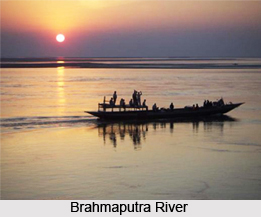
Greater part of Morigaon District is an alluvial plains dotted with many beels and marshes, numerous rivers and waterways. Brahmaputra River flows along the northern boundary of the district. Killing, Kollong and Kapili rivers flow through the southern part of the district. Geographical features of Morigaon District indicate that its general appearance is extremely picturesque. There are three reserved forest constituted under Assam Forest Regulation Act, 1891. These are Sunaikuchi, Khulahat, and Bura Mayong. There is also one wildlife Sanctuary, named Pabitora Sanctuary, which is famous for the Indian one horned Rhinoceros.
Demography of Morigaon District
According to the Population Census in the year 2011, the Morigaon District had population of 957,853 of which male and female were 485,328 and 472,525 respectively. Morigaon District population constituted 3.07 percent of total population of Assam. The population density of Morigaon district for 2011 is 618 people per sq. km. The average literacy rate of Morigaon was 69.37 percent compared to 58.53 of 2001. If things are looked out at gender wise, male and female literacy were 73.66 and 64.99 respectively. The total literates in Morigaon District were 554,143 of which male and female were 297,422 and 256,721 respectively. In 2001, Morigaon District had 5,312,396 in its district.
Culture of Morigaon District
Culture of Morigaon District depicts the unique confluence of Morigaon. The culture is silhouetted by Magic and Necromancy of Mayong. Mayong is a historical place, located on the bank of the River Brahmaputra which is only 40 KM away from the district headquarter Morigaon. It is situated beside Pobitora Sanctury, the place of World famous one horned Rhinos. In the 16th century, Shunyat Singha, the youngest brother of the Kachari King Shatrudaman of Mayong established the Kingdom of Mayong. This place was popularly known for its magic and necromancy. Wherever people heard of Mayong about "Jantra-Mantra" they are terrified and anxious.
Based on the Vedic Dharma, the tradition and faith of the ancient society had evolved in the 4th and 5th centuries under which the practice of magic became apparent. In course of time in the 17th Century the different & etc of Buddhism got mixed with Hinduism .Such tradition got spread by taking Maa Kamakhya (the goddess kamakhya) as its centre. During that time the society has been tremendously influence by the supernatural activities of the Mahajani (one arrow of Kamdeua) marrau (the act of killing or striking) people got in vowed in such activities instead of performing their own religion such traditions and faith had developed among the people with the faith in supreme goddess maa- kamakhya. According to yogini jantra, the main place maa - kamakhya was hundred gorges (a distance of Nine miles) of length and thirty gorge of width. This means that the Mayang was contained to this particular area, In course of time, due to the increase of sustain, so a lonely and remote place in the cast era side, Mayang was chosen to perform such activities. The devotees continued such performances by erecting four idols of Lord Ganesha (son of Siva and Parvati) in four different sides, such practices of magic and necromancy of the past made mayang famous as a land of magic and necromancy (Jantra-Mantra).
 It was believed that the influences of magic and necromancy had been tremendous. It recovered people from suffering of diseases could save from the attack of wild animals, form evil forces, devils and demons etc by applying Jantra Mantra. Even to save the selves form enemies and to beat the enemies, Propel used to apply Karati ; guaranty; Barkarati ; Panikarati; Sarba - dhak Karati, Pakshiraj mantra, Narasingha Mantra had been used. The magic and necromancy is believed to have performed many supernatural activities like making a fish from a leaf of trees, making the cooked fish alive the sitting pira (a stool) got attached to the guest etc. The fame of Mayang as land of Magic and necromancy is still alive which is famous not only in Morigaon but also in the country.
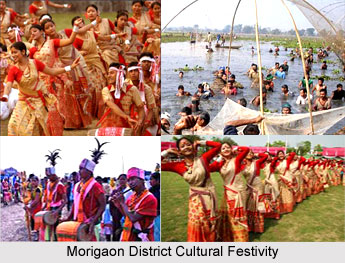
Jonbeel Mela is a folk festival of the community centred on ancient barter System with its distinctive features, the festival has been observed since ancient time of gobha kingdom it is held on the bank of junbeel (water area) which looks like a crescent moon. Beside Morigaon Jagiroad main road four kilometres north east of Jagiroad town and two kilometres of Jagibhakatgaon. It is held for three days just a week after the Sankranti of Assamese Puh month generally from Thursday to Saturday .the Magh Bihu festival of the Gobha Kindom is observed on the Saturday and Sunday of the Second week in the month of magh (January- February).
The beginning of the mela with the barter System its back ground is historical, Among the tiwa (Lalung) Kings,the Gobha King was the most powerful .With a view to ruling subjects efficiently, to Communicating his subjects, to integrating economically the hills and plains people, to establishing their relations, the King of Gobhga established community mart at phulaguri (only three Kilometres south to the National Highway,37 near nelli) to exchange their eventual commodities. Even the then Jaintia King and the offices of Ahom king assembled there to exchange their opinions. It was necessary to exchange the essential commodities as the Gobha King did not used currency in their Kingdom. In barter system is the consequence of the decision of Gobha king to be held on the bank of Jonbeel, a suitable place selected for ceremonial festival for exchanging their necessary goods, the neighbouring tiwa king Jayantia king were also invited to the mela and therefore a festive was set forth. Now, the mela has been transformed into a community market which transcends the differences of geography, religion Castes and genders.
The hills people bring with then items like sesame, ginger, turmeric, arum, potato, lac, chillies, cotton, cane and bamboo products, rice cakes of the plains tiwas, Such ancient barter system is still intact .the community fishing in Junbeel is also an integral part of the mela, now, the people outside Morigaon district also participle in the festival, Now the people outside Morigaon district also participate in the festival, particularly people from neighbouring Nagaon, Kamrup and Karbianglong district of Assam and many people from Meghalaya also participate in the Mela. The people of other parts of Assam also attend the Junbeel Mela which creates a good atmosphere among the people and helps to maintain unity and amity in the society. Thus, Junbeel Mela becomes a festival of communal integration and harmony.
Gosoin Uliwa Utsav is a particular type of Mela that is observed in different places of Morigaon and Nagaon District of Assam after the Bohag Bihu festival that continues to the last day of the Jetha Month.This festival is known as Gosoiuliwa or Bohagi Mela Firstly, it is organized in Jopakudi then it has been observing in different places like Barapujia, Charaibahi, Niz-Mikirgaon, Jarabari, Habiborongabari, Mayang etc. The last Mela of the season is held on the last day i.e. 31st of Jetha month at Doloisuba which is known as `Bohagi Mela`. At present hundreds of such Mela is organized in different villages of Morigaon district irrespective of caste and community, people assemble there with enthusiasm and love. Guests from neighbouring village are invited to every household on the occasion of the Mela. Relationship among the people and Kith and Kin are refreshened and has merriment and enjoyment.
It is noteworthy here to the fact that, initially this folk festival was organized and institutionalized in the 16th and 17th Centuries under the patronage of the Jiwa Puwai rajas. Accordingly to hearsay Chalarai, the brother of the Koch King Naranarayan , was captured by the Nawab of Gour while going to attack his kingdom, in order to attack Gour king Naranarayan sought help and co- operational from the Jiwa Puwali rajas of Pachuraja and saturajas kingdom, incidentally, the Nawab`s mother was bitten by a snake. The Nawab`s mother was saved under the treatment of Chalarai. To show his gratitude, the Nawab released Chalarai with honour and dignity. So they did not need to fight. But Koch King Naranarayan showed his gratitude to the Puwali rajas of Jiwa Kingdom by giving gifts and honour to organized festivity, since then Mela was organized by Jiwa Puwali rajas where people dance with swords and shields of wars. According by Sridhar Kandaki Melas were organized as a mark of complimentary to `phakua` (Holi festival) on the day of Namghars and temporal established on the pedestal under the temporally constructed `rabhaghar` made of kalpat placed in the monikut ; Hearsay again informs us that when `Damodar ataa` gave `saran` to chetua, one of the Pachu rajas in order to propagate Vaishnavism, advised to organize Doul utssau .It is clear from the about hearsays that the Gosaiauiwa utsau emerged under the patronage of the Tiwa king. Now a day, it is `Namghar` and `Manikut` are cleansed. Khatula is constructed in hierarchically shaped wooden shelves where `Gunamala` or `Bhagawat` is placed in the same places, idols of Krishna or Bishnu or other is placed temporarily under the `Rabhaghar`. The King and the other officials before the sun sets, the Khatula is carried to its original place. With the rhythm of the `Barshul`, the Baruotis dance with shields and swords, in this way, the Gosain Uliwa Utsav or Mela Utsav is organised after Rangoli Bihu festival in different places of Morigaon District.
Charaibahi is a historical Place, where trienmial komiti Bhawna of Charaibahi is observed once in a blue moon of three years with great enthusiasm and gaiety. Sinc 1858 A.D. people have been observing it by performing the noble creation of Naat-Bhawna of Sri Sri Sankarde.
Based on the Vedic Dharma, the tradition and faith of the ancient society had evolved in the 4th and 5th centuries under which the practice of magic became apparent. In course of time in the 17th Century the different & etc of Buddhism got mixed with Hinduism .Such tradition got spread by taking Maa Kamakhya (the goddess kamakhya) as its centre. During that time the society has been tremendously influence by the supernatural activities of the Mahajani (one arrow of Kamdeua) marrau (the act of killing or striking) people got in vowed in such activities instead of performing their own religion such traditions and faith had developed among the people with the faith in supreme goddess maa- kamakhya. According to yogini jantra, the main place maa - kamakhya was hundred gorges (a distance of Nine miles) of length and thirty gorge of width. This means that the Mayang was contained to this particular area, In course of time, due to the increase of sustain, so a lonely and remote place in the cast era side, Mayang was chosen to perform such activities. The devotees continued such performances by erecting four idols of Lord Ganesha (son of Siva and Parvati) in four different sides, such practices of magic and necromancy of the past made mayang famous as a land of magic and necromancy (Jantra-Mantra).
It was believed that the influences of magic and necromancy had been tremendous. It recovered people from suffering of diseases could save from the attack of wild animals, form evil forces, devils and demons etc by applying Jantra Mantra. Even to save the selves form enemies and to beat the enemies, Propel used to apply Karati ; guaranty; Barkarati ; Panikarati; Sarba - dhak Karati, Pakshiraj mantra, Narasingha Mantra had been used. The magic and necromancy is believed to have performed many supernatural activities like making a fish from a leaf of trees, making the cooked fish alive the sitting pira (a stool) got attached to the guest etc. The fame of Mayang as land of Magic and necromancy is still alive which is famous not only in Morigaon but also in the country.
Jonbeel Mela is a folk festival of the community centred on ancient barter System with its distinctive features, the festival has been observed since ancient time of gobha kingdom it is held on the bank of junbeel (water area) which looks like a crescent moon. Beside Morigaon Jagiroad main road four kilometres north east of Jagiroad town and two kilometres of Jagibhakatgaon. It is held for three days just a week after the Sankranti of Assamese Puh month generally from Thursday to Saturday .the Magh Bihu festival of the Gobha Kindom is observed on the Saturday and Sunday of the Second week in the month of magh (January- February).
The beginning of the mela with the barter System its back ground is historical, Among the tiwa (Lalung) Kings,the Gobha King was the most powerful .With a view to ruling subjects efficiently, to Communicating his subjects, to integrating economically the hills and plains people, to establishing their relations, the King of Gobhga established community mart at phulaguri (only three Kilometres south to the National Highway,37 near nelli) to exchange their eventual commodities. Even the then Jaintia King and the offices of Ahom king assembled there to exchange their opinions. It was necessary to exchange the essential commodities as the Gobha King did not used currency in their Kingdom. In barter system is the consequence of the decision of Gobha king to be held on the bank of Jonbeel, a suitable place selected for ceremonial festival for exchanging their necessary goods, the neighbouring tiwa king Jayantia king were also invited to the mela and therefore a festive was set forth. Now, the mela has been transformed into a community market which transcends the differences of geography, religion Castes and genders.
The hills people bring with then items like sesame, ginger, turmeric, arum, potato, lac, chillies, cotton, cane and bamboo products, rice cakes of the plains tiwas, Such ancient barter system is still intact .the community fishing in Junbeel is also an integral part of the mela, now, the people outside Morigaon district also participle in the festival, Now the people outside Morigaon district also participate in the festival, particularly people from neighbouring Nagaon, Kamrup and Karbianglong district of Assam and many people from Meghalaya also participate in the Mela. The people of other parts of Assam also attend the Junbeel Mela which creates a good atmosphere among the people and helps to maintain unity and amity in the society. Thus, Junbeel Mela becomes a festival of communal integration and harmony.
Gosoin Uliwa Utsav is a particular type of Mela that is observed in different places of Morigaon and Nagaon District of Assam after the Bohag Bihu festival that continues to the last day of the Jetha Month.This festival is known as Gosoiuliwa or Bohagi Mela Firstly, it is organized in Jopakudi then it has been observing in different places like Barapujia, Charaibahi, Niz-Mikirgaon, Jarabari, Habiborongabari, Mayang etc. The last Mela of the season is held on the last day i.e. 31st of Jetha month at Doloisuba which is known as `Bohagi Mela`. At present hundreds of such Mela is organized in different villages of Morigaon district irrespective of caste and community, people assemble there with enthusiasm and love. Guests from neighbouring village are invited to every household on the occasion of the Mela. Relationship among the people and Kith and Kin are refreshened and has merriment and enjoyment.
It is noteworthy here to the fact that, initially this folk festival was organized and institutionalized in the 16th and 17th Centuries under the patronage of the Jiwa Puwai rajas. Accordingly to hearsay Chalarai, the brother of the Koch King Naranarayan , was captured by the Nawab of Gour while going to attack his kingdom, in order to attack Gour king Naranarayan sought help and co- operational from the Jiwa Puwali rajas of Pachuraja and saturajas kingdom, incidentally, the Nawab`s mother was bitten by a snake. The Nawab`s mother was saved under the treatment of Chalarai. To show his gratitude, the Nawab released Chalarai with honour and dignity. So they did not need to fight. But Koch King Naranarayan showed his gratitude to the Puwali rajas of Jiwa Kingdom by giving gifts and honour to organized festivity, since then Mela was organized by Jiwa Puwali rajas where people dance with swords and shields of wars. According by Sridhar Kandaki Melas were organized as a mark of complimentary to `phakua` (Holi festival) on the day of Namghars and temporal established on the pedestal under the temporally constructed `rabhaghar` made of kalpat placed in the monikut ; Hearsay again informs us that when `Damodar ataa` gave `saran` to chetua, one of the Pachu rajas in order to propagate Vaishnavism, advised to organize Doul utssau .It is clear from the about hearsays that the Gosaiauiwa utsau emerged under the patronage of the Tiwa king. Now a day, it is `Namghar` and `Manikut` are cleansed. Khatula is constructed in hierarchically shaped wooden shelves where `Gunamala` or `Bhagawat` is placed in the same places, idols of Krishna or Bishnu or other is placed temporarily under the `Rabhaghar`. The King and the other officials before the sun sets, the Khatula is carried to its original place. With the rhythm of the `Barshul`, the Baruotis dance with shields and swords, in this way, the Gosain Uliwa Utsav or Mela Utsav is organised after Rangoli Bihu festival in different places of Morigaon District.
Charaibahi is a historical Place, where trienmial komiti Bhawna of Charaibahi is observed once in a blue moon of three years with great enthusiasm and gaiety. Sinc 1858 A.D. people have been observing it by performing the noble creation of Naat-Bhawna of Sri Sri Sankarde.
Tourism in Morigaon District
Tourism in Morigaon District is famed for a variety of scenic and inviting spots such as wildlife sanctuaries, ancient temples, waterfalls, sporting and many more activities. The tourist sites of this region elate the tourists in many ways by providing several types of experiences in a single trip. The natural beauty of the place is immensely alluring which enhances the popularity of the tourism.
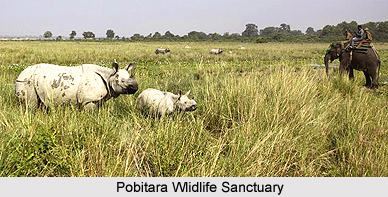
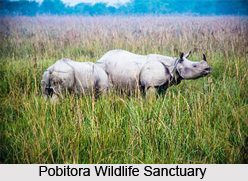 Pobitora Wildlife Sanctuary : Pobitora Wildlife Sanctuary is located in Morigaon District in the plains of River Brahmaputra. Previously it was a grazing reserve of former Nagaon district. It became popular during 1961-62 for housing One Horned Rhino, also known as Rhinoceros unicornis. The southern edge of the sanctuary is bordered by Garanga Beel whereas its north is bordered by River Brahmaputra. Rest of the sanctuary is surrounded by a number of villages. Pobitora Wildlife Sanctuary hosts four endangered, two critically endangered three near threatened and eight vulnerable bird species. Various types of flora and fauna are found here including the aquatic animals.
Mayong : Mayong, situated in the western zone of Morigaon district, is famous for its occult practices. The place serves as a major tourist attraction. Nature and wildlife tourism of the district includes a number of flora and fauna present in the Pobitora Wildlife Sanctuary along with picturesque beauty of hills and River Brahmaputra. Elephant and Jeep Safaris are also fascinating features of the region. A plethora of temples and shrines around Mayong makes it an ideal place for pilgrimage tourism. Significant pilgrimage sites of Mayong are Narashinha Ashram of Hiloikhunda, Kechaikhaiti Shrine of Burha Mayong, Lord Shiva Shrine of Kachashila, Lord Ganesha Temple of Hatimuria etc. Several archaeological remains and monuments of this region attract tourists for archaeological tourisms. A big stone inscription is situated in Mayong belonging to several hundred years ago. Mayong village Museum and Research Centre have preserved abundant earthen vessels, terracotta images, stone-bullets, stone-axes etc. Mayong is also an ideal place for river tourism, eco tourism and sporting activities. The place is also well known for its age old practice of black magic.
Kachasila Hill : Kachasila Hill is famous for housing an ancient temple belonging to 9th century. Statues of Lord Shiva and Parvati are placed inside the temple. A number of Lord Ganesha idols are also located in the temple. The temple is visited by researchers to study about coriin stones and rare statues.
Deosal : Deosal hosts an old temple dedicated to Lord Shiva. A grand fair is organized every year on the occasion of Shivaratri. Local myths say that Deosal was previously the Ashram of Valmiki where Lord Rama left Sita.
Sitajakhala : Sitajakhala has been discovered quite recently, in the fourth decade of last century. Temple stones were cut into steps up to the River Killing at Sita Jakhala Hills. Statues of Sita and Lord Hanuman are inscribed on the walls of the temple. It is believed that those stone steps were cut by Valmiki for Sita to reach from the temple to the river. Thus the steps had been named as Sita Jakhala.
Sivakunda : Sivakunda is a waterfall located in Amsoi hills. It is famous as tourist and picnic spots owing to its scenic natural beauty.
Asia`s largest dry fish market is situated in Morigaon District. Freshwater and sea dry fishes from different regions including Uttar Pradesh, Bihar, and West Bengal etc are brought to this market. Consignments of dry fishes from local areas also come to this market. The market supplies dry fishes to Nagaland, Mizoram, Manipur, Arunachal Pradesh and Meghalaya. These are also exported to South Asian Countries, Singapore and Malaysia.
People from far off places visit the tourist sites of Morigaon district. The sites are well maintained and provide several facilities to the visiting folks. Some of these places also contribute immensely in the national heritage of the country.
Pobitora Wildlife Sanctuary : Pobitora Wildlife Sanctuary is located in Morigaon District in the plains of River Brahmaputra. Previously it was a grazing reserve of former Nagaon district. It became popular during 1961-62 for housing One Horned Rhino, also known as Rhinoceros unicornis. The southern edge of the sanctuary is bordered by Garanga Beel whereas its north is bordered by River Brahmaputra. Rest of the sanctuary is surrounded by a number of villages. Pobitora Wildlife Sanctuary hosts four endangered, two critically endangered three near threatened and eight vulnerable bird species. Various types of flora and fauna are found here including the aquatic animals.
Mayong : Mayong, situated in the western zone of Morigaon district, is famous for its occult practices. The place serves as a major tourist attraction. Nature and wildlife tourism of the district includes a number of flora and fauna present in the Pobitora Wildlife Sanctuary along with picturesque beauty of hills and River Brahmaputra. Elephant and Jeep Safaris are also fascinating features of the region. A plethora of temples and shrines around Mayong makes it an ideal place for pilgrimage tourism. Significant pilgrimage sites of Mayong are Narashinha Ashram of Hiloikhunda, Kechaikhaiti Shrine of Burha Mayong, Lord Shiva Shrine of Kachashila, Lord Ganesha Temple of Hatimuria etc. Several archaeological remains and monuments of this region attract tourists for archaeological tourisms. A big stone inscription is situated in Mayong belonging to several hundred years ago. Mayong village Museum and Research Centre have preserved abundant earthen vessels, terracotta images, stone-bullets, stone-axes etc. Mayong is also an ideal place for river tourism, eco tourism and sporting activities. The place is also well known for its age old practice of black magic.
Kachasila Hill : Kachasila Hill is famous for housing an ancient temple belonging to 9th century. Statues of Lord Shiva and Parvati are placed inside the temple. A number of Lord Ganesha idols are also located in the temple. The temple is visited by researchers to study about coriin stones and rare statues.
Deosal : Deosal hosts an old temple dedicated to Lord Shiva. A grand fair is organized every year on the occasion of Shivaratri. Local myths say that Deosal was previously the Ashram of Valmiki where Lord Rama left Sita.
Sitajakhala : Sitajakhala has been discovered quite recently, in the fourth decade of last century. Temple stones were cut into steps up to the River Killing at Sita Jakhala Hills. Statues of Sita and Lord Hanuman are inscribed on the walls of the temple. It is believed that those stone steps were cut by Valmiki for Sita to reach from the temple to the river. Thus the steps had been named as Sita Jakhala.
Sivakunda : Sivakunda is a waterfall located in Amsoi hills. It is famous as tourist and picnic spots owing to its scenic natural beauty.
Asia`s largest dry fish market is situated in Morigaon District. Freshwater and sea dry fishes from different regions including Uttar Pradesh, Bihar, and West Bengal etc are brought to this market. Consignments of dry fishes from local areas also come to this market. The market supplies dry fishes to Nagaland, Mizoram, Manipur, Arunachal Pradesh and Meghalaya. These are also exported to South Asian Countries, Singapore and Malaysia.
People from far off places visit the tourist sites of Morigaon district. The sites are well maintained and provide several facilities to the visiting folks. Some of these places also contribute immensely in the national heritage of the country.
Recently updated articles in States of India
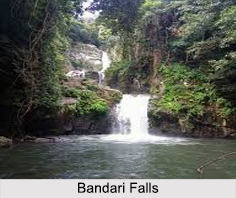
Bandare Waterfalls, Meghalaya
Bandare Waterfalls in South Garo Hills, Meghalaya, is a secluded natural attraction surrounded by dense subtropical forests and rugged mountain terrai...
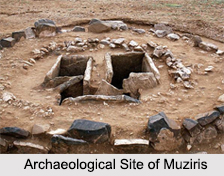
History of Thissur District
Early History of Thissur District explains flourishing of the port cities. Now these port cities are transformed into archaeological sites.
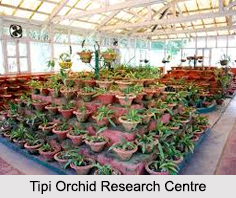
Tippi Orchid Research Centre, Arunachal Pradesh
Tippi Orchid Research Centre in Arunachal Pradesh is renowned for its rich collection of exotic and endangered orchids. Surrounded by lush rainforest...
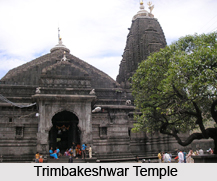
Tourism in Nashik District
Pilgrimage tourism in Nashik district involves visiting the various places of Hindu and Jain worship located here. Some of the holiest sites for Hind...
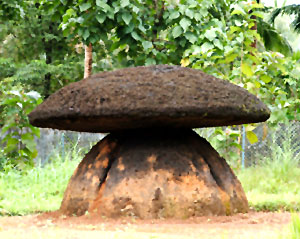
Mangadu, Kerala
Mangadu in Kerala’s Kollam district is a significant megalithic site known for its urn burials, cist burials, menhirs, and stone circles. Excavations...
Related articles in States of India
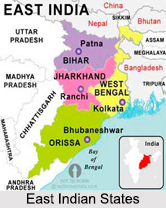
East Indian States
East Indian States comprises of Bihar, Jharkhand, West Bengal, Odisha and also the Union Territory of Andaman and Nicobar Islands. It defines the cult...
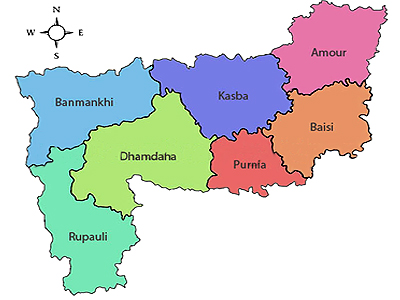
Purnia District in Bihar
Purnia District is located in Bihar and extends from River Ganga to Nepal. The district has a rich Hindu history and glorious past.
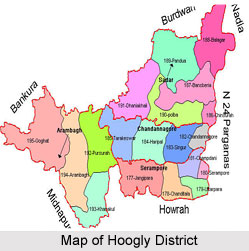
Hooghly district
Hooghly District along the bank of the river Hooghly is one of the principal trading ports of West Bengal.
Geography Of Chittoor District
Geography of Chittoor district is spread along the topography of the land which is divided into two natural divisions; Chittoor has a dry and healthy...
Districts of West Bihar
Districts of West Bihar is comprised of medieval monuments that were built by the different governors of Mughal era.