Introduction
Churches in Goa are amongst the most renowned institutions which are marvellous manifestations of Portuguese colonization in this part of the nation. Historians are of the view that the Portuguese had forcefully imposed the religion of Christianity on the Goans during `Inquisition` and damaged several temples. A majority of churches were erected over the remnants of the temples, and they portray the magnificent architectural styles of Europeans. Currently, these churches of Goa belong to the Archdiocese of Goa. Therefore, besides religious significance, these regional churches are extraordinary instances of historical and aesthetic value.
Other Churches of Goa
The Indian state of Goa comprises innumerable other churches which involve St. Michael`s Church at Anjuna, Church of Our Lady of Miracles, Rachol Seminary, Church of St. Alex at Curtorim, Nunnery of Santa Monica, Church of Mae De Deus at Saligao (Bardez), Lady Rosary Church and many more.
Basilica of Bom Jesus
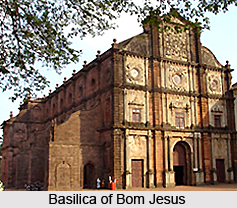
The Basilica of Bom Jesus had been constructed during the 16th century and possesses the mortal remains of the famous saint, Francis Xavier, inside a silver container. Today, the church is a World Heritage Monument and it is dedicated to Infant Jesus. The term `Bom Jesus` is the name given to the Infant Lord Jesus.
Se Cathedral
Se Cathedral is one the most popular churches of the state of Goa. There exist five bells in this Cathedral, of which one of the bells is said to be the largest bell in Goa and the very best in the entire world. It is based in Old Goa and is said to be amongst the biggest churches in Asia and dedicated to Catherine of Alexandria.
Church of St. Francis of Assisi
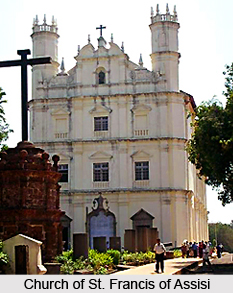
The Church of St Francis of Assisi church is situated in Old Goa and was erected during the year 1661 in the Portuguese Viceroyalty of India, by the Portuguese rulers who governed this portion of India during this time. Spectacular paintings adorn the interiors of this historical church, whose entrance has been created in Manueline style.
Church of St. Anne
Church of St. Anne, located at Talaulim is a reputed masterpiece of Christian architecture which had been erected in the year 1695 on the banks of Siridao River. Its walls exhibit beautiful, baroque architecture and has been proclaimed as a `national monument` by the Archaeological Survey of India or ASI.
Ruins of the Church of St. Augustine
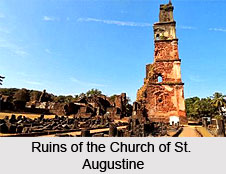
The Ruins Of The Church Of St. Augustine was built by 12 Augustian monks on 3rd September 1572. The construction of the church began in 1597 and it continued till 1602. However the Portuguese government had put a ban on the construction of the church hence it was abandoned by the monks. Thus the continued neglect of the church turned it into a ruined structure.
St. Cajetan Church
The architectural style of St. Cajetan Church is inspired by that of St. Peter`s Basilica in Rome and is existent in Old Goa. It is located at a distance of nearly half a kilometre away to the north-eastern portion of the Se Cathedral, near the remnants of Viceregal Palace. It is well-known for a famous vault which contains the words `My House Is a House of the Words of Christ`.
Our Lady of the Immaculate Conception Church
Our Lady of the Immaculate Conception Church is situated at Panjim in Goa and is believed to be amongst the most ancient churches of this western Indian state. It is present here since 1540.
Reis Magos Church
This church is known to be one of the oldest churches of Goa and was created in the year 1555 and dedicated to the `Magi` rulers, who are known as the `Three Wise Men`. The Three Wise Men are believed to have granted offerings to Infant Jesus. The term `Reis Magos` implies `Magi King`, in English.
Church of Lady of Rosary
The Church of Lady of Rosary stands on the top of the western side of the Holy hill or Monte Santo overlooking the Mandovi River and Divar Island. This is supposedly the very place where Alfonso de Albuquerque led his troops to victory in 1510 AD and a plaque was placed with the inscription in the 1950`s. Its status was raised to a church in 1543 AD and it was entrusted to the care of the Franciscans. The people held it in great reverence as St. Francis Xavier used to teach catechism here every evening to the public who flocked together at the sound of a little bell he rang.
The facade of the church appears like a fortress openings in its wall to look out for the invaders. The design is simple. The tombstone of Garcia de Sa, one of the earlier Governors of Goa lies in front of the altar. It is a fine example of true "Manueline" style architecture of the early Portuguese. Its interior is simple and has five altars. The main altar bears the image of Nossa Senhora de Rozario or Our Lady of the Rosary.
Church of St. Augustine
12 Augustian friars constructed the convent in 1572 AD immediately after their arrival at Goa on 3rd September 1572. The church was constructed in1602 AD. Both the church and the convent are in ruins. The church was in good condition till 1835 AD when it was abandoned because of the ban on the religious orders by the Portuguese government. The vault of the church collapsed in 1842 AD, whereas the facade collapsed on 8th and 19th August 1931. Only the bell tower without the bell is left today. The bell was taken to the Fort Aguada Light House initially from 1841-71 AD. In 1871 AD, it was moved to the church of Our Lady of Immaculate Conception at Panaji where it is functioning even today.
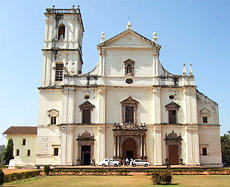
Chapel of St. Catherine
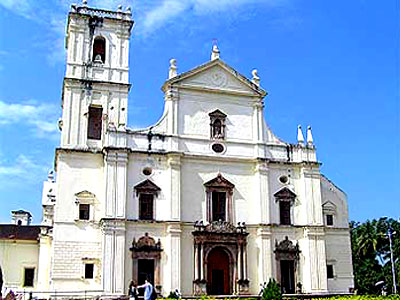
Chapel of St. Catherine situated in Old Goa is dedicated to St. Catherine. It stands as a living monument of the conquest of Goa by Alburquerque. The church is magnificently built laterite blocks and has a tower on both the sides of the facade.
Chapel and Tomb of St. Francis Xavier
The Chapel of St. Francis Xavier in Old Goa was dedicated to Saint Francis Xavier. The chapel was re-dedicated to him after his canonization in 1622. The chapel houses the mortal remains of the saint and is believed to have been built by Saint Francis himself.
Church and Convent of St. Monica
The Church and the Convent of St. Monica was earlier called the Royal monastery. Sanctioned in 1598 and the church was erected by the Archbishop Dom Frei Alexio de Menezes. This church and convent is believed to be the first nunnery built in the east. It now houses an educational institute, the Theological Center of the Matar Dei.
The Church of Mae de Deus
Church of Mae de Deus was built in 1873. The chief attraction of this church is the shrine of the Mae de Deus or Mother of God, which was brought from the ruins at Old Goa. The church is built in gothic style.
Chapel of St. Anthony
Chapel of St. Anthony The Royal Chapel of St. Anthony erected in the 17th century is located in Panjim, the capital city of Goa. The church is dedicated to St. Anthony. The construction of the church was ceased in 1835 but in 1894 the renovation process was started by the last Governor General of Goa, Vassalo de Silva.
Church of Our Lady of the Mount
Church of Our Lady of the Mount in Goa was built in 1557 by Alfonso de Albuquerque after his victory over the Goan Muslim ruler Yusuf Shah. The Chapel of Our Lady of the Mount faces the west side proving a view of Old Goa where Sultan Adil Shah had placed his artillery to guard the city from the Portuguese attack
Church of St. Peter
Church of St. Peter is one of the oldest churches of Old Goa having been raised in 15th century at the expense of the public treasury by the Portuguese architects. It is located on the way from Panaji to Old Goa.
Viceroy`s Arch
This was one of the gates of Adil Shah`s Fort. It was renovated by Portuguese and was the gateway to Goa for Portuguese Governors. Every incoming Viceroy used to disembark at this place.
The Church of Mae de Deus at Saligao (Bardez)
This is situated 13 km away from the district town. This was built in 1873 and is situated amidst picturesque surroundings. The holy place of the miraculous statue of Mae de Deus or Mother of God was brought from the ruins of the convent of Mae de Deus at Old Goa. This beautiful church is the finest piece of gothic style. The Church is well illuminated at night.
The Church of St. Alex at Curtorim
This is placed at 9 Km from Margao. It is one of the Oldest churches in Goa, which was built in 1597.
The Church of St. Ana at Talaulim, Ilhas
This is placed at 11 Kms away from the district. This church is dedicated to St. Ana and is a remarkable piece of ancient Christian architecture. It was built in 1695 on the right bank of Siridao River and has picturesque surroundings. The unique feature of this church is that it has hollow walls through which people could walk in secrecy for the purpose of confession.
Rachol Seminary
This is situated just off the banks of Zuari River, which is 12 kilometers from Margao in South Goa. In 1521 the Portuguese, in their customary fashion first built a church after that a prison and later in 1574-1610 a seminary to impart philosophy and theology. It is in this seminary that the museum of Christian Art is housed.
Churches In North Goa
The impressive Churches of North Goa, are still the example of the Portuguese architecture. The lofty churches in North Goa have attracted quite a number of tourists time and time again .Some of the famous churches are as follows:
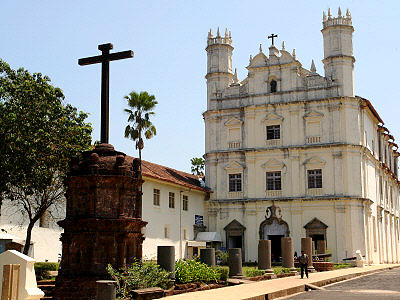
Basilica of Bom Jesus
Se Cathedral
Church of St. Francis of Assissi
St. Cajetan Church
Church of Our lady of Rasary
Nunnery of Santa Monica
Ruins of Church of St. Augustine
Viceroy`s Arch
Reis Magos Church
The Church of Mae de Deus at Saligao (Bardez):
The Church of St. Alex at Curtorim
The Church of St. Ana at Talaulim, Ilhas
Rachol Seminary
Churches of Old Goa
The Churches and Convents at Velha (Old) Goa owe their existence to the Portuguese rule. The churches depict the European architectural style and have been of much historical importance. These churches have been major tourist spots attracting visitors from all over the world. The churches in old Goa are :
Church Of St. Francis Of Assisi
Chapel Of St. Catherine
Basilica of Bom Jesus
Chapel and Tomb of St. Francis Xavier
S E Cathedral
Church and Convent of St. Monica
The Church of Mae de Deus
Church of Our Lady of the Mount
Church of Our Lady of the Rosary
Church of St. Cajetan
Church of St. Peter
Ruins of the Church of St. Augustine