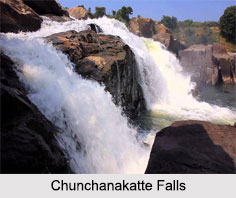
 Chunchanakatte Falls is a prominent waterfall in South India, located in Mysore district of the state of Karnataka. Situated near the village of Chunchanakatte in Krishnarajanagar Taluk of Mysore district, the Chunchanakatte Falls is in the Western Ghats. The water of the Chunchanakatte Falls cascades in two small sections from a height of 20 m before joining again to flow as one.
Mythological History of Chunchanakatte Falls
The waterfall is part of the Kaveri River and is located in Chunchanakatte, which is the holy place where Lord Rama during his banishment stopped by and was greeted with the hospitality of a tribal couple called Chuncha and Chunchi. The significance of the Chunchanakatte Falls is that the sound of the water can be heard all over except inside the sanctum sanctorum of the ancient Hindu temple.
This is because according to the Indian epic, Ramayana, the lore goes that Lord Rama being tired of the constant complaining of his consort, Sita, cursed the land saying that the tongue of a woman should not be sharp. And since the Kaveri River is considered to be female, the noise that the river generated would not be heard in the sanctum sanctorum of the lord.
Another legend states that once weary and tired Goddess Sita wanted to take a bath and Lord Rama directed Lakshmana, his brother to fire an arrow at a rock. Once Lakshmana fired the arrow, water in three different shades started pouring out, one with turmeric, one with oil and other with shikakai. These shades are visible even today when there is considerable amount of water flowing in the falls.
Kodanda Rama Temple
There is an ancient Hindu temple built here dedicated to Lord Kodandarama called the Kodanda Rama Temple. The uniqueness of the idol installed here is that Sita is standing to the right side of Lord Rama instead of the usual left. There are two ancient temples dedicated to Lord Hanumana, one at the entrance to the temple and the other at the end of the temple near the river. The most astonishing feature of this temple is that inside the sanctum sanctorum, the roar of Chunchanakatte Falls cannot be heard.
Festivities in Chunchanakatte Falls
Brahma Ratotsava, a South Indian car festival is held on the day of Makara Sankranti every year. Then there is the cattle festival, which is one of the biggest in Chunchanakatte. Both of these festivals are held during January. Many water and shore birds can be spotted here. The Chunchanakatte Falls attracts tourists and are a good place for picnic.
Visiting Information on Chunchanakatte Falls
The Mysore Junction is the nearest railway station at a distance of 54 km and the Mysore Airport is the closest at a distance of about 69 km from the falls.