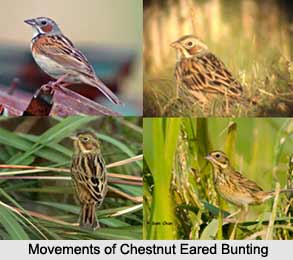
 Chestnut-Eared Bunting is an Indian bird that bears a scientific name "Emberiza fucata" and is a passerine bird in the bunting family Emberizidae.
Species of Chestnut-Eared Bunting
Chestnut-Eared Buntings are three subspecies. The nominate subspecies E. F. Fucata occupies the northern part of the range. E.F. Arcuata is found in the Himalayan Mountain Range and south-west and central parts of China; it is darker with broader breastbands. The third subspecies E. F. Kuatunensis lives in south-east China and is darker and more rufous above with narrower breastbands.
Size of Chestnut-Eared Bunting
Chestnut-Eared Bunting is 15 to 16 cm in length. The plumage is mostly brown with dark streaks. The male has a grey crown and nape with dark streaks, chestnut ear-coverts and bands of black and chestnut across the breast. There is a rufous patch on the shoulders and the rump is also rufous. Females are similar to the males but duller with a less distinct head and breast pattern. First-winter birds are plainer but show warm brown ear-coverts and have an obvious ring around the eye.
Voice of Chestnut-Eared Bunting
The voice of Chestnut-Eared Bunting is similar to the rustic bunting but quieter. The song is a rapid twittering which begins with staccato notes and then accelerates before ending with a distinctive two or three note phrase. The call is an explosive pzick.
Breeding Range of Chestnut-Eared Bunting
The breeding range of Chestnut-Eared Bunting extends from the Himalayan Mountain Range locally across China to south-eastern Siberia, Korea and northern Japan. Northern birds migrate south to winter in southern Japan, southern China, Taiwan, north-east India and south-east Asia. The species is a vagrant to Kazakhstan and in October 2004 the first European record occurred at Fair Isle in Scotland. Preferred habitats include scrub, fields and grassland.
Nests of Chestnut-Eared Bunting
Chestnut-Eared Bunting build cup-shaped nest. They built at ground level or low in a bush. Three to six eggs are laid with four being most common. These are whitish with Reddish-Brown Speckling and are incubated for 12 days.
Breeding Season of Chestnut-eared bunting
The breeding season of Chestnut-Eared Bunting is variable. It is lasting from May to August in India, May to July in Honshu and June to August in Hokkaido.