Buddhist Temples in Kushinagar
The historical city of Kushinagar in the state of Uttar Pradesh embodies three Buddhist Temples, namely, the Japanese Temple, the Watt Thai Temple and the Chinese Temple.
Japanese Temple
The `Ashta Dhatu` or `Eight Metals` of Lord Buddha is worshipped as a deity in this temple.
This is one of the most interesting and beautiful Buddhist temples in the beautiful city of Kushinagar.
The `Ashta Dhatu` or `Eight Metals` of Lord Buddha is worshipped as a deity in this temple. This idol has been brought from Japan in dismantled form. Later it was joined before establishing it in the temple.
The Atago Isshin World Buddhist Cultural Association has erected this temple. The Japanese Monarchy funded for this temple. This temple consists of a single circular chamber, housing a golden image of Buddha.
Watt Thai Temple
This kind of temple is unique in the whole of Indian subcontinent.
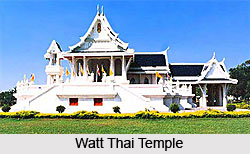
One of the most beautiful and most visited temples of Kushinagar is the Watt Thai Temple. This kind of temple is unique in the whole of Indian subcontinent.
This temple was erected to commemorate the Golden Jubilee Celebrations of His Majesty King Bhumibol `s accession to the throne of Thailand.
It is laid out on a lust green lawn. It was actually made to serve as a forest monastery. As a result of this, there are various kinds of trees, plants, herbs, shrubs, etc.
As the temple is centrally located in Kushinagar, anyone interested can visit the temple hiring a cab, an auto or a rickshaw.
Chinese Temple
The architecture of the temple differs entirely from the traditional Buddhist temples of Kushinagar.
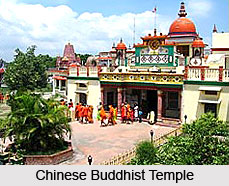
The Chinese Temple, situated at Kushinagar in Uttar Pradesh is another beautiful temple and frequented tourist destination. A Chinese Buddha is preached in the temple. Thousands of devotees from all over the world visit the temple every year.
The architecture of the temple is worth to be mentioned. It differs entirely from the traditional Buddhist temples of Kushinagar. The architecture of this temple is predominantly `Han Chinese`. It also has design elements, which have been borrowed from various provinces of Mainland China. Chinese and Vietnamese architecture marks the beauty of the exterior of the temple.
Buddhist Temples
Buddhist Temples in Tripura support the fact that Buddhism is quite prevalent in the state. Archaeological evidences have suggested that Buddhists have inhabited the region since ancient times. Several Buddhist rulers ruled over the state and left permanent influences on the culture of the state. However in the 16th century AD Buddhism was almost eliminated from this region owing to the defeat of Buddhist rulers. It was revived in Tripura in the 17th century AD and since then has been permanently existed in the state.
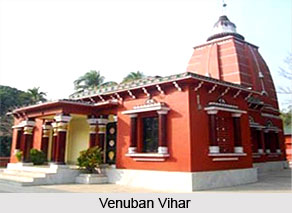
Venuban Vihar
Venuban Vihar is located about 2 kilometres away from Agartala city. It is a small Buddha shrine that houses some magnificent metal idols of Lord Buddha and Bodhisatva. These idols have Burmese origin which were transferred to this shrine and installed. On the occasion of Buddha Purnima, Buddha Jayanti is celebrated in the temple with grandeur and great religious fervour every year. A huge fair is also organized in the same occasion. The ambience of Venuban Vihar is rich in serenity. The temple attracts a number of tourists and devotees.
Udayan Buddha Vihara
Udayan Buddha Vihara is the most ancient Buddha temple of the state of Tripura. It is situated at Pecharthal in the district of North Tripura. It was established in the year 1931 and the idol of Buddha was brought in the same year from Rangoon. The idol is incredibly heavy and has a weight of almost 700 kg, but the appearance of the idol is not so enormous.
Manu Bakul Buddha Temple
Manu Bakul Buddha temple is located at about 125 kilometres away from the Agartala Airport in the district of South Tripura. The idol of the temple is believed to have brought from Arakan. Every year, in the month of April, a week long fair is organized here. The temple and the fair attract not only the devotees from the country but also from Thailand, Japan, Bangladesh, Myanmar and many other places. The fair is celebrated by the devotees with great religious fervour.
In the present scenario, Tripura houses a huge Buddhist population which comprises communities like Chakma, Uchai, Barua and Mog. Being an important aspect of socio cultural heritage of the state, Buddhist temples in Tripura finds a distinct position in the society. They not only attract the devotees but numerous tourists from distant regions.
Buddhist Temple Sculpture
The Buddhist art in sculptures can be marked with special features and distinct characters of its own. After the sculptures of Indus Valley, the next golden chapter in the history of Indian sculpture opened in the 4th century BC. When King Ashoka, adopted the Buddhist philosophy, he then immediately followed the mission to spread the teachings of this faith in all possible directions. This resulted in the creation of over 85,000 stupas or dome-shaped monuments, where the teachings of Buddhism were also engraved along the rocks and the pillars. These constructions, which served as edicts can be easily noticed in Buddhist monuments, created in the Gujarat, Bihar, Madhya Pradesh and Tamil Nadu. The monuments of above mentioned places show the vibrant art of Buddhist, these are as follows:
1. Sanchi

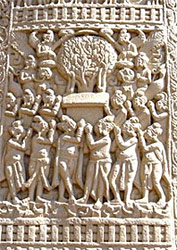
One of the important things of attention is that the Buddha is not represented at all through figures at Sanchi. But instead through various symbols of his teachings he is described, as it was the tradition in the early period of Buddhism. The flower of lotus represents the birth of Buddha, the big tree signifies his enlightenment, the Wheel represents his first sermon and the Stupa finally represents his nirvana or salvation. The footprints and the throne are used to denote the Buddha`s presence. This site at Sanchi also includes remains of smaller stupas, pillars and monasteries. The temples included here are as follows:
Gupta Temple: This temple, built in the 4th Century AD, is in the condition of ruins now. According to some historians, it is one of the earliest known examples of temple architecture in India. A simple flat roofed chamber characterizes it & a pillared porch constructed at front.
Temple 18: It is a chaitya hall, situated just in front of the Southern Gateway of the Great Stupa. It is comparatively recently built around 7th Century A.D and its style of architecture closely resembles with the rock-cut chaitya halls at Karla Caves in Maharashtra.
The Monastery and Temple 45: It was built during the period of the 7th and 11th centuries and more developed styles of architecture are marked from it. The doorways of this construction are ornamented, with the image of Buddha in an oval Halo.