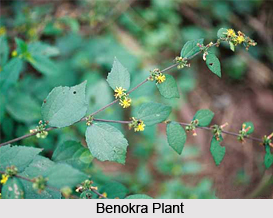
 Benokra is an Indian Medicinal plant and its botanical name is Triumfetta rhomboidea Jacq. Some of the common names of this plant in India are Bunokra in Bengali language, Tupkadi in Konkani, Jhinjhirita in Sanskrit language, Ottupullu in Tamil, Jhipato in Gujarati language, Tutturubenda in Telugu language, etc. It is a pan tropical weed which is found on roadsides and in other disturbed and open habitats all over the subtropical and tropical India to an altitude of twelve hundred meters in the Himalayas. This plant is known as Bojoromuli and Jotojoti in Oriya language.
Benokra is a herbaceous and perennial plant which grows up to a height of about 1.5 meters, often woody at the base. The branches of this plant are slender and the pubescent possess simple hairs when young, becoming glabrous. The leaves of this plant are variable; lower leaves are 5 to 7.5 centimeters long and broad, usually three-lobed, irregularly serrate, clothed with stellate and simple hairs on both surfaces and simple hairs on the nerves beneath, base is cuneate or cordate, three to seven-nerved. The petioles are three to four centimeters long; the upper leaves of this plant are generally simple with very short petioles. The flowers of Benokra are yellow, 5 to 6 millimeters across, in dense terminal and leaf-opposed cymes; sepals are oblong, hooded and apiculate; petals are shorter than the sepals, ovate-oblong and ciliate at base with very long claws. This plant bears small fruits, ovoid or globose, four to six millimeters in diameter, with smooth, small, and hooked spines. In the central parts of India, flowering occurs between the month of August and December and fruiting takes place from the month of September to January.
In Ayurveda, the roots of this plant are regarded as bitter, tonic, acrid, styptic, aphrodisiac, galactagogue and cooling, and are used in the treatment of dysentery. Both the fresh leaves and barks of Benokra are used to treat dysentery and diarrhoea. Pounded roots are at times used in the treatment of intestinal ulcers and their hot infusion is very helpful in treating gonorrhoea and to facilitate childbirth. The leaves, fruits and flowers of this plant are astringent, mucilaginous and demulcent and are used in treating Gonorrhoea or Ushnavata and to promote parturition when the same was delayed. The flowers and leaves are used against Leprosy or Kushta Roga. This is one of the Indian Medicinal plants the inner bark of which yields a soft, glossy fiber which is very much in use in the state of Tamil Nadu.