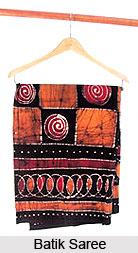
 Batik Sarees are one of the textured art form from India famous for attractive contrast colour schemes. The textured art form of Batik is famous for the artistic freedom it offers due to its inherent style and technique. The charm of Batik lies in each piece being individualistic and a fresh creation.
Multi-coloured and beautifully designed Batik Sarees are popular and attractive for their contrast colour schemes. It is an art wherein parts of cloth are covered with wax to make it dye resistant, and the other areas are dyed, to create coloured and uncoloured areas on the same piece. Indigo was one of the most popular and frequently used colours for the dyeing process. In the contrast between these dyed and undyed areas lies the inherent beauty of Batik Art.
History of Batik Saree
Batik is an ancient art which uses wax and dyes to create a visual magic on fabrics. This form of art has been practiced in India for over 2100 years now. Batik is done on a large scale in Indore and eastern states of India.
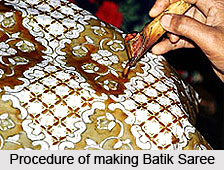
Procedure of Making Batik Sarees
The technique of Batik is basically a three-stage process including waxing, dyeing and de-waxing. There are also several sub-processes like preparing the cloth, tracing the designs, stretching the cloth on the frame, waxing the area of the cloth that does not need dyeing, preparing the dye, dipping the cloth in dye, boiling the cloth to remove wax and washing the cloth in soap.
Batik is a resist process in which the fabric is painted with molten wax and then dyed in cold dyes. The surface of a finely woven fabric has melted bee wax and paraffin applied with a brush as a resist to block the parts which are not to be dyed or meant to be in light shade. After this it is then immersed in a cold dye which colours the background. The other remaining parts are dyed, part by part, shutting off the ones not to be covered.
In the final stage, the entire fabric is cleared of wax with boiling water and soap. As the fabric is handled in the process the wax coating breaks up into a kind of irregular network of thin hair - like cracks through which the dye finds its way and creates involuntarily a design of its own which gives the fabric a fresh added quality and enhances its attractiveness.