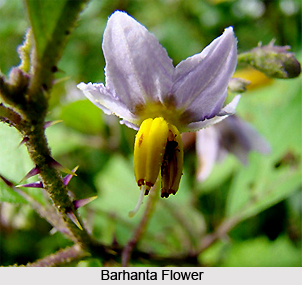
 Barhanta is a small herb of multiple branches which is 1.8 meters tall. This herb is found commonly throughout tropical and subtropical India at an elevation of about 1500 meters. The Botanical name of Barhanta is Solatium Indicum. Some of the other names by which this Indian herb is called are Gurkamai, Byakura and Titveguna in Bengali, Mhotir-Ingni, Motaringni, Ubhibhoringni, Vadaringni and Ubhir-Ingni in Gujharati, Badane, Kirigulla, Habbagulla, Kadusonde, Kempugulla and Sonde in Kannada, Nunnuniyakoli, Bonobryhoti and Bryhoti in Oriya, Kakamunchi, Chittimulaga and Tella-Mulaka in Telugu, Janglibringan in Urdu, Etc.
Barhanta is a highly-branched spiny herb or small shrub which grows up to a height of 1.8 meters with a stout, often purple stem. The prickles are large, sharp, with a long compressed base and are slightly recurved. The leaves are 5 to 15 centimeters long and 2.5 to 7.5 centimeters wide, ovate in outline, subentire or with a few large triangular-ovate lobes, sparsely prickly and hairy on both sides, base cordate, cuneate or truncate, often unequal-sided and the petioles are 1.3 to 2.5 centimeters long and are prickly. The flowers of this herb are borne in racemose extra-axillary cymes, peduncles are short, and the pedicels are 6 to 13 millimeters long, stellate-hairy and prickly. The calyx is 3 millimeters long, stellately hairy, teeth triangular and 1.5 millimeters long. Corolla is pale purple and is 0.8 centimeters long, outside covered with darker purple stellate hairs. The lobes are 5 millimeters long, deltoid-ovate and acute. The fruits (berries) of Barhanta are globose, about 0.8 centimeters in diameter, dark yellow in colour when ripe and are glabrous. The seeds are 0.4 centimeters in diameter and are minutely pitted. Flowering in this Indian herb takes place mainly between the months of August and October and fruiting in November and December in the central parts of India and earlier in southern India.
The root of Barhanta is considered carminative and expectorant, and is in the treatment of coughs, asthma and catarrhal affections, dysuria and colic. Its extract is reportedly given to infants in order to check vomiting following intake of milk among the Kathodias and Raibaris of Rajasthan. A decoction of the root is treated as a tonic and is also used to facilitate childbirth. The pounded root is used in the treatment of nasal ulcers. The juice of the leaves is mixed with the juice of ginger root to stop vomiting. The fruit and leaves, mixed with sugar, are used as an external application to give relief from itching. The dried, powdered fruit pulp is given to children to expel worms among the Kondhs of south-western Orissa state. The partially ripened fruits of Barhanta are eaten in the form of preserves, chutneys and in curries and the leaves are also eaten as a vegetable.