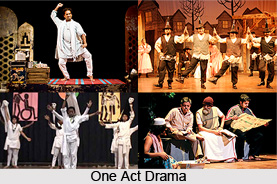
 Development of Amateur Theatre had indeed led to some of the significant changes in the theatre circuit of Karnataka. Amateur Kannada Theatre, contributed immensely to the modern Kannada theatre as well, and enriched the history of Kannada theatre. The gift of the amateur stage to the dramatic literature of modern Kannada is both bountiful and varied. But for an occasional interpretation or a parody, it almost completely discarded the once supreme mythological and even historical themes. The emphasis was now placed on social themes. It evolved the one-act play: the total number of one-act plays written during the initial phase of amateur theatre, perhaps exceeded three hundred at least.
Successful experiments brought in new themes and also new forms like the Impromptu play, the Opera, the Dream play, Mime, Fantasy, the Shadow play and the Radio play. As a result, the Amateur theatre established itself as a significant part of the artistic life of towns, and also helped to substitute, enrich and strengthen a decadent professional stage of Kannada theatre.
A number of amateur troupes maintained regular rolls of members, actors and patrons. They also toured the Kannada country like professional troupes. Some of them like the famed Amateur Dramatic Association and Chaya Artists of Bengaluru and Kalopasak Mandal of Dharwar went far from their home-towns to visit different parts of India. Such amateur troupes sprang up in every important town of Karnataka during the last three decades, though not all of them lived long. A number of troupes grew up in association of Karnataka Sanghs, colleges and other social, literary and educational institutions.
The Stage-play soon became an inevitable item in the programme of almost every social gathering, festival and conference. Drama Conferences became a part of the Annual Literary Conferences of Kannada Sahitya Sammelana - wherein, problems connected with the stage were discussed. The amateur stage steadily gained experience, self confidence and some degree of financial stability. Strictly speaking, it is only groups of amateur artists with rolls of regular membership of artists and patrons that should be considered as the true backbone of the Amateur Theatre.
A peep into the history of a few representative amateur troupes would reveal their qualities and status. It would also indicate the amazing variety of themes and forms which the modern Kannada playwright created for the amateur stage to produce.
 One Act Play in Amateur Theatre has been a thriving act for a long time, and almost every playwright of