
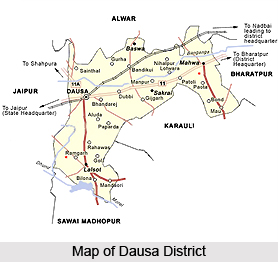
 Dausa District is situated at about 55 kilometers far from Jaipur on NH-11. It is also known as Devnagri and is famous for Mehandipur Balaji Temple. A worship place of Lord Shiva with beautiful and natural water-fall at Jhajhirampura is also a major attraction of the Dausa District.
Dausa District
Dausa District is situated in Rajasthan. The district is named after a hill called Devgiri.
Introduction
Dausa District is situated at about 55 kilometers far from Jaipur on NH-11. It is also known as Devnagri and is famous for Mehandipur Balaji Temple. A worship place of Lord Shiva with beautiful and natural water-fall at Jhajhirampura is also a major attraction of the Dausa District.History of Dausa District
Dausa District was constituted on 10th April 1991 by separating 4 Tehsils namely Dausa, Baswa, Sikrai and Lalsot of Jaipur district. Mahwa Tehsil of Sawai Madhopur was included in this district on 15th August 1992. The city of Dausa is situated in the north-eastern region of Rajasthan, a region widely known as Dundhar. The Chouhans and Badgurjars ruled this land in 10th Century A.D. Dausa was privileged to become the first capital of the then Dundhar Region.
Dausa was an important political place for Dundhar region. The Chauhan ruler Raja Soodh Dev ruled this region during 996 to 1006 AD. Later, from 1006 AD to 1036 AD, Raja Dule Rai ruled this region for 30 years.
Dausa was an important political place for Dundhar region. The Chauhan ruler Raja Soodh Dev ruled this region during 996 to 1006 AD. Later, from 1006 AD to 1036 AD, Raja Dule Rai ruled this region for 30 years.
Geography of Dausa District
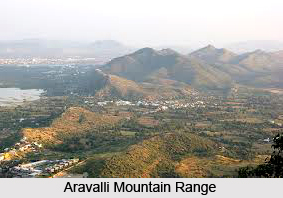 Dausa district is located in the state of Rajasthan, in the Jaipur Division. It is surrounded by 6 districts, namely- Tonk, Sawai Madhopur, Karouli, Bharatpur and Alwar. Occupying a total area of 3404.78 sq. kms, the district is roughly semicircular, or C-shaped, tapering towards the eastern and western corners. The hills found in the district belong mainly to the Aravalli Mountain ranges. The Lalsot-Bayana Hill range, runs from Lalsot to Bayana, and demarcates the boundary between Dausa and Sawai Madhopur districts. The Aravalli exposures have a perfect concordant sequence of beds from Lalsot to Bayana ridge. A belt of crystalline quartzite is found in the hills from Dausa to Bhankari, schistose quartzite is also predominately exposed. Morel and Ban Ganga are the major rivers located in the district.
The soil of the district is yellowish to dark brown, mostly fine textured, generally suitable for all type of crops. Further, a watershed scheme has been implemented in the district to avoid erosion. The district has 219575 hectares of arable land of which about 128169 hectares 58.92 percent is under irrigation. Crops are grown here according to the Kharif and Rabi season. The principal crop of the district in Kharif is Bajra. The most important food grain crop in Rabi is wheat. During Kharif season; groudnut is produced in irrigated areas. Maize also requires irrigation. Generally other crops are sown at the commencement of the rainy season. Groundnut, maize and cotton are sown by broadcasting the seeds. Fertiliser is applied before sowing of groundnut and cotton. During Rabi, mustard and gram is sown from September to October, in unirrigated land, while in the irrigated land, barley, gram and mustard are sown in October-November and wheat in November-December. The district has 94652 hectares of double cropped area with crop cycles of moong-wheat, groundnut-wheat, moong-mustard, bajra-mustard, bajra-gram etc. The major sources of irrigation in the district are wells and tube wells. A large part of the irrigation in the area is covered by these sources. Besides this, a very limited area is irrigated through small rivers and ponds. There are a total of 36 dams in the district. The most important ones are Sainthal Sagar, Kalakho Bandh, Madhosagar Bandh and Moral Bandh.
Dausa district falls under the Indus Plains floristic region of India. Each region has its distinctive species. This district is endowed with Acacia nilotica ( Babool ), Asenegal (Kumta), Anogeissus (Dhok), Prosopis (Khejadi), Capparis(Kair) and Caotropis (Ak). This vegetation is typical of tropical thorn forests. The district is endowed with a variety of habitats. Although not rich in dense forest growth, Dausa sustains considerable biological diversity. As far as the fauna is concerned, the district falls under the Oriental region. Of the characteristic wildlife of the region, the wild animals still surviving in the district include the monkey, lemur (langur), panther, black buck and peafowl.
Administration of Dausa District
Dausa had been identified as the 29th district of Rajasthan. District Collector & District Magistrate is the head of District administration. Additional District Collector (Administration), Chief Executive Officer (Zila Parishad), Sub-divisional Officers and Assistant Collector are the other administrative officers in this Rajasthani district. Various district level departments and offices are located at the district headquarter. Dausa district has 5 sub-divisions, 5 tehsils and 1098 revenue villages.
Culture of Dausa District
The folk art of Hela-Khayal is a unique singing style of this region. Its uniqueness lies in its traditional singing which is highly stylised yet it has now been skilfully employed to comment on the current socio-economic-political scenario in a satirical manner. Extremely popular among the village folk of Dausa, Hela singers demonstrate and typify the undying spirit and zest for life of its people.
Administration of Dausa District
Administration of Dausa district is headed by the District Collector and District Magistrate. Dausa had been identified as the 29th district of Rajasthan. Apart from the district collector, and aiding in the process of administration are the Additional District Collector (Administration), Chief Executive Officer (Zila Parishad), Sub-divisional Officers and Assistant Collectors. Various district level departments and offices are located at the district headquarters. The district has 5 sub-divisions, 5 Tehsils and 1098 revenue villages. The Dausa Tehsil has 244 villages, Baswa has 230, Lalsot has 323, Mahwa has 162 and Sikrai has 139 revenue villages. Further, the district has 5 blocks (Panchayat Samiti) and 223 Gram Panchayats.
The important offices located in the main Collectorate building are the Collector`s Office, SP`s Office and the Treasury. Besides this, the district has offices of Education (Primary and Secondary), Medical and Health, Family welfare, Agriculture, Horticulture, Animal Husbandry, Transport, Forest, Public Health and Engineering, Public works, Irrigation, Industries, Planning, Social welfare, Statistics, Public relations, Supply, Sales tax, Sports, Employment, Cooperative and Fisheries department. JVVNL, JVPNL, RIICO and RFC also have their offices at the district office. The district also has central government offices such as Income Tax, Railways, NIC and BSNL etc. There is separate building for the Zila Parishad near the Collectorate. The Zila Parishad has to look to the development activities of the district. The Zila Pramukh is the Head of the Zila Parishad and a senior administrative office is the Chief Executive Officer of the Zila Parishad.
The district has two important projects, namely, Sarva Shiksha Abhiyan and National Rural Employment Guarantee Scheme. Further, the district has Zila Shaksharta Samiti, Zila e-Mitra Samiti and District Computer Training Centre.
Dausa district has five Sub-divisions or blocks namely Dausa, Bandikui, Lalsot, Sikrai and Mahwa. Sub Divisional Officer and Sub Divisional Magistrate (SDO and SDM) are at the head of the sub-division. For Blocks, the Block Development Officer (BDO) is the incharge of the block. The development activities are coordinated by the BDO whereas SDO has to manage the administrative matters. SDM also acts as the first class Magistrate.
Various development works and projects have been implemented at the rural level (Gram Panchayat level). These are managed by the BDO`s office. One Gram Sevak (Secretary) is appointed at each Gram Panchayat to keep a record of the development works. Gram Panchayat meetings are organised at fixed intervals to discuss village level issues such as development works, land holding rights and relief activities.
There are five Tehsil headquarters in the Dausa district. These are Dausa, Baswa, Lalsot, Mahwa and Sikrai. Each one has a Tehsildaar as the administrative officer. Tehsil has overall control over land administration and records. A Tehsil is divided into "ILR Circles" which are further divided into "Patwar-mandals". "ILR Circle" is supervised by Inspector Land Record (ILR) whereas "Patwar-mandal" is supervised and managed by the Patwari. There is only one Sub-Tehsil in the district, namely, Lawan in Dausa Tehsil and Nayab Tehsildaar is the controlling officer for the same. Tehsildaar also acts as an executive magistrate in his respective area.
Thus discussed is the administrative layout of the district of Dausa.
The important offices located in the main Collectorate building are the Collector`s Office, SP`s Office and the Treasury. Besides this, the district has offices of Education (Primary and Secondary), Medical and Health, Family welfare, Agriculture, Horticulture, Animal Husbandry, Transport, Forest, Public Health and Engineering, Public works, Irrigation, Industries, Planning, Social welfare, Statistics, Public relations, Supply, Sales tax, Sports, Employment, Cooperative and Fisheries department. JVVNL, JVPNL, RIICO and RFC also have their offices at the district office. The district also has central government offices such as Income Tax, Railways, NIC and BSNL etc. There is separate building for the Zila Parishad near the Collectorate. The Zila Parishad has to look to the development activities of the district. The Zila Pramukh is the Head of the Zila Parishad and a senior administrative office is the Chief Executive Officer of the Zila Parishad.
The district has two important projects, namely, Sarva Shiksha Abhiyan and National Rural Employment Guarantee Scheme. Further, the district has Zila Shaksharta Samiti, Zila e-Mitra Samiti and District Computer Training Centre.
Dausa district has five Sub-divisions or blocks namely Dausa, Bandikui, Lalsot, Sikrai and Mahwa. Sub Divisional Officer and Sub Divisional Magistrate (SDO and SDM) are at the head of the sub-division. For Blocks, the Block Development Officer (BDO) is the incharge of the block. The development activities are coordinated by the BDO whereas SDO has to manage the administrative matters. SDM also acts as the first class Magistrate.
Various development works and projects have been implemented at the rural level (Gram Panchayat level). These are managed by the BDO`s office. One Gram Sevak (Secretary) is appointed at each Gram Panchayat to keep a record of the development works. Gram Panchayat meetings are organised at fixed intervals to discuss village level issues such as development works, land holding rights and relief activities.
There are five Tehsil headquarters in the Dausa district. These are Dausa, Baswa, Lalsot, Mahwa and Sikrai. Each one has a Tehsildaar as the administrative officer. Tehsil has overall control over land administration and records. A Tehsil is divided into "ILR Circles" which are further divided into "Patwar-mandals". "ILR Circle" is supervised by Inspector Land Record (ILR) whereas "Patwar-mandal" is supervised and managed by the Patwari. There is only one Sub-Tehsil in the district, namely, Lawan in Dausa Tehsil and Nayab Tehsildaar is the controlling officer for the same. Tehsildaar also acts as an executive magistrate in his respective area.
Thus discussed is the administrative layout of the district of Dausa.
Tourism in Dausa District
Abhaneri is famous for its Post-Gupta or early medieval monuments. It is situated at about 33 Kms from the district headquarter towards Bandikui. The Chand Baori (Step Well) and Harshat Mata Temple are the important places to visit. The temple is an excellent example of intricate carving on stone whereas the Baori has stairs with unparallel artistic and architectural beauty.
Recently updated articles in States of India
Bandare Waterfalls, Meghalaya
Bandare Waterfalls in South Garo Hills, Meghalaya, is a secluded natural attraction surrounded by dense subtropical forests and rugged mountain terrai...
History of Thissur District
Early History of Thissur District explains flourishing of the port cities. Now these port cities are transformed into archaeological sites.
Tippi Orchid Research Centre, Arunachal Pradesh
Tippi Orchid Research Centre in Arunachal Pradesh is renowned for its rich collection of exotic and endangered orchids. Surrounded by lush rainforest...
Tourism in Nashik District
Pilgrimage tourism in Nashik district involves visiting the various places of Hindu and Jain worship located here. Some of the holiest sites for Hind...
Mangadu, Kerala
Mangadu in Kerala’s Kollam district is a significant megalithic site known for its urn burials, cist burials, menhirs, and stone circles. Excavations...
Related articles in States of India
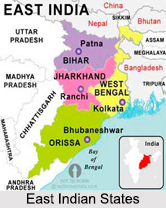
East Indian States
East Indian States comprises of Bihar, Jharkhand, West Bengal, Odisha and also the Union Territory of Andaman and Nicobar Islands. It defines the cult...
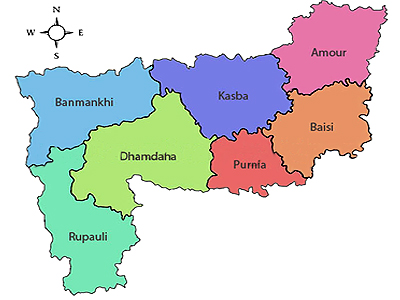
Purnia District in Bihar
Purnia District is located in Bihar and extends from River Ganga to Nepal. The district has a rich Hindu history and glorious past.
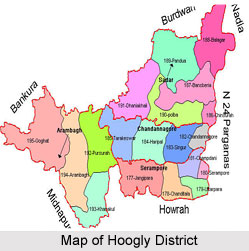
Hooghly district
Hooghly District along the bank of the river Hooghly is one of the principal trading ports of West Bengal.
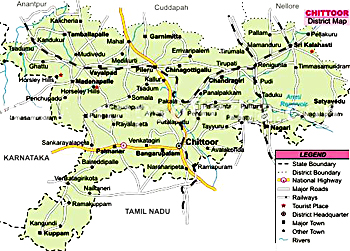
Geography Of Chittoor District
Geography of Chittoor district is spread along the topography of the land which is divided into two natural divisions; Chittoor has a dry and healthy...
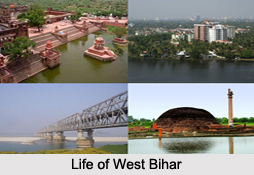
Districts of West Bihar
Districts of West Bihar is comprised of medieval monuments that were built by the different governors of Mughal era.