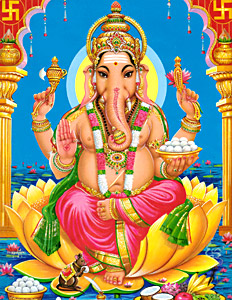
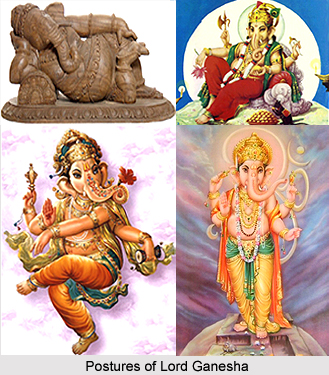
 There are several poses and postures of Lord Ganesha such as standing, seated, lying and dancing. The sculptures of the popular Hindu God depict Him in a number of heavenly postures which are often influenced by Indian dancing. The standing posture shows a rigid stance similar to Tirthankara or Lord Vishnu. These poses are known as samapada, abhanga or samabhanga. A dwibhanga (two-fold bending) or a tribhanga (three-fold bending) are also common with Ganesha. When the Lord is depicted in a standing position, one of the feet is grounded firmly and the other foot is placed on His vahana, the divine mouse.
In the seated posture Lord Ganesha is shown in the Arddhaparyankasana position in which the Lord the right hand is bent and raised and the left leg is folded in the front. The elephant-headed deity is also depicted in the Arddhaparyankasana with his consort (Shakti) who is seated over the left leg of Ganesha. The elephant-headed god is also shown in the Lalitasana position where He is seated on a throne. The right leg hangs and rests on the ground while the left leg is folded backwards. The folded leg represents a semi-meditation posture and the leg resting on the ground shows that he has knowledge about reality. This symbolizes the Lord Ganesha is focused on the Atman (ultimate reality) at the individual level within Him.
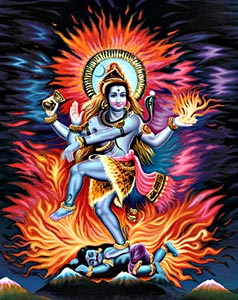
In some of the Puranic texts, the deity is also portrayed in a dancing posture. According to the Linga Purana, Ganesha began a dance performance in front of all the gods after He was created by Lord Shiva and Goddess Parvati. The idols and sculptures of Nritya Ganapati are mostly shown in the dancing position. The left leg is bent and placed on the ground while the right leg is raised. Another dancing posture is shown with the left leg raised and folded and the right foot resting on the ground. The left foot is stretched to the ground. This position resembles the Urdhvajanu dance of Lord Shiva.
Apart from the above mentioned postures of Lord Ganesha, He is also shown in a lying posture. In modern depictions, the deity is shown lying on a couch and leaning against a cushion.