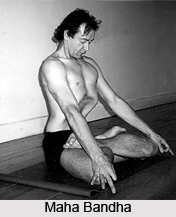
 Maha Bandha is considered as one of the greatest Bandha postures. The term `Bandha` is derived from Sanskrit which means to hold or lock. Bandha is broadly incorporated in various Mudras as well as Pranayama techniques. Different yogic texts such as Hatha Yoga, Pradipika, and Ghrenda Samhita have mentioned three bandhas namely Jalandhara, Moola and Uddiyana Bandha. Together these three Bandhas form Maha Bandha.
Practice of Maha Bandha
In a meditation pose for the period of Bahir Kumbhaka all the above mentioned bandhas are gradually assumed and held in the following order: Jalandhara Bandha, Uddiyana Bandha and finally Mula Bandha. Releasing of the bandhas also goes in the same order. The steps of Maha Bandha are:
•Firstly, inhale deeply and exhale fully through the mouth.
•Then hold the breath out.
•Place the hands on the knees; raise the shoulders and tilt the upper body forward slightly, keeping the back straight.
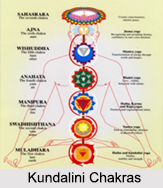
•Now, execute Jalandhara Bandha and focus on the Vishuddhi Chakra.
•Perform Uddiyana Bandha and focus on the Manipura Chakra.
•Finally, come into Mula Bandha and focus on the Muladhara Chakra. Stay in this position, with all three Bandhas maintained, for as long as the breath can easily be held.
•Release the Bandhas in the same sequence as they were applied.
•Inhale deeply and return to the starting position.
•Breathe normally and remain for some time in this position.
•It can be repeated for three to four rounds.
Benefits of Maha Bandha
Maha Bandha ensures various health benefits, some of which are as follows:
•Practicing this is beneficial for the health of the entire body.
•It is good especially for the autonomic nervous system, internal organs, muscles and nerves.
•It ensures a positive influence upon the mind.
•It proves beneficial for a weak bladder.
•It is also good for those who have the problem of constipation.
•It improves weak digestion.
•It also proves beneficial for descended organs and neck tension.
•It flushes away old, dead cells and in this way all the organs are strengthened and rejuvenated.
Note: It can be practiced by anyone. However, it is advisable to start the practice under the patronage of yoga expert.