Gujjar community of Kashmir have their own cultural and
linguistic heritage. In Rajouri District around 12% population is comprised of
Bakarwals (Gujjars) while 23% population belongs to Gurjars, both having some
common enlightening as well as linguistic inheritances. Gujjars of Kashmir
region mostly rear cattle and they are herdsmen of buffaloes and possess small
pieces of lands, kacha houses on slopes and foothills of mountains in Rajouri
district. Bakarwals are the offshoots of Gurjars in Kashmir and they are
nomadic tribes. Most of them are landless and houseless. Their livelihood is
mostly dependent on sheep and goats for which they have to rear these animals.
In search of green pastures for their herds and flocks, they travel from one
place to another with their baggage and flock of sheep and goats, fleet of
horses and dogs. Their favourite dresses are waist Coat, salwar, Kurta (long
shirt) and turban while the women usually bear trouser, kurti (shirt) and
cotton shawl.
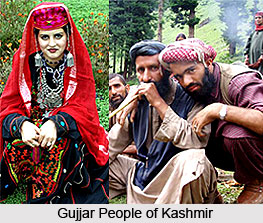
Gujjars or hill people of Kashmir are found in several parts of the state. They
are known as Rajputs. They migrated from Rajasthan and
accepted the Muslim faith. According to some historians, the Gurjars and
Bakarwals originally belong to Rajputana region of Gujara (Kathiawad) and due
to famine and other hostile conditions, they migrated to the Kashmir region.
Early records show that the Gujjars living on the borders of Kashmir embraced
Islam after some time and later on divided into two professionally different
sects of Gujjars and Bakarwals. After detailed and in-depth study made by the
historians, anthropologists, social scientists, researchers and ethnographers,
the links of Gurjars have been traced to the house of the pandvas of Mahabharata, Lord
Krishana himself was closely connected with the family of milkman.
Study of India's History has revealed that Gurjars or Gujjars played a crucial
role in making and unmaking the kingdoms and principalities.
Though the government has done a lot for the development of Gurjars and
Bakarwals, for instance, in the field of education, permanent and mobile
schools were established, Gurjar and Bakarwals hostels were built at the
District level with free boarding and lodging facilities, reservation was made in
employment and vocational institutions. However, the Gujjar community in
Kashmir is still backward. The Gujjar community of Kashmir have their own Gujri
language, which they generally speak. However, they generally respond in Urdu language.