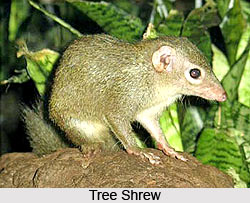
 Tree Shrews belong to the family Tupaiidae. There are two species of Tree Shrews found in India. The Malay Tree Shrew (Tupaia glis) occurs in Assam, the Naga Hills and extending eastwards into the Himalayan foothills. It is also found in Burma and Malaysia. The Indian Tree Shrew (Anathana ellioti) is confined to the peninsula and southern tip of India. Thirteen other species are known, all confined to the forested areas in Southeast Asia.
Physical Appearance of Tree Shrew
In size and appearance, these animals look like tree squirrels, with long busty tails (from fifteen to twenty centimetres in length) and the head and body of approximately equal length, but they differ from the squirrels in lacking any prominent long whiskers and having a long tapering pointed snout with moist rhinarium (nose-pad) like an insectivore. In colour, the throat and chest of the Malay Tree Shrew is orange to buff whilst that of the Indian Tree Shrew is more grayish white. The rest of the body fur is grizzled blackish olive and ferruginous.
Habitat of Tree Shrew
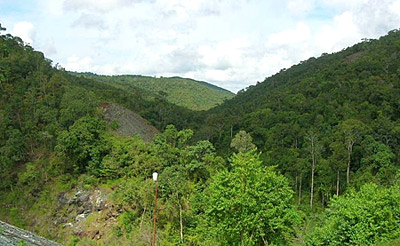
In habits they are all diurnal, and though equipped with naked padded soles to their feet, and long and flexible digits with recurved claws, they spend as much time foraging upon the ground as in trees. All the Tree Shrews are forest-dwelling animals, typically associated with evergreen tropical rain-forest, though the Indian Tree Shrew occurs in dry deciduous forest also.
They apparently can breed throughout the year and normally bear small litters of only one to two off springs, though the females sometimes have three pairs of mammae. Though there are reports of females not tolerating each others` proximity and fighting any other Tree Shrews encountered, it has been observed that the Malaysian Tree Shrew appears relatively unafraid of man and is remarkably active and agile, climbing up slender twigs, or probing and sniffing rapidly among the leaf litter and fallen branches of the forest floor.
Their exact phylogenetic relationship with other mammalian groups is still disputed. They show considerable anatomical differences from most insectivores except for the Elephant Shrew (Macroscelididae), and most zoologists prefer to classify them with primitive pro-simian ancestors of the primates.
Diet of Tree Shrew
Their diet consists partly of insects, soil-born crustacean and fruit and probably eggs of birds and nestlings.