Panhala Fort
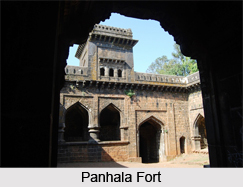
Panhala Fort is one of the largest forts in the Deccan built by Raja Bhoj II. Its strategic location has led to a number of wars.

Share this Article:

About Panhala Fort

Panhala Fort, MaharashtraThe Panhala Fort, also known as the Panhalgarh Fort, is one of the most important hillforts among the various monuments of the Deccan. Roughly triangular in shape, it lies about 12 miles north-west of Kolhapur, at a height 2,992 ft. The Panhala Fort is located at a strategic juncture and overlooks the Sahayadri mountain range which used to be a major trade route from the interior of Maharashtra to the coastal areas. Despite the ages, many parts of the Panhala Fort and the structures within are still intact.

The Panhala Fort was built by the ruler of the Silahara dynasty of Konkan, Raja Bhoj II between 1192 and 1209.It is one of fifteen forts that were built by the King. Because of its strategic location it was the centre of several skirmishes in the Deccan between the Marathas, the rulers of the Mughal dynasty and the British East India Company.

The fort was the seat of Raja Bhoj II between 1192 and 1209. In 1489 the fort and territory passed to the Adil Shahi dynasty of Bijapur.Chatrapati Shivaji seized the fort in 1659, but it was retaken two years later. It was then stormed once more in 1673, and subsequently held by the Marathas, except for a short period between 1690 and 1707 when it surrendered to the Mughals. After a local rebellion in 1844 the fort was assailed and taken by the British.

The Panhala fort is one of the largest forts in the Deccan. The fortifications are about 7-2 km in circumference, and there are a total of 110 lookout posts contained in the fort. A number of under ground tunnels stretch out from underneath the fort, one of which is almost a kilometre long. For considerable sections they are protected by a steep scarp reinforced by a loopholed parapet wall. The remaining sections have a strong stone wall varying between 15 ft and 30 ft in height, strengthened by bastions. Only two of the three original gates survive.

When the fort came under the control of the Adil Shahi dynasty of Bijapur in 1489 it was extensively fortified. They built the strong ramparts and gateways of the fort which, according to tradition, took a hundred years to build. Most of the architecture is of the Bijapuri style. The peacock motif of the Bahmani Sultanate is prominently seen on many structures. Some of the older bastions also have the lotus motif of Bhoja II. Numerous inscriptions in the fort refer to the reign of Ibrahim Adil Shah, probably Ibrahim I.Panhala Fort, Maharashtra

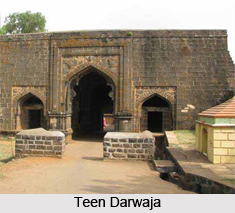
There are a number of monuments at the fort which have been considered as notable by the archaeological survey of India. There are three double gateways of the fort- the Teen Darwaza, the Wagh Darwaza and the Char Darwaza.
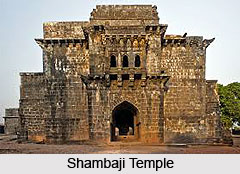
Panhala Fort, MaharashtraTo the north is a palace of the Maharaja of Kolhapur, a two-storey mud structure. In the south area is the Talim khana, with three rooms capped by domes. Some temples and Mausoleums are also found within the fort. There is a very old temple of Ambabai found here. It is the temple where Shivaji used to make offerings before embarking on an expedition. Also found within are temples devoted to Sambhaji II and Someshwar and a Mahakali temple. There is a temple of Maruti in the ruins.

There is a mausoleum of Jijabai found here, lying opposite to the mausoleum of her husband Sambhaji II.Also among the mausoleums found here are the ones erected for Ramchandra Pant Amatya(a minister in Shivaji`s court), Moropant(an 18th century Marathi poet)

A Muslim shrine dedicated to the saint Sadhoba is also present. Most of the Panhala fort is now in ruins. The parts remaining intact, mainly the palace of Tarabai, are currently used to house several Government offices, a school and a hostel.

Location of Panhala Fort

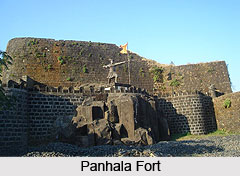
Panhala Fort is one of the largest forts in the Deccan Mountain Range in India, with a perimeter of 14 km and 110 lookout posts. It is 845 m (2,772 ft) above sea level. This fort is built on the Sahyadri Mountain Range, rising more than 400 metres above its surrounding plain. Numerous underground tunnels stretch out from underneath the fort, one of which is almost 1 km long.


Architecture of Panhala Fort

Architecture of Panhala FortArchitecture of Panhala Fort vivifies the Mughal art, design, architecture and the Bijapuri style of architecture. The Bijapur art and architecture is dominant in Panhala Fort.
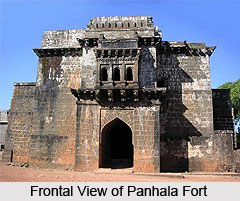
Most of the architecture is of the Bijapuri style with the peacock motif of the Bahmani Sultanate prominently visible on several structures. Some of the older bastions also have the lotus motif of Bhoja II. There are several monuments at the fort which are considered notable by the Archaeological Survey of India.

Fortification of Panhala Fort : The fortification of Panhala fort covers more than 7 kilomteres of fortifications, which define the approximately triangular zone of Panhala fort. The walls are protected for long sections by steep escarpments, reinforced by a parapet with slit holes. The remaining sections have 5-9 metro high ramparts without a parapet, strengthened by round bastions the most notable of which is Rajdindi.

At the east end of the Panhala fort is Kalavatin`s Sajja or the Courtesan`s Terrace-Room. Also known as the Nayakini Sajja, it was used as a residence for the ladies of the court during the occupation of the fort by the Bahmani Sultanate. It had become a complete wreck by 1886 with only traces of ornamental work on the ceiling remaining.

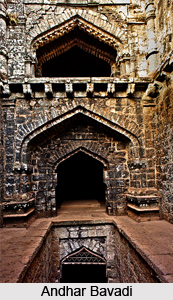
Andhar Bavadi in Panhala Fort : Architecture of Panhala Fort Andhar Bavadi (Hidden Well) was formed to have an escape route and to save the life from the Mughal armies. This is a three-storey structure with winding staircases that conceal the well which was the main water source for Panhala fort. There are recesses in the wall so that soldiers can be permanently stationed. Several hidden escape routes in the Andhar Bavai lead outside the fort. With its own water source, living quarters and its own exit routes, likely this structure was designed like a fort within a fort with the intention of making it an emergency shelter in case the main fort fell.
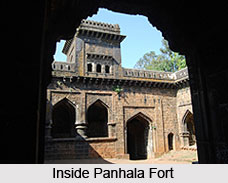
Nayakini Sajja in Panhala Fort : Nayakini Sajja literally means "Courtesans` Terrace room". It stands on the east side of the fort close to the rampart. By 1886, it had become a complete wreck with only traces of ornamental work on the ceiling. This was used during the occupation of the fort by the Bahmani Sultanate as a Rang Mahal (residences for the ladies of the court).

Ambarkhana in Panhala Fort : Amberkhana is situated in the centre of Panhala Fort. There were the three granaries built in the Bijapuri style of architecture. They enabled Shivaji, the Mughal Emperor to withstand a 5 month siege by Siddhi Johar. It consists of three buildings called the Ganga, Yamuna and Saraswati Kothis.

Ganga Kothi in Panhala Fort : Ganga kothi was the largest with a capacity of 25,000 khandis (with one khandi being 650 lbs). It covers an area of 950 sq m and is 10.5 m high. The rice, nachni and warai were the major provisions stored. Stairs on both sides lead the top of the buildings. It has sixteen bays each with its own flat vault with a hole on top through which grains used to be passed. The eastern entrance has a domed chamber with a balcony and plasterwork of the Bijapuri style.

Dharma Kothi in Panhala Fort : An additional granary, the Dharma Kothi, was also constructed next to the Amberkhana. It was a stone building 55 feet by 48 feet by 35 feet high. Leading to the terrace are an entrance and a staircase. The purpose of the Dharma Kothi was to distribute grain to the needy.

Sajja Kothi in Panhala Fort : The Sajja Kothi is a massive two-storey building perched on the edge of a precipice. It has been built in the Bijapuri style by Ibrahim Adil Shah in 1500.The purpose of the Sajja kothi is that it was a kind of viewing pavilion that overlooked the valley below. The upper chambers are domed and have faceted pendetives. The balconies hang over the ramparts of the fort. An interesting historical fact about the Kothi is that when Sambhaji, son of Chatrapati Shivaji, threatened to defect to Aurangzeb, this is where he was imprisoned.

Architecture of Panhala Fort The Teen Darwaza or three-doored Gate is an impressive structure with handsome sculpture approached via a steep path which is commanded by the curtain battlements. The outer entrance has a lintel and corbels set in a high pointed arch. The inner gate from the court is highly decorated with the lintel having finely carved motifs, including one of Lord Ganesh. The entrance passage leads through two doorways, past guardrooms to a courtyard, which is a killing ground for any invading troops who pierce the outer defences. The third door leads past further guardrooms. Saucer-shaped domes crown the central bays of the outer entrance passage. There are three Persian inscriptions-one on top and one each on either side. All three declare that the gate "was built in the reign of Ibrahim Adil Shah I by Malik Daud Aki son of Minister Ahmed" in 1534.

Double Gate in Panhala Fort : Double gate in Panhala Fort with a court lies in between that has arcades. The outer gate has an ornate chamber on top with decorated eaves. The inner gate from the court is highly decorated with the lintel having finely carved motifs, including one of Lord Ganesha. The latter has been placed by the Maratha Empire of India during their occupation of the fort.

The Char Darwaza or Four-doored Gate was demolished by the British in the attack of 1844. Situated in the centre of the court are three huge stone granaries, the Amberkhana, built in the Bijapuri style of architecture. It consists of three buildings called the Ganga, Jamuna and Saraswati Kothis. Of these three the largest is the Ganga Kothi. It covers an area of 10,200 sq. ft and is 35 ft high. It has sixteen bays each with its own flat vault with a hole on top through which grain used to be passed. The eastern entrance has a domed chamber with a balcony and plasterwork of the Bijapuri style. The top of the building can be reached by the stairs on two sides.

Persian inscriptions in Panhala Fort : There are three Persian inscriptions, one on top and one each on either side. All three declare that the gate "was built in the reign of Ibrahim Adil Shah I by Malik Daud Aki son of Minister Ahmed" in 1534 CE.

Architecture of Panhala FortWagh Darwaza in Panhala Fort : The Wagh Gate lies in a re-entrant angle of the fort and has a long, steep approach. This was another entrance to the fort. It was designed in such a way so as to elude invaders into getting trapped into a courtyard. They could then be easily neutralized. Part is destroyed, but the principle of guardrooms flanking the entrance is the same as elsewhere. There is an elaborate Ganesh motif at the entrance.
Rajdindi Bastion in Panhala Fort : Rajdindi bastion in Panhala Fort was one of the hidden exits of the fort to be used in times of an emergency. It was used by Shivaji to escape to Vishalgadh during the battle of Pavan Khind. Rajdindi is still intact.


Temples in Panhala Fort

There are temples devoted to Sambhaji II, Someshwar and Ambabai in addition to the Mahakali temple. Ambabai temple is very old and it was here that Shivaji would make offerings before embarking on major expeditions. The mausoleum of Jijabai lies opposite to that of her husband, Sambhaji II. Ramchandra Pant Amatya (who wrote Adnyapatra, a treatise on Maratha policy) was the youngest minister in Shivaji`s fort. He died at Panhala fort and a mausoleum was erected here for him and his wife. The mausoleums were covered with rubble till 1941 and till 1999 had not undergone any restoration work. Also a mausoleum to Moropant an 18th-century Marathi poet who wrote poetry in the adjacent Parashar caves can be seen. A shrine to a Muslim saint Sadhoba is also present.


Seige of Panhala fort

Siege of Panhala Fort was undertaken by the joint forces of the Adil Shahi dynasty of Bijapur. Shivaji was proving to be an increasing threat to the Mughal and Adil Shahi forces. Thus, they sought to defeat him and for this purpose, they even allied together. According to the plans of the Mughals and Adil Shah, Adil Shah sent Siddi Jauhar in 1660 to attack Shivaji along his southern borders, preceding the expected major Mughal attack from the north. Siddi Jauhar ordered his army of forty thousand men to march north towards Kolhapur to confront and defeat Shivaji. This was a part of their alliance with the Mughal emperor Aurangzeb. For this purpose, he was successful in securing the support of local chieftains such as Jasvantrao Dalvi of Palavani and Suryarao Surve of Sringarpur to defeat Shivaji.

During the time of this plan of attack, Shivaji was camped at Panhala fort with eight thousand Marathas. Siddi Jauhar`s army besieged Panhala on 2nd of March 1660, cutting off supply routes to the fort. Helping with siege were Baji Ghorpade and Siddi Masud from the west, Sadat Khan and Bhai Khan from the north, Rustam Zaman and Bade Khan from the east, Siddi Jauhar and Fazal Khan from the south. The Commander of the Maratha forces, Netaji Palkar, was on a mission away from Panhala. He was at this time busy harassing and attacking Adil Shahi territory and was not able to come to the aid of Shivaji.

The fort of Panhala was a most formidable one. The army of the Adil Shahis was repeatedly repulsed by cannon fire and pelting of rocks. Siddi Jauhar approached Henry Revington, the British chief at the Rajapur port to seek long-range and more powerful cannons. Henry decided to help him in return for future favours, and began pounding Panhala fort. Despite this, the Marathas continued to defend Panhala, and succeeded in keeping Siddi Jauhar at bay. The Marathas, though without much success, also managed to raid the Adil Shahi camps a few times.

It was in one such raid that two from the Maratha side, Tryambak Bhaskar and Kondaji Farzand pretended to be allies of the British and Adil Shahi forces. They came down to the Adil Shahi camp and met Henry Revington and his associates. They managed to kill one British officer and injured Henry. They also managed to sabotage the canons and make them ineffective. Greatly angered at this incident, Jauhar made the siege even more intense. He undertook every possible measure to ensure that the siege around Panhala was unyielding, and personally ensured that no one in his army was complacent. He even braved the heavy monsoons and continued the siege even during heaviest downpours. When Netaji Palkar heard that the siege around Panhala had been further tightened, he returned from Bijapur and launched an attack on the Adil Shahi forces surrounding Panhala. However he was unsuccessful as his small force was pushed back by the much larger Adil Shahi army.

Following this, Shivaji decided to escape to a nearby fort, Vishalgad, in order to re group his soldiers. With this intention in mind, he sent misleading messages to Siddi Jauhar, indicating a willingness to negotiate. When the Adil Shahi forces received this message, they relaxed their vigilance. Taking advantage of this, Shivaji escaped from Panhala on a stormy night. Meanwhile, the soldier`s of Jauhar`s army claimed to have captured a small group of Marathas including Shivaji. On closer inspection it was realised that he was only a look alike named Shiva Kashid who was dressed like Shivaji. This was a mere diversion that had been created in order to facilitate the escape of the real Shivaji. However this realisation came too late as Shivaji had already fled to Vishalgad and thus the siege on the Panhala came to nothing in the end.


Share this Article:

Related Articles

More Articles in Indian Monuments


Monuments of Punjab
Monuments of Punjab are the founding stones of the state. Punjab has numerous historical monuments and religious monuments scattered throughout its different cities.throughout its different cities.
Monuments of Lakshwadeep
Monuments of Lakshwadeep are famous for their ancient religious feel and historical value.
Monuments of Jharkhand
Monuments of Jharkhand are well maintained by the state government as these are popular tourist destinations. These monuments are remnants of the history of the region, narrating significant incidents from the past.
Monuments of Haryana
Monuments of Haryana represent the glorious culture and history dating back to thousands of years. These monuments are popular for their historical, religious, or political significance.
Monuments of West Bengal
Monuments of West Bengal, mainly from the British era, are considered as priceless heritage of the state and attracts many tourists to the state.
Monuments of Andaman And Nicobar Island
Monuments of Andaman and Nicobar Island loaded with their rich past unveils the history of India. Most of the monuments here are reminiscence of dark and brutal rule of the British Empire in India.
Monuments of Andhra Pradesh
Monuments of Andhra Pradesh represents several wonderful and glorious sagas of various ruling dynasties of the past. Most of these monuments are protected by the government for their architectural excellence and historical significance.
Monuments of Chhattisgarh
Monuments of Chhattisgarh have a significant role to play in the state`s tourism. The land has a rich cultural and political history that is reminiscent in the historical forts, palaces and temples of Chhattisgarh and are great tourist attractions.
Monuments of Telangana
Monuments of Telangana covers the ancient, medieval and modern historical structures illustrating the architectural grandeur and attracting thousands of tourists throughout the year.
Monuments of South India
Monuments of South India show strong Dravidian traditions and are located in Tamil Nadu, Kerala, Andhra Pradesh and Karnataka.
Tombs in India
Tombs in India are famous all over the world for their architectural beauty and most of these tombs have been built in the medieval period. Travellers from all across the globe throng these historical sites.
Daulat Khana
Daulat Khana complex belongs to the early phase of Nawabi construction in Lucknow. It was commissioned to be built by Nawab Asaf ud Daulah. The Daulat Khana Complex consists of the Shish Mahal, the Shish Mahal Ka Talab and the Baradari Shish Mahal.
Mahesh Vilas Palace
Mahesh Vilas Palace is located in the state of Uttar Pradesh amidst 35 acres of Lush Green Lawns, Fountains and Orchards.
Architecture Of Andhra Pradesh
Architecture of Andhra Pradesh is an illustration of diverse types of Hindu, Buddhist and Islamic architectural styles.
Architecture Of West Bengal
Architecture of West Bengal comprises Hindu temples, Muslim, Buddhist and Colonial monuments and the unique terracotta style.
Architecture of Lucknow
Architecture of Lucknow is mostly Islamic in nature. It is representative of 18th and 19th century Indian architecture. The architecture is broadly divided into religious architecture, such as that of Imambaras and secular architecture, such as that of Baradaris and Kothis.
Cheena Kottaram
Also known as the China Palace, the Cheena Kottaram used to be a rest house for the then King of Travancore.
History of British Architecture in India
History of British architecture in India had begun with a solemn promise, keeping no stones unturned. This line of architecture invaded in India from the early colonial times in the states like Delhi, Kolkata, Mushidabad and Pune.
Monuments of Assam
Monuments of Assam are timeless remnants of historical masterpieces which reflect the architecture of ancient Assam. these monuments are remnants of the glorious history of the region under different rulers.
Bharhut Stupa
Bharhut Stupa is situated between Jabalpur and Allahabad in the erstwhile Nagod state of Madhya Pradesh. In 1873, the place was discovered by Sir Alexander Cunningham.