
Chandogya Upanishad is one of the oldest Upanishad written on the Vedic Brahmana period about ninth to eighth century BC. Chandogya Upanishad is associated with Sama Veda. It is ranked ninth in the Muktika canon of hundred and eight Upanishadas. The 3rd Khanda of Chapter Four of Chandogya Upanishad states about the dialogue of Raikva and Janasruti. The air (Vayu) is verily the ultimatum (sambarga) of all. When a fire goes out, of a truth it merges with the air (Vayu). When the sun sets it merges into the air, so does the moon when it sets in. When waters dry they vanish in the air. Here the air consumed it. These were with reference to the celestial beings. The next reference is to the body. Here the Prana is the swallower. When a man sleeps, speech goes into the Prana, sight goes into the Prana, hearing goes into the Prana and the mind goes into the Prana. The Prana thus absorbs them all. Thus, these are the two swallowers, the air among the gods and the Prana among the senses. Once, while Saunaka of the race of Kapi, and Abhipratarin, son of Kakshasena, were being served at their meals a Brahmacharin sought alms from them. However, they did not give him any alms. The Brahmacharin addressed Saunaka as the descendent of Kapi. He told him that Prajapati is the swallower of the four great ones and is the descendent of Kapi. He abides in manifold forms. Thus, the food that they are taking has not been offered to him. Sanaka of the line of Kapi, pondered on his words. He told the brahmacharin that Prajapati is the self of the gods, the creator of all beings, with unbroken teeth, the eater, and the truly wise one. All speak of his magnificence. His greatness is said to be extreme, and none can consume him. He thus, eats even what is not common food. All meditates on this Brahman. He then asked his attendants to give him food.
The first five, the eater vayu and fire, the sun, the moon and water, which are its food and those five, the eater Prana and the organs of speech, the eye, the ear and the mind, which are its food together make ten. They constitute the krita i.e. the highest throw in a game of dice. These ten make up the Virat, the consumer of food. Through it, all this becomes visible.
3rd Khanda of Chapter Four
3rd Khanda of Chapter Four of Chandogya Upanishad states about the conversation of Raikva and Janasruti.
Recently updated articles in Indian Philosophy
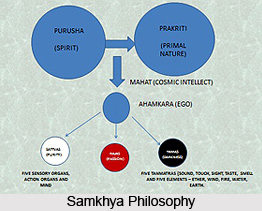
Samkhya Philosophy
Samkhya philosophy is one of India’s oldest intellectual traditions, explaining reality through the interplay of Puruṣha (pure consciousness) and Prak...
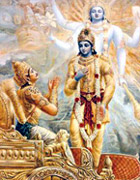
Maya, Prakriti in Hinduism
Maya or illusion is a very potent instrument of the Divine Prakriti, the Primal nature. In Hinduism one must be able to come out of Maya in order to a...
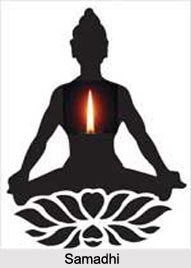
Samadhi in Hinduism
Samadhi is the result of meditation or that state of mind when there is an absence of all idea of individuality.
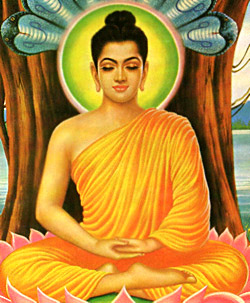
Samadhi in Buddhism
According to Buddhism, oen can only achieve samadhi through strict meditation and right concentration.
Abdul Rehman Jilani Dehlvi
Syed Abdul Rehman Jilani Dehlvi was a renowned Sufi saint of the Qadri Order in India.
Related articles in Indian Philosophy

Ajivika Philosophy
Ajivika philosophy is different from the mainstream religion
Indian Philosophy In The Vedic Period
Indian Philosophy in the Vedic Period was primarily based on the concepts of nature worship.
Achintya Bheda Abheda Philosophy
Achintya-Bheda-Abheda is a School of Vedanta that represents the philosophy of unimaginable one-ness and difference in relation to the power creation...
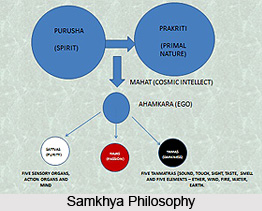
Samkhya Philosophy
Samkhya philosophy is one of India’s oldest intellectual traditions, explaining reality through the interplay of Puruṣha (pure consciousness) and Prak...
Charvaka Philosophy
The Charvaka Philosophy believes that only those things that can be perceived is the ultimate reality.