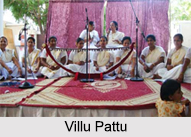
 Villu Pattu is a popular folk music of the South Indian state Tamil Nadu. It is also well known by the name "Bow Song". This art form is accredited to one "Arasa Pulavar" of the 15th century. Villu Pattu is an ancient form of musical story-telling in India where narration is interspersed with music. It is one of the charming types of simple and popular folk music of Tamil Nadu, which still stands as a symbol of a cultural prosperity of the Tamils. Villu Pattu is usually performed during the festival season of September to December in temples and fairs.
Theme of Villu Pattu
The Villu Pattu is an art form of Tamil Nadu, which illustrates various social messages and also speaks out on mythological themes. The idea of question and answer sessions among the troupe members is also introduced in Villu Pattu to make it more interesting. Sometimes the performers also divide themselves into two groups and have a lively musical debate. But the central theme of the performance always remains the conquest of good over the evil.
 Performance of Villu Pattu
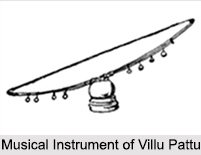
There are total eight members in a Villu Pattu orchestra. The lead singer also plays the role of the main performer. He also handles the dominating instrument which is bow shaped. The palmyra wood is used to make this instrument. It is curved like a bow with its two ends attached by a string that is stretched tight with tension. This bow is rested on the neck of a large earthen jug, which in turn rests on a circular plate made of coconut fibre. There are numerous bells hung from the string of the bow and two cymbals are also seen at each end. There were two slender wooden rods called the `veesukkol`, which were used by the main performer to strike the string of the bow in time with the beats. This sets off the bells and the cymbals.
The second artiste of Villu Pattu is needed to handle both the earthen jugs. He hits the mouth of the jug and also the sides to make sounds and for the latter activity he uses a coin. In the performance of Villu Pattu, the third artiste performs on an instrument known as the `udukku`. There is a fourth member in the music team, who keeps time by two wooden blocks called the `kastha`. The cymbals are used by the fifth member of a Villu Pattu team. The rest of the members sing the chorus line and the refrains. The performance of Villu Pattu involves a lot of jokes, quick wordplays and loads of humour.
Another very exciting characteristic of the Villu Pattu art is the ex-tempore debate in poetry. The party splits itself into two groups and the main singer with the "veesukol", those who sing with him and the two men who keep "tala" by playing on the "Kastha". The first group of persons singing on the right hand side is called the "rightists" (Valathe padupavar) and those who sing on the left hand side will be called the "leftists" (Idathe padupavar). The rightists will create verses on the spot in a particular tune and the subject matter of the verses may be anything under the sun, on "vedanta", or "siddhanta" religion, philosophy or theology.
Villu Pattu is a catchy folk music, which still stands as a symbol of a cultural wealth of Tamil Nadu.