
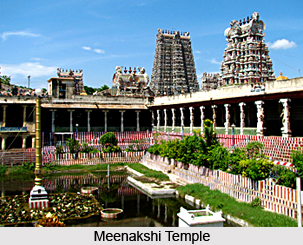
 Meenakshi Temple is one of the beautiful temples in the state of Tamil Nadu. It was built during the Nayak rule and presently it serves as an important landmark of the city. Located in the heart of the city of Madurai, the Meenakshi-Sundareswarar temple is dedicated to goddess Meenakshi, the consort of Lord Shiva. There are around fifty priests in the temple who perform the rituals at the time of festivals and also on a daily basis. For the people of Madurai, the temple is the very centre of their cultural and religious life. The Meenakshi-Sundareswarar temple has long been the focus of both Indian and international tourist attraction. It is one of the greatest Shiva temples in India and one of the most important places of Hindu pilgrimage.
Meenakshi Temple
Meenakshi temple, in Madurai, Tamil Nadu is one of the greatest Shiva temples in India and one of the most important places of Hindu pilgrimage.
Introduction
Meenakshi Temple is one of the beautiful temples in the state of Tamil Nadu. It was built during the Nayak rule and presently it serves as an important landmark of the city. Located in the heart of the city of Madurai, the Meenakshi-Sundareswarar temple is dedicated to goddess Meenakshi, the consort of Lord Shiva. There are around fifty priests in the temple who perform the rituals at the time of festivals and also on a daily basis. For the people of Madurai, the temple is the very centre of their cultural and religious life. The Meenakshi-Sundareswarar temple has long been the focus of both Indian and international tourist attraction. It is one of the greatest Shiva temples in India and one of the most important places of Hindu pilgrimage.History of Meenakshi Temple
 History of Meenakshi Temple, Tamil Nadu, can be traced back to the Indian mythology. It is believed that the temple was founded by the king of celestial deities, Indra, during the time of his pilgrimage which he undertook to atone for his misdeeds. As he reached near the swayambu lingam of Madurai, which is referred to the self formed lingam and is a representation of Lord Shiva, he felt his burden lifting. According to him, the miracle occurred due to the lingam and thus he built the temple to enshrine it. Indra worshipped Lord Shiva in the temple and the latter created the golden lotus in the pool situated nearby.
Over the last two millennia, the temple finds its mention in the Tamil literature. As per a famed Hindu saint of Saiva philosophy, Thirugnanasambandar, the temple belongs to 7th century and he has also described its deity as Aalavai Iraivan. It is believed that in 1310, the temple was demolished by the infamous Muslim invader Malik Kafur and all the ancient elements of the temple got destroyed along with it.
The first Nayak king of Madurai, Viswanatha Nayak (1559 -1600), took the initiative to reconstruct the temple. The renovation of the structure was supervised by the prime minister of the Nayak dynasty and the founder of the Poligar System, Ariyanatha Mudaliar. The original design of Meenakshi Temple was created in 1560 by Vishwanatha Nayak which was later considerably expanded to its present structure during the regime of Thirumalai Nayak (1623-55). Several complicated structures were erected inside the temple as the ruler took much interest in developing the temple. Some of the major contributions by the ruler include the construction of Kilikoondu Mandapam (corridor of parrots) and the Vasantha Mandapam for celebrating vasanthorsavam (spring festival). The Meenatchi Nayakar Mandapam and the corridors of the temple tank were constructed by Rani Mangammal.
In the year 1812, the Collector of Madurai was Rous Peter who was nicknamed as Peter Pandian for his respect towards all faiths and equal treatment to the people belonging to all religions. He also contributed to the temple by donating a set of golden stirrups studded with diamonds and red stones. It is believed that Goddess Meenatchi once saved Rous Peter from a fatal incident. He had also wished that after his death, his body must be buried in such a position that his eyes would face the temple.
Architecture of Meenakshi Temple
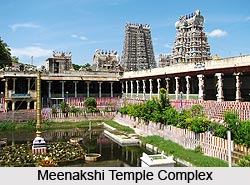 Architecture of Meenakshi Temple is spectacular and it forms one of the largest temple complexes of the state of Tamil Nadu. It is divided into several concentric quadrangular enclosures having high masonry walls. The temple has four entrances which face towards four directions, a feature quite rarely found in the temples of Tamil Nadu. It has been mentioned in the Tamil classics that the temple once served as the centre of the city and its streets radiated out from the temple like a lotus and its petals. The outer precincts of a temple called the prakarams house an elaborate festival calendar. The temple complex spans over an area of 45 acres.
Gopurams of Meenakshi Temple : Meenakshi Temple is enclosed with gateway towers, also known as gopurams. Among the ten gopurams of the temple, the famed southern tower is the tallest and rises to a height of 170 feet. It was constructed in 1559. The one at the eastern end is the oldest one which was constructed by Maravarman Sundara Pandyan during 1216-1238. Each of them is a multi-storeyed structure adorned with numerous stone figures of animals, demons and gods painted in vibrant colours.
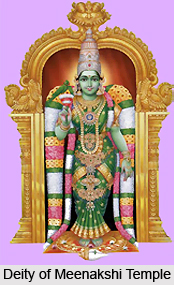
Shrines of Meenakshi Temple : The main shrine of Meenakshi Temple and that of her consort Sundareswarar are enclosed by three enclosures and four minor towers at the four points of the compass protect each of them. An emerald coloured black stone image of Meenakshi is enshrined in it. Sundareswarar shrine is located at the centre of the temple complex and both the shrines have gold plated tower over sanctum called Vimanam.
 This golden top can be witnessed even from a great distance. Outside the Sundareswarar shrine and on the way of Meenakshi shrine, there is a tall sculpture of Lord Ganesha which is carved out of a single stone and is known as Mukuruny Vinayakar.
Temple Tank of Meenakshi Temple : The temple complex houses a sacred temple tank called Porthamarai Kulam having 165 feet and 120 feet length and breadth. Tamil legends say that the lake judges the worth of a new piece of literature. As per the beliefs, the authors place their works in the lake and the scholastic works float whereas the poorly written ones sink. There is a small portico towards the western part of the tank which houses an ancient Nayak painting depicting the marriage of Sundareswarar and Meenkashi which was attended by Rani Mangammal and Vijayaranga Chokkanatha.
Halls of Meenakshi Temple : The corridor which surrounds the sanctum of the Meenakshi is known as Kilikoondu Mandapam. Previously it was used for keeping green parrots trained to utter the name of Meenakshi. There is a Hall of temple tree called Kambatadi Mandapam having seated Nandi. The hall had carvings of various manifestations of Lord Shiva along with the marriage of Meenakshi sculpture.
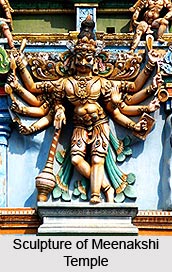 A number of other sculptures also adorn the hall including that of Shiva and Kali. Tirumala Nayak had constructed the Puthu Mandapam or new hall in the temple, opposite to the east gopuram, containing several sculptures. At the entrance of Meenakshi shrine, the first hall is Ashta Shakthi Mandapam or the Hall of Eight Goddess. The hall shelters statues of eight goddesses. The temple contains another large hall having huge corridors called Viravasantharaya Mandapam. Kalyana mandapam is the hall located towards the south of the previous one. This hall celebrates the marriage of Shiva and Parvati every year during Chithirai Festival. Other halls of the temple include Mudali Pillai Mandapam, Mangayarkarasi mandapam, Servaikarar Mandapam and Kolu Mandapam.
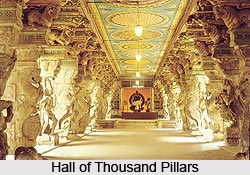
Hall of Thousand Pillars : Meenakshi Temple has a Thousand Pillar Hall which has 985 pillars and was constructed by Ariyanatha Mudaliar, the prime minister and general of the first Nayaka of Madurai named as Viswanatha Nayak, in 1569. It exhibits fine artistic vision and engineering skills. A statue of Ariyanatha Mudaliar seated on a horse-back is placed at the entrance of the hall. Each of the pillars has carvings of Dravidian sculptures. The hall also houses a Temple Art Museum with drawings, photographs, icons and other artefacts belonging to 1200 years ago. There are musical pillars outside the hall which produces musical notes when struck.
Festivals of Meenakshi Temple
It is said that the people of the city wake up, not by the call of nature but by the chant of hymns at the temple. All the major festivals of Tamil Nadu are celebrated here with gaiety, most important being the Cittirai festival that is held in April/May, when the celestial marriage of Meenakshi and Sundareswarar is celebrated, drawing a huge crowd of people from all over the state. The sculpted pillars are adorned with the exquisite murals that celebrate the ethereal beauty of princess Meenakshi and the scenes of her wedding with Lord Shiva. At the Sundareswarar temple across the courtyard, Lord Shiva is represented as a lingam. The pillars depict scenes from the wedding of Meenakshi and Sundareswarar.
Recently updated articles in Temples of India
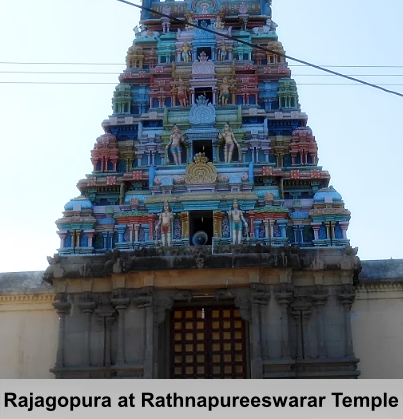
Rathnapureeswarar Temple
Rathnapureeswarar Temple in Tiruvarur district, Tamil Nadu, is a revered Shaivite shrine among the Paadal Petra Sthalams. Dedicated to Lord Shiva, it...
Gayatri Temple, Sirmaur
Gayatri Temple is located in Sirmaur district, Himachal Pradesh. Gayatri Temple is a sacred shrine that belongs to the medieval age.
Thousand Pillars Temple
Thousand Pillars Temple, Andhra Pradesh possesses 1000 pillars built by the Kakatiya ruler Rudra Deva during 1163 AD and is adorned with beautiful scu...
Triloknath Temple, Mandi District
Triloknath Temple is built in the Shikhara style of architecture, situated in Mandi, HP.

Shiv Temple at Mooni, Jammu & Kashmir
Ideally seated at the Billawar taluk of Kathua, Shiv Temple is a holy shrine.
Related articles in Temples of India
Khajuraho Temples
Khajuraho Temples are known the world over for their beauty and architectural construction. This group of temples is situated in the central Indian st...
Temples In Hampi
Temples in Hampi are the manifestations of rich religious beliefs and architectural and sculptural abundance.
Badami Cave Temples
The Badami Cave Temples, an exemplary production of Indian architecture, are situated in the town of Badami.
Temple Architecture During Rajput Period
Temple architecture during the Rajput period was inclined to the aspect of Bhakti. Rajput kings encouraged this art which is reflected in the grandeur...
Medieval Temples of India
Medieval temples of India vary from each other due to the style and architecture. The impact of the prevalent kingdom is prominent in the style of bui...