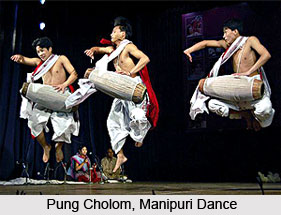
 Pung Cholom Dance is a traditional dance practised in the north-eastern Indian state of Manipur and has greatly inspired the classical Manipuri Dance and Manipuri Sankirtana music. Performed by men as well as women, this dance-form is actually a prelude to the Raslila dance and is characterised by the playing of a drum known as `pung` by the dancers even as they dance. The dance is also known as `Mridanga Kirtan` or `Dhumal` or drum dance, since this is performed with a drum, called the Mridanga. Pung Cholom dancers maintain some acrobatic dance movements with exquisite grace and simultaneously ensure that they adhere to the general rhythm of the music. A subtle rhythm is associated with the initial phase of this dance which starts ascending till the climax. Certain features of Pung Cholom dance have been motivated by some characteristics of `Maibi Jagoi` and also from `Sarit Sarak` and `Thang Ta`, which are renowned Manipuri martial arts.
The dance is performed either as an integral part of `Nata Sankirtan` or independently in front of the social gathering. When it is a part of the Nata, two players participate in its performance, but as an independent dance performance at least 14 players follow the sequence of the Nata Sankirtan. In this series, more than 40 complicated `talas` and `sanchars`, are presented, which represent particular compositions of rhythms. The rulers had patronized and organized four distinct types of Pung Cholom, in connection with Hindu religious festivals.
The general rules that are organized for its performance make it a distinct type of a folk dance. Its performance is full of various body movements that are executed with great artistic skills and excitement. Sometimes, Mridanga creates the sounds of thunder, voice of birds and animals. The movements at the initial stage are soft, but later on become momentous and vigorous. The performers wear a special type of turban, which they drop by flipping their heads with their movements. This art requires a lot of practice before the actual performance is done, since it is full of stylish movements and ritualistic in nature. Hence, this art form has to be practised right from the teenage level, if the youth have to be a master in this dance form.
There is a wonderful blending of the interplay of intricate rhythms and cross rhythms from the slow to the quick ones, used with varying time. It is highly refined classical dance number characterized by the modulation of sound from soft whisper to a thunderous climax. The whole performance is characterized with graceful and vigorous body movements that lead to make it a unique dance form.