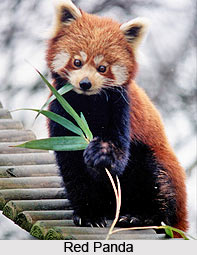
 Red Panda is an Indian Animal whose scientific name is Ailurus fulgens. Currently, the Indian Red Panda is under threat of extinction. The Indian Red Panda is also called Cat Bear, Bear Cat, Bright Panda, Common Panda, Fire Fox, Red Fox, Fox Bear, Himalayan Raccoon, Lesser Panda, Nigalya Ponya, Panda Chico, Panda Rojo, Petit Panda, Poonya, Crimson Ngo, Red Cat, Sankam, Small Panda, Thokya, Wah, Wokdonka, Woker and Ye. It is mainly found in the Himalayan Ranges of India and is listed as an endangered species.
Features of Red Panda
The Indian Red Panda is slightly bigger than the domestic cat and can keep climb trees very easily. It grows for a length of fifty to sixty centimeters. It has a long tail which is nearly thirty to sixty centimeters. The male Pandas are larger than the female Pandas. The male Pandas weigh nearly 4.5 kilograms to 6.2 kilograms while a female panda weighs somewhere between 3.7 kilograms to 4.5 kilograms. The upper part of the body is covered with long and soft, reddish brown fur. The lower part of the body is covered with black fur. The short and black legs of the Red Panda are covered with thick soles, which is like an insulator to enable it to walk on snow.
Habitat of Red Panda
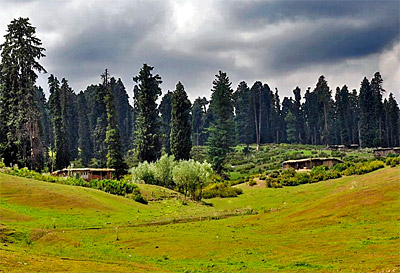
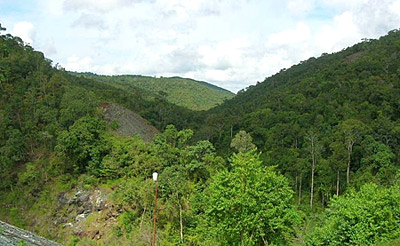
 In India, the Pandas are nocturnal animals which sleep during the daytime in the branches and hollows of trees. They are not gregarious. They prefer to stay alone rather than roam in groups. Red Pandas make a twittering and whistling sound and rarely communicate with each other. They are found in the mountainous region of India situated at an altitude of more than 1800 meters.
The Indian Red Panda attains maturity at the age of two to three years. The mating season is usually around end of December to the mid February. The gestation period is for about one hundred and twelve to one hundred and fifty eight days. The nest of the Indian Panda is located in the hollow of a tree. The young Panda becomes independent after five months of its birth.
Diet of Red Panda
The staple diet of the Indian Red Panda consists of bamboo. The other things that it consumes include berries, fruits, mushrooms, roots, acorns, lichen, grasses, young birds, eggs, small rodents and insects.
In India, the Red Panda is found in the wildlife sanctuaries of Darjeeling, West Bengal and Sikkim as well as in Arunachal Pradesh.