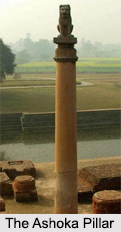
 Sarnath is the place where Lord Buddha delivered his first sermon after attaining enlightenment. King Ashoka, who spread Buddha`s message of love and compassion throughout his vast empire, visited Sarnath around 234 BC and erected a `Stupa` and a pillar there. Several Buddhist structures were constructed at Sarnath between the 3rd century BC and 11th century AD and today the place represents most important ruins amongst places on the Buddhist trail.
Sarnath is located 10 kilometres away from the holy city Varanasi and is an exceedingly tranquil place. The ruins, the temple and the museum add the value to Sarnath and all within walking distance. The deer park in Sarnath is where Gautama Buddha taught the Dharma and where the Buddhist Sangha came into survival during the enlightenment of Kondanna.
History of Sarnath
Buddha after accomplishing enlightenment at Bodh Gaya came to Sarnath and delivered his first address to 5 disciples namely - Kaundinya, Bashpa, Bhadrika, Mahanaman and Ashvajit for saving civilization. While travelling to Sarnath, Gautama Buddha had no money through which to pay the ferryman to cross the Ganges, so he crossed it during the air. Buddha consequently also spent his first rainy season at Sarnath at the Mulagandhakuti. Earlier Sarnath has been known as Mrigadava. The Sangha had developed to 60 in number and Buddha sent them out in all directions to travel without help and teach the Dharma. All 60 monks were Arahants.
Buddha`s first speech, delivered at Sarnath is known in Pali as the "Dhammacakkhapavathana Sutta". Buddhism increased in Sarnath because of the support of kings and prosperous merchants based in near Varanasi. By the 3rd century, Sarnath had become a significant centre for the arts, which reached its peak in the Gupta period. When Hsuan Tsang visited from China in the 7th century, he found 30 monasteries and 3000 monks living at Sarnath. The existence of images of Heruka and Tara specify the Vajrayana of Buddhism which was also exercised there. At the conclusion of the 12th century, Sarnath was bagged by Turkish Muslims. The place was afterwards sealed for building materials and has remained in ruins until the present day.
Different Attractions of Sarnath
Every bit of of the antique buildings and structures at Sarnath were damaged or destroyed by the Turks. There are some major attractions in Sarnath and these are as follows:
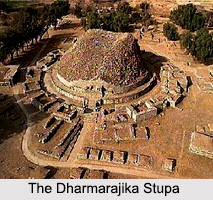
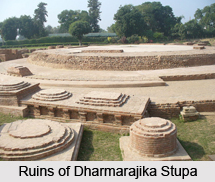
The Dharmarajika Stupa: This is the earliest of the remains here at Sarnath, built on Mauryan period attributed to the Emperor Ashoka the great. The Dharmarajika Stupa was expanded and enlarged several times up to 12th century AD. The structure was destroyed by repeated invasions and negligence. What is found today is the result of repeated effort of reconstruction.
The Chaukhandi Stupa: Chaukhandi is the first monument encountered by the visitors as they enter Sarnath. It is a lofty mound of brick, a structure whose square edifice is surrounded by an octagonal tower. This structure is also said to be raised by Emperor Ashoka.
The Dhameka Stupa: This is the most conspicuous structure at Sarnath. Colonel Cunningham bore a shaft from the top centre of the stupa and discovered a stone tablet on which an inscription is written with the word `Dhameka`, which mentions that this is the spot where Buddha delivered his first sermon. Dhamekha seems to be a distorted form of Dharma Chakra, which means turning the wheel of the Dharma.
The Ashoka Pillar: The Ashoka pillar is extremely important because on top of the pillar there used to be a statue of four lions holding up a wheel, which is national sign of India now. The wheel stands for `Dharma`. The pillar is broken now and the `Lion capital of Ashoka` is in display at Sarnath museum, which consists of a canopy representing an inverted bell-shaped lotus flower, a short cylindrical abacus where alternate four 24-spoked Dharma wheels with four animals (an elephant, a bull, a horse, a lion in this order) and four lions facing the four cardinal directions.
The Mulagandha Kuti Vihar: It is the modern temple erected by the Mahabodhi Society. It has excellent frescoes by Kosetsu Nosu who is famous Japanist painter. Several Buddhist relics are also excavated here. On Buddha Purnima, the birth ceremony of Buddha, relics of Buddha are taken out in procession. The archaeological museum at Sarnath houses several Buddhist sculpture and relics, also a rich collection of Buddhist manuscript and writings.
Sarnath Archaeological Museum: The grand lion wealth which topped the pillar and survived its 45 base drop to the land is on exhibit at the Sarnath Archaeological Museum. The museum is also a dwelling for some of the supreme treasures of Indian Buddhist art as well as nearly 300 images.
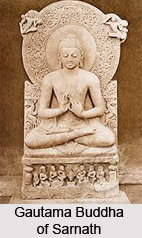 During the first three centuries of the contemporary era, the workshops of Gandhara and Mathura had created virtually all the surviving freestanding stone sculptures, together with style. A handful of works, predominately yaksis, in styles allied to Mathura, were found as Far East as Patna. For images of the Buddha, both standing and seated, exports from Mathura itself were relied upon. The Kanoria Parsvanatha stele, from Patna, was commonly held to be from the late 4th century, and the fragmental inscription of Rajgir, the seated Neminatha, may be attributed to the reign of Chandragupta II (c.377-414), due to the manner in which the lower garment of the standing attendee figure terminates just above the knees, with four audacious ripples descending between the legs. Both manifests the preliminary stages of a style which had climaxed during the post-Gupta Buddhas of Nalanda, but not, interestingly enough, the great Gupta Buddhas of Sarnath, confessedly further to the west. The legendary seated Buddha from Bodh Gaya, dated in the year 64 of an anonymous king who presumably reigned within the Gupta period (i.e. 320 + 64 = A.D. 384), is one of the central pieces in the long history of Indian sculpture. It was long assumed to be an import from Mathura, because the body was in the same position as the Katra-type Buddhas created there, the pleats of the robe were crowded together in a likewise manner, and its throbs with their immense physical vivacity. But the head was rather unusual- the face was threatening, heavy lidded, the eyes concentrated the end of the nose- an over-the-top controlling evocation of the Buddha as the great yogi. According to Stella Kramrisch`s words, it is `the first image in India which by its form signifies what its name implies`.
 One of the most endearing Indian sculptures is the Gadhwa `lintel` frieze, its charm possibly heightened by the doubtfulness environing its purpose and themes. In the midpoint of the long narrow carving, stands Vishnu Visvarupa, in one of his emanatory forms. At one end stands Surya, the sun god, in his chariot on the backdrop of a circular disc, while at the other end stands Chandra (the moon), seated with his consort on a hemispherical moon. Towards the left, a long parade of musicians, young girls and others carrying food, curves its way, behind a figure kneeling at the feet of Vishnu, a sunshade referring high rank held over his head. On the opposite side, with additional gifts of food, another parade approaches, including a burly soldier with a hefty amount of hair, carrying a sword, tallying a Nepalese kukri. At its head is a statuette, also fêted by a sunshade. They are adjoined by two others, emerging from a building, plausibly a dharmaiiilii, or pilgrim`s hall, in which bending figurines are being fed by women, wearing a distinguishing head-cover, that comes down under the chin. The Gadhwa lintel is discerned by the nonexistence of wholly ornamental elements (no jewellery even is present) and by the dexterous metrical insertion and variety of stances of the procession- work of a superior sculptor `unusually adept in representing three-dimensional poses, with an exceptionally slender canon of proportions`. On stylistic justifications, the lintel would seem to belong to the latter part of the reign of Kumaragupta (C. 414-55), whose inscriptions appear at the place with others of Gupta date. It exemplifies the peak of Gupta narrative relief.
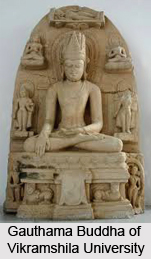 those of beings who have surpassed the world of samsara and exist in a state of complete devout consciousness- a quality, which describes the complete image. Perfectly balanced, the bodies are not realistically treated, but accomplish an approximately marvellous harmony of interflowing planes. They are among the world`s greatest classic accomplishments- classic both in being, consequently unmatchable and in historical sense, in deciding the form, which the Buddha image was to take for centuries.
 Sarnath is one of the most beautiful sites in the world & sacred where the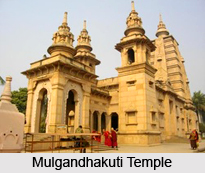
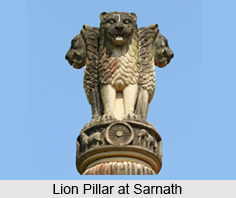 The Lion Capital of Ashoka is a sculpture of four Asiatic lions standing back to back, on an elaborate base that includes other animals as well. A graphic representation of it was adopted as the official